Can you see the thousands of dollars?

My year 7 has had laptops now for a few weeks. The class received 12 laptops, which is a costly investment. A colleague once wisely said if that much money was spent you should be able to walk into a classroom/school and notice a difference. You should be able to visibly see that investment’s impact on student learning. So I asked myself exactly that question – Is the learning different in my classroom now? Is the learning better in my classroom now?

I’d like to say yes, and here’s my evidence:
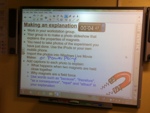
-Students now use their laptops in small groups to demonstrate their understanding, often with higher order thinking skills. Today we explored the properties of magnets. Instead of doing the prac activity from the textbook and writing a prac report, students made a photo story to explain to other year 7s the magnetic properties they have discovered. This took 2 hours. Minimal editing was involved as I wanted the students to focus on the explanation of science, not on fancy video transitions.

-Laptops are used to differentiate learning. Year 7s have been learning about area of composite shapes and expressing area and perimeter through algebraic expressions. Students had to self assess whether they needed more practice in composite shapes or were ready to move onto algebra. Students who selected to refine their skills in composite shapes worked on a self-marking quiz on the laptops while the rest had small group instruction on algebra.

These are just 2 activities where laptops have enhanced learning. When you walk into my classroom, you can see, hear and feel those thousands of dollars making an impact.

Are your thousands of dollars of investments visibly making a difference?

20120821-222310.jpg

20120821-222357.jpg

Innovation – what exactly is it?

innovation road sign picture

I’ll be heading to Auckland, New Zealand to represent NSW in the Microsoft Partners in Learning Teacher Awards. In 2011, I was selected as the NSW winner of this award, which is largely based on implementing technologies in an innovative way.

But what is innovation, and what exactly makes an innovative teacher? I’d like to start with what I think innovation ISN’T

Innovation isn’t about:

  • the latest technology – having the latest iPad doesn’t automatically equal innovation; neither does reading an e-textbook from an iPad
  • change only or change or the sake of change – just because it’s different it doesn’t mean it will make learning better
  • using technology – while technology is often related to education innovation, technology by itself is not innovation. For example using an interactive whiteboard to show PowerPoints to support lecture-style teaching isn’t innovation

I think innovation is more to do with teacher qualities rather than things and strategies per se. Innovation MUST also be able to enhance and improve student learning.

I think innovation is:

  • the willingness to take risks to try new things (technologies, strategies, etc) then reflect and evaluate on how this affects students’ learning.
  • not being afraid to “fail” and be able to see these “failures” as a learning process to grow as an educator
  • being able to  see that education is no longer based on a “knowledge is scarce” model, recognise that knowledge is now available to students at an instant and change as a teacher accordingly
  • thinking ahead; being proactive in understanding and predicting learning needs rather than being responsive and playing catch-up
  • being able to inspire others to join you

In the end, innovation in education, whatever it may be, must focus on improving student learning. As an educational leader, I also think it is vital that schools are environments where teachers are stimulated to be innovative. Schools should be environments where teachers feel that it is OK to try new things, it is OK when something new being implemented doesn’t go to plan and teacher successes in the classroom are celebrated and shared.

What do you think innovation in schools look like? How does your school encourage innovation?