
This year I’m teaching an integrated curriculum for Year 7. This means Year 7s are learning English, Maths, Science, Geography and History through cross-KLA concepts.
Last week we had a lesson on scaled drawings and maps, which covered both ratios in Maths and map reading in Geography. The traditional (and perhaps easier) way is for me to show them how to work with ratios and different types of scales is to do a few examples on the board and then the students do a bunch of maths and geography questions. I then tell them whether they’re right or wrong.
But I decided to do it differently. I wanted my students to show their understanding in their own way, not through a set of questions that someone has set for them. It is also my school’s goal to allow students to negotiate their learning, and to prepare them for this I wanted to let them make negotiations on small parts of the task.
The “lesson” lasted for 5 periods. In the first 2 hours we discussed ratios, scales and how they were applied in real life (in maps, scaled models, toys, etc). Then we made “desk maps”, which were scaled drawings of our desks in the classrooms using scales such as 1 cm = 10 cm, with various objects (also drawn to scale) on the desk. This was followed by measuring scaled distances of a street map showing the local area.
The class then broke into teams. Their task was to make an explanation on how to draw a scaled diagram to someone who doesn’t know how to draw scaled diagrams. They had to plan according to these 3 questions:
1. What is my goal for this task?
2. What will my explanation for the scaled diagram be?
3. How will I present my explanation? Why have I chosen to present it in this way?
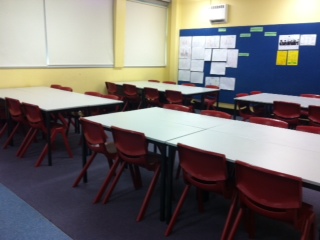
The planning process involved students spread across the whole classroom. Some students stayed at their regular desks. Others moved to the lab benches for more space. Others used the whiteboard on the other side of the room. It is more chaotic then the regular classroom, but it’s good chaos 🙂
Most students chose to do a video (for some reason my Year 7s love to make videos; I think it’s because they want to use the iPads). Their reason was because it’s easier to understand how to do maths when you can see and hear the explanation. Other groups chose to make posters. Their reasoning was because the posters can be pinned up in the classroom and students can refer to them if they needed to.
The groups then started to make their products. This involved students spreading out even more. Students who made videos went out into the playground or the storeroom next to the classroom to make their recordings. Students who made posters stayed in the classroom.
The last hour of the lesson involved students evaluating their learning process. I emphasised the process of making their product was just as important as the product. Students had to reflect on these questions:
1. What have I learnt this lesson?
2. How do I know I’ve done a good job?
3. Did I know what I had to do during the lesson? If not, how did I find out?
4. Was I able to stay on task? Why or why not?
5. Was I able to complete my task on time? Why or why not?
6. If I did the task again, how will I do an even better job?
I planned for the class to watch the videos and look at the posters after their learning evaluations, but we ran out of time. We’re going to do that next lesson where each group has to come up with a “wow” and “wonder” for each product. The “wow” is something that was done well in the product. The “wonder” is a question raised from the product such as “I wonder if you could show other scales besides 1cm=10cm to show more difficult calculations”. We’ll see how it goes.
Here’s part of one group’s videos.
 Alice Leung