The first five years of teaching … (Part 1 of reflections of 2011)

There are milestones in teaching. The first, most obvious milestone is the getting through the first year of teaching. The next milestone is getting through your first five years of teaching. As more and more research shows, five years is the time when a large number of teachers choose to leave the profession (25% to 40%).

There is a global shortage of teachers. There are newspaper reports after newspaper reports about the looming massive retirement of the teaching force and the need to recruit more teachers. However, there are signs that it is just as important to work out what is keeping teachers in the profession because a lot of teachers leave within five years. There is no educational benefit to students of recruiting lots of teachers just to have them leave within five years.

Well, this is my fifth year of teaching and I have no plans of leaving the profession. There are numerous articles (eg. Sydney Morning HeardThe AgeThe Herald Sun) that tell you why teachers are leaving. But I’m going to go through why I choose to stay:

  • I love my job. Yes, teaching is stressful. Yes, teaching is hard work. Yes, teaching involves long hours. Yes, teaching means you never stop working (this could just be me not knowing how to switch off). But I don’t mind because I honestly love what I do.
  • I had a fantastic teacher mentor, head teacher and principal in my first school. We had a teacher mentor who didn’t have a teaching load. She was an experienced teacher who had a wide range of teaching repertoire, who just mentored us. She’d come into the classroom to team teach and was always there when you needed support. She wasn’t there to “judge”. She gathered all the beginning teachers at our school together every fortnight so we can share our positive and not-so-positive experiences in the classroom. If it wasn’t for her, my attitude and enthusiasm for teaching would’ve probably been very different.
  • I had a fantastic colleague, who was also a beginning teacher, when I first started. We shared resources and supported each other through the good times and the bad times. I continue to have fantastic colleagues who work together as a team and share our resources and ideas with the aim of enhancing of our students.
  • I was provided with leadership opportunities very early on in my teaching career. Both my head teacher and principal actively encouraged me to take on leadership opportunism. My current principal and school executive continues to do so.
  • When I had an idea that would benefit student learning, I was allowed to run with it. The school leadership at all the schools I’ve worked at, were very supportive. This is particularly true at my current school,
  • I do other things while I am teaching. I have done a range of freelance work with UNSW and UTS, mostly in the school holidays. While this was hard work at times, it provided me opportunities to work with people who in industries outside the high school system. This offered me something different to work with.

I hope that all beginning teachers have the same positive experiences I’ve had. Or perhaps I’ve just been lucky?

Part 2 of my reflections of 2011 will be on my journey as an educational leader. Watch this space.

Level up! Games, resilience & innovation

I have just returned from a five-day trip to Adelaide where I attended the Global Emerging Leaders Summit (GELS) and the Australian Council for Educational Leaders conference. The overall arching theme was “change” and “innovation”. One thing that really stuck out at me from both conferences was the need for resilience. Students need to be resilient in order to be innovative in a rapidly-changing world. To order to innovate, you need to be able to fail, fail multiple times, and get back up to reflect and improve. In one of the conference sessions, the principal from North Sydney Girls High School spoke about how her school was developing students’ resilience as a foundation for them to think outside the square.

But what about the teachers and their resilience? In GELS there was lots of talk about many teachers being skeptical about change; that they don’t want to prototype or try anything new when clearly what they are currently doing is not working or is contrary to research on best practice. While it is important to build students’ resilience, I think it is equally as important to build teachers’ resilience.  I think every teacher has had this experience – they come up with a brilliant lesson or activity to engage their students and improve their learning, but when they implement it, it just doesn’t go right. Sometimes it even fails dismally. I have had this many, many times. But I look back at the reasons why it failed, tweak the idea and try again. Many teachers do this, but  many teachers would simply give up and go back to their previous way. Some teachers not only give up but become increasingly cynical towards new ideas.

So how can we make teachers more resilient in order to lead to innovation? I think games based learning will have a role to play here, for students and teachers. No one is ever successful at a game the first time they play. And no one gives up on a game the first time they fail. (Yes people do rage quit, but that is usually after many attempts.). When you die in a game, you re-start and try again. Most of the time you work out what killed you the previous time so you won’t do that again and try something different. Most of the time you work out patterns in things like how the enemies come out at you so you devise more efficient ways of wiping them out. Imagine what our schools and classrooms would be like if all students and teachers did this? There is research that shows playing games can build resilience of improve “self-concept”. Susan Main and John O’Rourke showed that when students used hand-held console games to learn maths, their confidence in themselves increased and their achievements increased, signficantly more than the control group of students who did not use games. (This article is in the Australian Journal of Teacher Education, vol 36 (2), pp. 42-55)

So video games build your resilience, but it is unrealistic to expect a student or teacher to play a game and suddenly become resilient all other aspects of their lives. We need to look at elements of video games that build players’ resilience. I think there are three key elements.

Element 1 –  You have a guide

In games this is usually a fairy, a dog, some sort of partner like a fellow detective, or a third-person voice that speaks to you. This guide doesn’t know everything, but they are there to give you hints and suggestions when you feel stuck. And that’s why you try different things to pass a level. A good example of this is the fairy Navi in the Legend of Zelda series.

navi and link from legend of zelda

Element 2 – A supportive community

When the fairy in the game doesn’t give you anything useful and you’re still stuck, you jump on the internet to ask other gamers. The gaming community is a supportive network that would tell you what you’ve done wrong and give you suggestions to improve.

Element 3 – Setting you up for success

red mushroom power up  star power up

Games place strategic “power-ups” and objects to make sure you can be successful in your quest. Games do not set up for players to fail. Games make sure you can work out how to win. This can be placing extra “health packs” in a space just before you go fight a boss, or the game reminding you that perhaps it’s a good idea to visit the markets to stock up on health supplies before embarking on your next quest.  The Child and Youth Health website actually makes an analogy between video games and resilience, citing that you need “power-ups” to keep you going in life when you face obstacles.

Teachers and students need these three elements in gaming to be replicated in their real worlds. We all need a Navi to guide us. We all need a supportive community like an online professional learning network where we can share our expertise but also ask for guidance from others. We also need power-ups (resources, leadership, etc) to make sure we are set up to succeed.

So grab your Xbox, Playstation and Wii and play something as the first step. Imagine how innovative and engaging our classrooms can be …

Gamification in the classroom


Games based learning is supposed to be the next big thing. So when I revamped a unit of work for Year 10 based on designing scientific investigations, I decided to “gamify” the unit of work.

I was inspired by a YouTube video by Seth Priebatsch on gamification, where elements of gaming can be added to education. After also seeing presentations by Dean Groom and Ben Jones I have  come up with my first “gamified” set of learning experiences.

The normal non-gamified version

Here is the unit of work in its regular, non-gamified version. It is like many units of work in high schools – sequential, everyone does the same thing, etc. In a nut shell the unit of work is about how to design and carry out fair experiments to test a prediction, how to record results accurately, how to make sure your results are reliable and how to write up a report to share you findings.

scientific investigations 2011_blog version

So here’s the gamified version

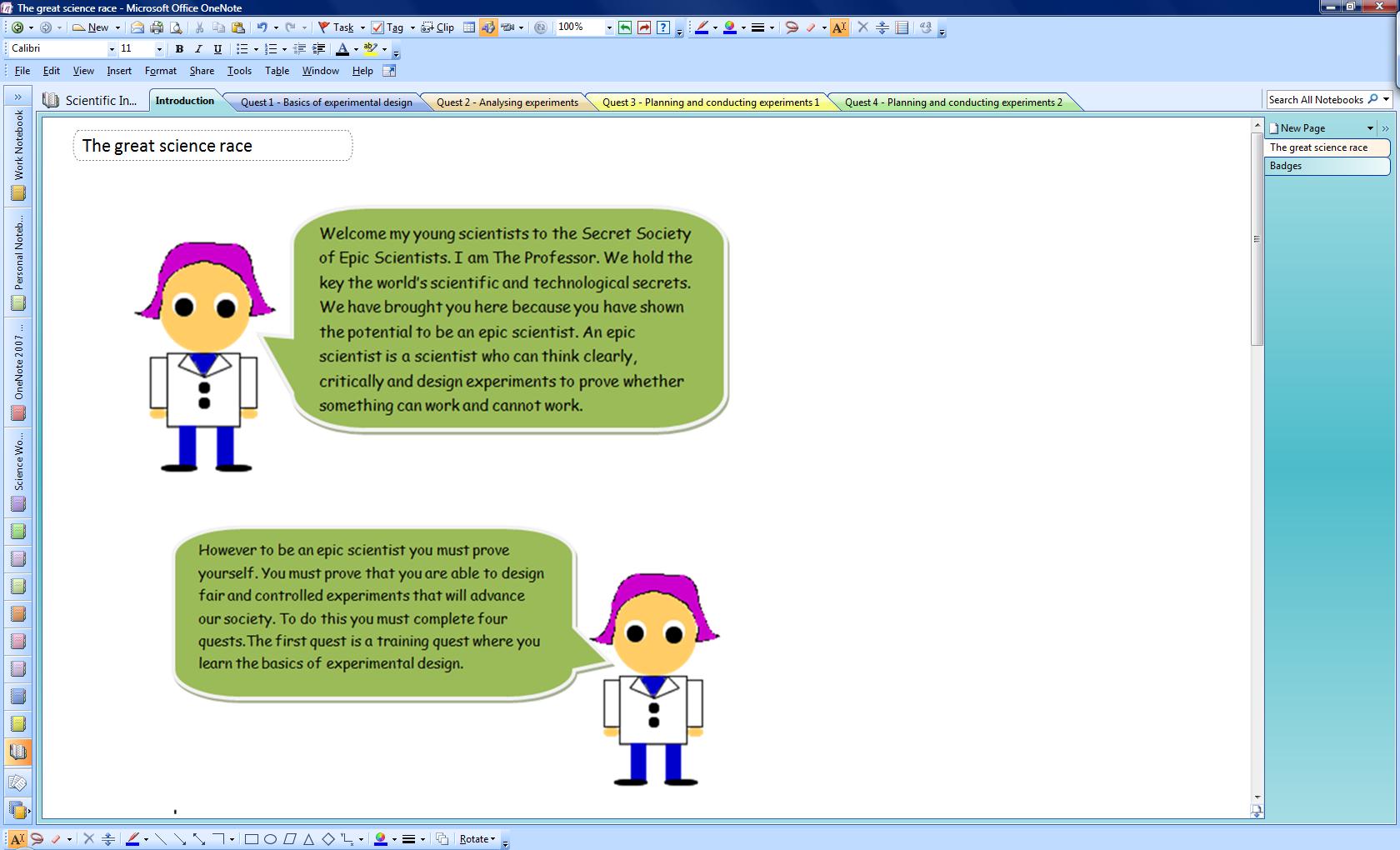
The unit of work has been turned into a game called “The great science race”. At the start students are introduced to The Professor, who explains the overall game narrative. It’s sort of a  corny narrative. If anyone has a much better narrative, please let me know!


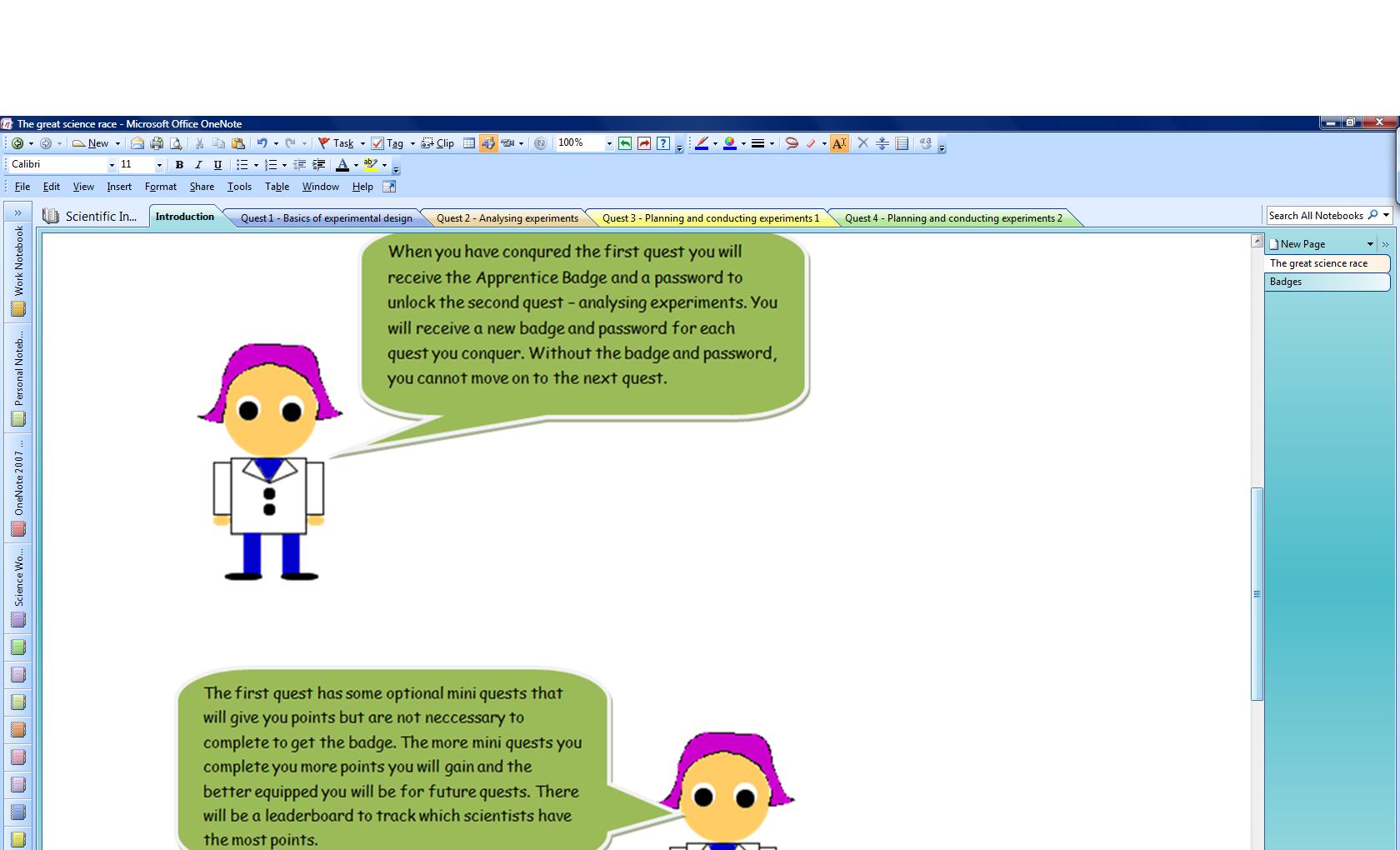
The game is divided into four quests. Each quest has a number of tasks where some are compulsory and others are optional. All tasks have been assigned points that reflect their difficulty level. For example, a fairly easy task where students have to tick whether an experiment is controlled or not will allow students to gain 5 points on completion. Whereas a more difficult task with more higher-order thinking questions will allow students to gain 10 points on completion.  This is set up to encourage students to undertake more difficult tasks. There will be a leadership showing the students’ scores.

Quest 1 is the training quest and introduces students to the  basics of experimental design (for science nerds these are the basics like the types of variables, the meaning of accuracy and reliability, when to use a control, etc). There are three compulsory tasks in Quest 1. These tasks need to be completed in order to gain the apprentice badge and a password to level up and unlock Quest 2. Quest 1 also has a number of non-compulsory tasks that will add to the students’ score. Like Quest 1, the other three quests require students to complete certain tasks before they are awarded a badge and a password to level up and unlock the next quest.

apprentice badge  cool scientist badge  distinguished scientist badge  epic scientist badge

Quests 3 and 4 involve students choosing a problem from a list and designing an experiment to solve the problem. The problems are given different points depending on their level of difficulty.

The gaming platform

So how can I implement this game? I could program it into Adobe Flash and turn it into a FLV game, but I haven’t got the time at the moment. So I decided to use the exiting resources that I’ve got:

-The game narrative, quests and the tasks within the quests will be given to students at the start of the unit of work as a OneNote notebook. The introduction (which contains the game narrative and explanation of badges) and Quest 1 will be unlocked sections. Quest 2, 3 and 4 are different sections which has been password protected. Once students have been awarded the relevant badge they will get the password to unlock the section.

-Edmodo will be used to give students their badges and password. The class will be a group on Edmodo. This will mean that a post to the class group will be seen by all students. A “small group” will be created for each student team. Posts to small groups will be seen only by students in that small group. This means that students can have discussions amongst each other and with The Professor (me) without the rest of the class seeing. Once a student team has completed a Quest, they convert that OneNote section of the quest into a pdf document and use the “turn it in” function in Edmodo to submit it for marking. The Professor (me) will mark the quest and provide feedback. Points, badges and passwords will be given to students via posts to their Edmodo small group. Updates on which teams’ progress on badges and points will posted on the Edmodo class group.

So that’s it for the time being ….

This unit of work will be implemented in a week’s time. There will be some classes doing the non-gamified version and my class (and others) doing the gamified version. I shall update the progress on this blog.

I am also applying the same gamification techniques to a Year 7 unit of work on the classification of living things.

Watch this space …. 🙂

What teachers can learn from video games

I’ve recently integrated an Xbox racing game into my Year 10 science class. Students played Formula 1 2010 to learn about Newton’s laws (click here for more info). This got me back into video games. Over the weekend I started playing Fable II – an action role playing game (RPG) on the Xbox. I’ve always been a huge fan of RPGs, more than any other game genre. Whenever I play RPGs, I become totally immersed in the game. I can spend hours being totally focused on the game. Every time I tell myself to stop I’d say to myself “let’s just finish this village first” or “let’s just defeat this boss first”.

While many teachers think of video games as recreational activities or even ‘a waste of time’, teachers can learn a lot from video games. How can we transfer the elements of video games that make the player sit in front of the screen, focused on hours on end, into the classroom? I found myself pondering this whilst playing Fable II.

I think video games harnesses many elements of educational learning theories associated with cognition and motivation. Here’s three elements:

1)      Video games are challenging, but too challenging.

In Fable II you are presented with missions or tasks that you have to complete. The game gives you enough information at the start to get you going, but you have to work it out for yourself by talking to characters in the game and finding clues in the virtual world. It’s often not easy to complete the mission. However, the game provides you with enough clues that you can complete the mission in a timeframe that won’t make you quit the game for good. This sounds really familiar to Vygotsky’s zone of proximal development (ZPD), where it is proposed that effective learning occurs when the learning experience is placed between what a learner can do independently without help and what the learner cannot do. Closely associated with ZPD is the concept of scaffolding, where hints and strategies are provided to help the learner bridge the gap between what they can do and cannot do. Video games often place the player at the ZPD, and guides them from what they can’t do initially to defeating that impossible boss, and level up! In Fable II, verbal and visual clues are provided to help you complete a mission.

2)      Choice and personalisation

Fable II allows you to choose to be male and female and to be good or evil. Throughout the game, you are presented with choices that give you points for being good or evil. Eg. When you find a missing bottle of wine in the village, you have a choice of giving it to an alcoholic or his relative who wants to help him with his alcohol addiction. Giving the alcohol will give you points towards being evil. Giving the alcohol to the relative will give you points towards being good. (I accidentally stole a toy from a chest at someone’s house and have gained some evil points). Fable II also gives you a choice to complete the main game or to go off and play mini-games in other worlds, then go back to the main game. It also allows you to choose your own clothes, etc, which gives you a personal connection to the game.

Student direction is one of the elements in the Quality Teaching Framework. I find that students will usually be more motivated to complete a task and be more self-regulated if they have chosen to do the task themselves. If they feel they have some ownership on the task, the more likely they’ll be engaged with the task. Like in Fable II, teachers can provide students with more choice in what they want to learn and more opportunities for personalisation.

3)      Ability to take risks

Video games allow you to take risks. If you do something wrong, you die, but you can come back and try again. In Fable II I know I can try out some new skills I’ve acquired in the game knowing that if I stuff it up, I can revise my strategy and have another go at it. In video games you are encouraged to adopt the strategy of trial and error and learn from your mistakes. In contrast a lot of educational tasks only let you take one shot at it. As teachers, perhaps we need to create opportunities that allow students to have multiple attempts at a task and encourage them to reflect on how they can improve on their previous attempts.

4)       There is a strong narrative

Fable II, like all other RPG games, has a strong narrative. It has a storyline that involves mystery and human emotions such as revenge. This is the main reason I like RPG games more than any other genre. Racing, fighting and puzzle games do not have storylines. I still play these games but they don’t glue me to the screen.

From personal experience I found that many students also like stories. Narrative is another element of the Quality Teaching Framework. By linking interesting stories with mystery and suspense, teachers can also glue their students’ attention to the lesson.

After finally being able to detach myself from the Xbox, I find myself wondering how can we as teachers create learning experiences that have the same engaging factors as video games? Or perhaps I just like video games a little too much.