The future of science education in Australia – there is an elephant is in the room and no one is looking

When I took on my first Year 11 physics class in 2007, I remember saying this to a colleague:

“I do so many things to make science interesting in Year 7-10. But when it comes to Year 11 and 12, it all goes out the window. It’s just about learning the dot points.”

I was reiterating what many senior science teachers feel – science in the senior years of high school is mostly about passing on content, making sure students can remember the content and pass the exam so they can get into the university course they want. (Note: I still do engaging activities with my senior students. I just have less time to do it)

This is one of the major findings in the report “The Status and Quality of Year 11 and 12 Science in Australian Schools”. The report indicated that science in the senior years of high school is mostly taught via the traditional transmission model, driven by the perception of teachers and students that the purpose of Year 11 and 12 science is to get them into university and prepare them for university. According to the report this has made the senior science curricular cramped with so much content that teachers don’t feel like they have enough time to integrate the social aspects of science and students feel they don’t have enough time to think about what they are learning. These quotes from students in the report sums up how students feel about science as they progress through high school:

“Science just got harder and harder … it went from like fun and exciting to like boring and numbers.”

“There is a major difference [between junior and senior science]. In junior they had to make it fun and interesting otherwise we just wouldn’t have done it.”


While the report pointed out that junior science is more about scientific literacy rather than just content, and allows more flexibility to make it more engaging, the report did indicate that the transmission model of teaching has filtered down to junior science in for some students, perhaps in order to prepare students for senior science.

Some other interesting points of the report are:

For students who don’t chose not to study science in year 11 and 12:

  • Many of these students like science and think learning about science is important
  • These students often had negative experiences in year 7 to 10 science, but still think science is important to learn
  • Some of these students have been counselled against studying science in year 11 and 12 because teachers and career advisers think it is too difficult for them and will not help their university entrance score

For students who do choose to study science in year 11 and 12:

  • The majority of these students indicate that the purpose of year 11  and 12 science is to get into a university course they want to apply for and/or meet prerequisite requirements set by universities
  • These students also think that science is enjoyable to learn

So the trends are showing that many students have an intrinsic interest in science and think it is important, but they are turned off from studying science.

The report made several recommendations including:

  • Setting a realistic amount of content in senior science courses so that the social aspects of science and science inquiry skills can be included
  • Making junior science more interesting by using an inquiry based approach where learning has authentic contexts and audiences

I wholly agree with the second recommendation. However it seems to me that the report in general appears to be avoiding the elephant in the room – that a summative, high stakes, university entrance exam is possibly driving pedagogy in year 11 and 12 science and unless that changes, it will continue to do so. The report findings such as an overcrowded curriculum, students copying notes from the board and a focus on memorisation, are typical teaching strategies that result from trying to maximise scores in high stakes exams.

The report overall asks this question: “Are we as a nation content that only half our senior secondary students are studying science?”


I would like to ask these questions instead:

  •  If year 11 and 12 science is to prepare students for university, when did universities say they wanted students who spend most of their time copying notes, memorising a lot of facts and not have enough time to think about what they are doing? How does this prepare them for university?


  •  Are we as nation content with our future scientists and innovators being prepared to solve the complex problems of the 21st century by being encouraged and rewarded for low level thinking?


  • If we reduce the amount of content in year 11 and 12 science would it have any impact on the way it is taught if there is still a high stakes university entrance exam?


Perhaps there should be a recommendation of getting rid of university entrance exams as they currently are and look at alternative models of university entry. Without the exam, students will be able to learn science for the love of science and not as a means to an end.

Energy: Our Future

I’m making this post because I’m super-excited about this. For the past 6 hours, my colleague (Twitter: @HenryYavuz) and I have been re-thinking our approach to Year 9 Science. We want to make it more relevant and engaging for the students. We want students to realise they can make an impact on the world and change it!

In the past Term 1 involved students learning about atoms, electricity and nuclear energy. Atoms involved just teaching about atoms and the periodic table and the topic lacked context. Electricity and nuclear energy are OK but they don’t allow much scope for students to connect their learning to audiences outside the classroom. So we came up with the idea of using the looming energy crisis as the main theme for the topic, a problem that our Year 9s will face as adults.

Students will work in teams to act as advisors to make recommendations for Australia’s future in energy. They will need to investigate the social, economical, scientific, environmental and legal implications of coal energy, nuclear energy, solar energy, wind energy and biomass in order to recommend whether Australia should:

  • Continue with coal powered stations
  • Adopt nuclear energy
  • Expand on solar energy
  • Expand on wind energy
  • Expand on biomass
  • A combination of any or all of the above

They will present a written report to persuade the adoption of their recommendation. They will also need to make a presentation on their recommendation to a (mock) panel of government reps.

To ensure students will be successful in this task, we have set up mini tasks that will act as learning artefacts for students to demonstrate their understanding and provide the scope for regular feedback. These mini tasks will be uploaded to their electronic portfolio (a blog). The mini tasks are:

  • A timeline of how energy sources and use have changed overtime
  • Using a model of the atom to explain how electricity works and describe the benefits and limitations of models
  • A summary of the social, economical, legal, scientific, etc pros and cons of different types of energy
  • An exposition of whether radioactive waste should be moved from Hunters Hill to the Auburn-Lidcombe LGA

Students will also be uploading a learning journal and other learning artefacts onto their blog. Each group will be assigned a “buddy group” so they can comment on each other’s blogs.

So far this is what we got. We’ve started to nut out the learning sequence.

What do you think of it so far? If you were a 14 year old, would you find this engaging and meaningful? Are we trying to do too much?

Feedback is welcome 🙂

Rocking with QR codes

I’m teaching Year 7s about rocks and their origins at the moment, which includes learning about the origins of sedimentary, metamorphic and igneous rocks. Sedimentary rocks are rocks made from the bits of other rocks. Sedimentary rocks are the ones you usually find. Metamorphic rocks are rocks that have been exposed to so much heat and pressure underground that they have changed. Igneous rocks are rocks formed by volcanic activity.

The usual way to teach this is to whack up a picture of the rock cycle, point to it and just tell students where each type of rocks come from. The teacher might bring out some samples of rocks – basalt, granite, sandstone, slate. Students look at it for 5 seconds and lose interest. No one really feels connected to the experience. This is not only boring, but most students don’t remember it. So I thought I might do it different this time.

picture of rock cycle rock samples

I’ve been mucking around with QR codes for a little while now with a previous rock quiz and a geolocation game using the Aris platform. I came to the conclusion that if I want my students to know where different rocks come from, I want them to experience it and interact with the rocks in a way beyond looking at samples of rocks in the classroom.

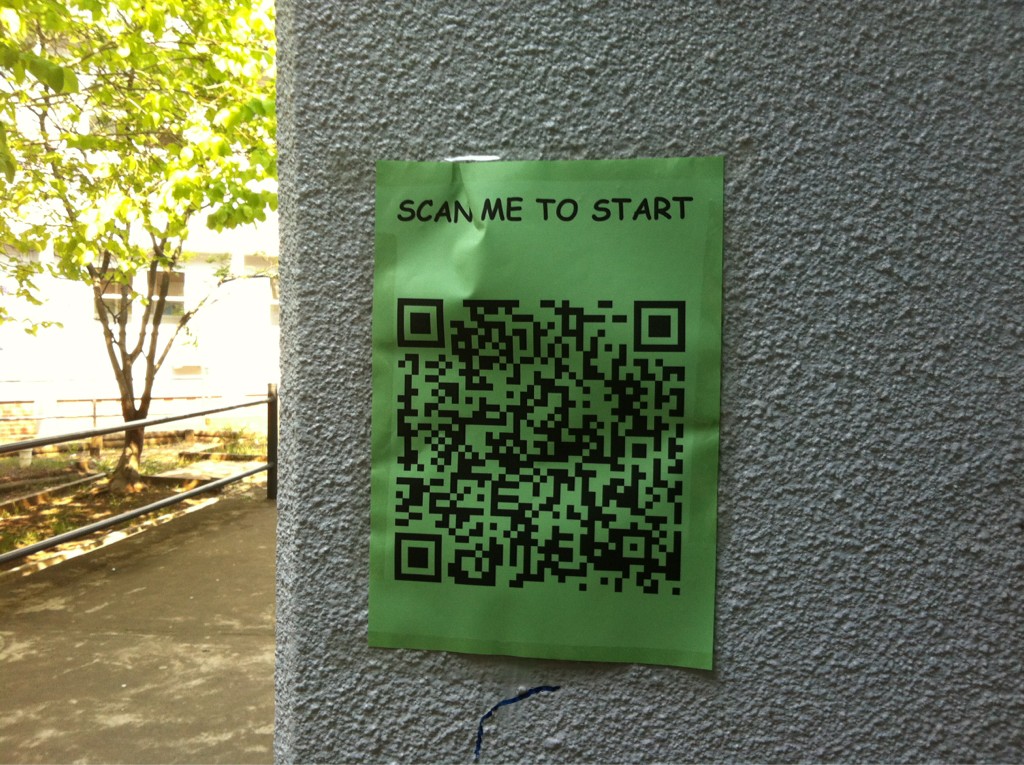
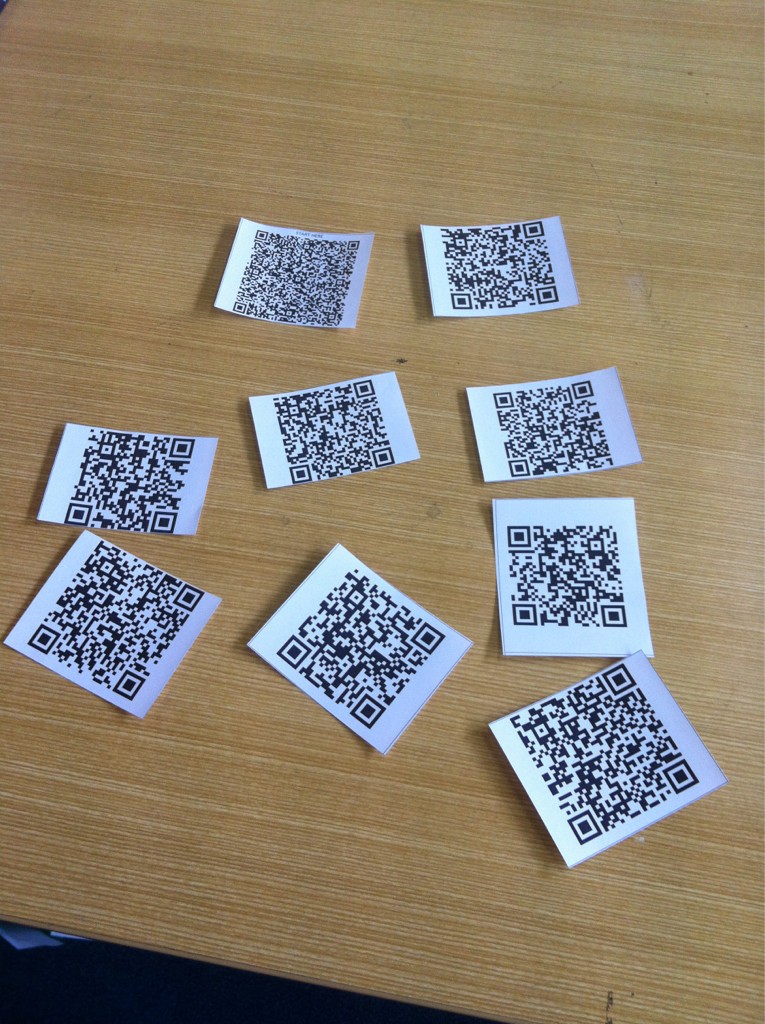
So I decided to make a rock hunt. There’s a small courtyard near my classroom. I used Block Poster to make a gigantic image of a volcano and printed a gigantic “underground” sign. I pasted these images on the walls surrounding the courtyard and scattered different types of igneous rocks near the volcano, various metaphoric rocks near the underground sign and placed a bunch of sedimentary rocks around the place. Each rock had a QR code attached to it. When students scanned the QR code with their iPods, the rock’s name would come up. They would then need to work out whether the rock is sedimentary, metamorphic or igneous based on the location that they found the rock in.

image of giant volcano

QR code for students to practise scanning

QR codes for rocks

The rock hunt was a success, because students were able to produce a descriptive report on the three types of rocks after the rock hunt (most of them did so independently as well). I think the QR code rock hunt also allowed them to physically interact with the rocks in a simulated environment that mimicked where the rocks would normally be found.

The next time I do this activity, I would not only have the rock’s names on the QR codes. I would link the QR code of each rock to a short video about the rock. That way, not only are students interacting with the rocks, they’d be able to connect a classroom activity easily with digital resources.

And as a bonus, other teachers saw the QR codes and jumped onto free online QR code generators to try making their own.

My Spore Journey – digging deeper into GBL

Today was my last Year 10 Science lesson. We have been learning about evolution for the last four weeks. Over the four weeks, my class worked in groups to play the game, Spore, while learning about the scientific perspectives of evolution. The aim was to allow them to play Spore and evaluate the scientific accuracy of the game (for more information, see my previous post). Due to the time pressures of the looming high-stakes exam known as the School Certificate, the class only played the cell phase, with some groups playing the start of the creature phase. This still allowed all students to get a fair idea of how the game functioned in terms of evolution. Students also completed simulations that promoted scientific perspectives of evolution so they can critique Spore.

From classroom observations, students enjoyed the game. They asked whether it was their group’s turn to play the game at the start of each lesson and genuinely enjoyed playing the game. While we didn’t have time for the class to create a product to review the scientific accuracy of the game, we had a lengthy discussion on the topic. I displayed the evolution of one group’s spore creature and had the class discuss how the creature had changed overtime and how environmental changes can be inferred from the changes in the creature. This was similar to how environmental changes can be inferred from the fossil record.

evolution of a spore creature

We then compared the similarities and differences of evolution according to scientific perspectives and evolution in Spore. We compared the game’s version and the scientific version of how life originated, how changes came about in organisms and whether organisms evolved to “suit” the environment. The last two points were the most important as Spore purports two common misconceptions of evolution – (1) That changes in a species were for a purpose and (2) That organisms grew to adapt to their environment. In contrast evolution from a scientific perspective is random. There is no purpose to evolution and organisms do not evolve to become suited to their environment. Instead characteristics that might be useful to a changed environment come about randomly through mutations and the organisms with these mutations are just lucky that they end up being useful when the environment changes.  The two misconceptions that Spore purports are more aligned with intelligent design.

After the discussion, students were asked to post their understanding of the scientific version of evolution onto Edmodo. From their posts, they appear to grasp most of the aspects of evolution:

“Natural selection is the mechanism of evolution. Natural selection involves a group of organisms with favourable charactistics to be able to survive in an environment better than those who do not have these characteristics. This is called adaptation. The organisms that are able to adapt to the environment will successfully pass on their gene and over time many organisms within that group will inherit the same gene.”

“Natural selection is the mechanism of evolution where organisms with a certain characteristic are more likely to survive in the environment. The organisms with this characteristic survive while the other organisms without the characteristic die out. The organisms that survived will pass on this characteristic to their offspring and over time, more and more of those organisms will have that adaptation.”

However, what was more interesting was the students’ apparent perceptions of using Spore in class. From the class discussion it was clear that there were two groups of students. One group treated the game as a serious learning resource and were analysing the game for its scientific accuracy of evolution. The other group dismissed the game as a learning resource and thought using a game as a stimulus for learning about evolution was a joke. This group of students held a very traditional view of what school learning is. They were also the same students who thought 1:1 laptops did not enhance their learning because they thought they learnt better from copying notes (see previous post for more info).

Just like there is research to say that the successful use of technology in education is largely due to a teacher’s perception of learning and teaching, I think the same applies to some extent to our students. Some of our students hold very traditional views of learning and teaching. They believe that they learn by the teacher telling them what to know and what to do. Copying notes from the board, answering comprehension questions and memorising facts allow them to be very successful at the current schooling system. Just like some teachers, these students are comfortable with traditional, transmissive modes of learning and exams tell them they are good at it. I’m not the first person who have thought of this. In my prac teaching back in 2006, my supervising teacher took over a class from a teacher who who taught by the transmission model. My supervising teacher had a very constructivist approach to her teaching and had her students work things out for themselves through a series of self-discovery activities that ran every week. She said she experienced a lot of student cynicism at the start, where groups of students told her that this wasn’t how they learnt.

It will be interesting to find out how students’ perceptions of learning and teaching affect their learning in a classroom that is structured in non-traditional ways. I’m planning to do an evaluation of using Spore and other games in learning activities when the class completes the School Certificate exams to see whether there is a correlation between students’ perception of what learning looks like at school and their attitudes towards games based learning. Suggestions of survey questions or focus group questions are welcome

Using cake to model the Earth

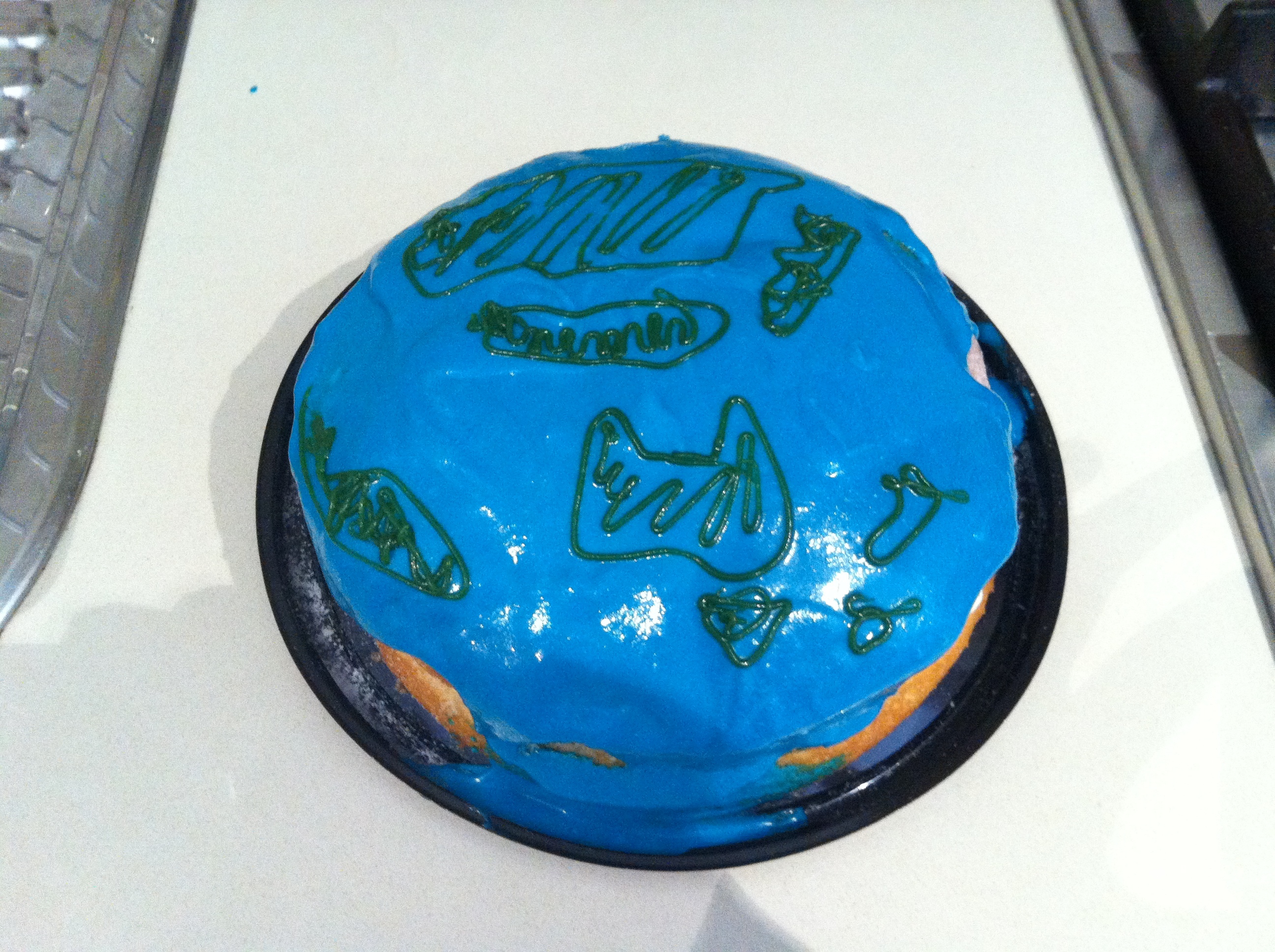
Today I used a jam and cream sponge cake for my students to learn the benefits and limitations of models.

It was a store-bought cake from Coles. I made some vanilla icing with added blue food colouring and spread it on top of the cake. I then used icing writing pens to draw the continents.

Year 7 students compared the cake to the structure of the Earth. They came up with some benefits of models such as making it easier to visualise things that are difficult to imagine. They also came up with limitations such as the cake not being spherical, not showing molten rock in the mantle and not showing the temperature changes of inside the Earth.

And we also got to eat cake at the end.

20111024-213118.jpg