Calling all science teachers. I need some help. My Year 8s are currently learning about the particle model and states of matter. Like I mentioned in my previous post, many students have various misconceptions on the particle.
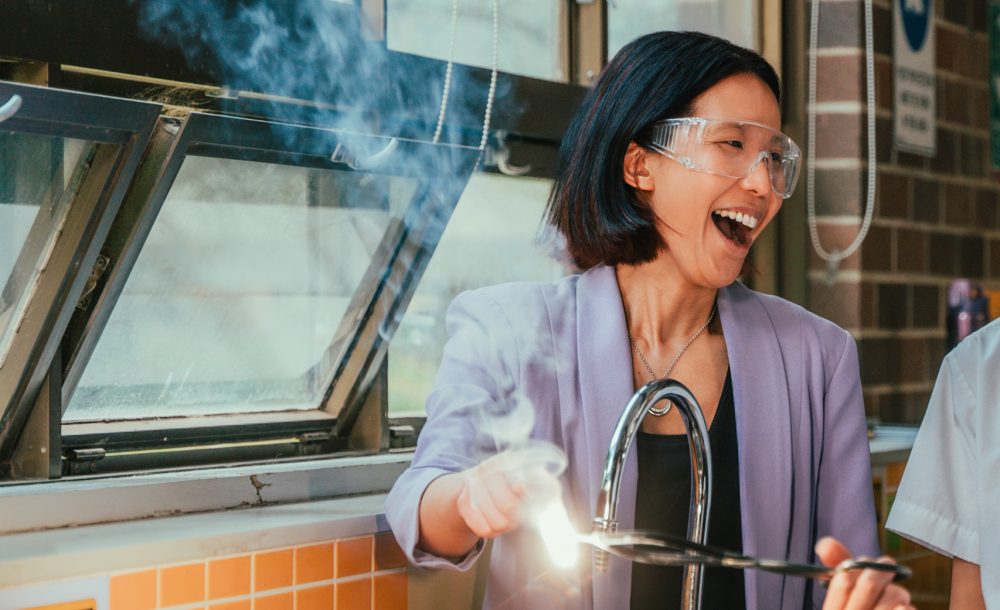
Today Year 8s made home made thermometers to learn how expansion and contraction (see image above)
They have already learnt about how movement of particles is related to the amount of energy they have, which then determines the state of the object. After they made their homemade thermometers and observed the liquid expanding and rising in hot water and the liquid contracting and falling in ice water, they wrote a paragraph using some sentence starters, that led them to use the particle model to explain their observations and explain how real thermometers work.
I had a one-to-one conference with each student to go through their explanations to make sure I identify their misconceptions. Here are some common misconceptions from my Year 8s:
-When particles are heated they expand
-When particles are cooled they contract
-Particles are inside matter (as opposed to matter being made of particles)
Many of my Year 8s are actually thinking that the particles themselves become larger and smaller. They are confusing the particles and the matter made out of these particles.
What can I do to challenge these misconceptions? I don’t want to just tell them to reword their explanation. I want to give them a learning experience that makes them realise their current understanding is wrong.
Many people frown upon PowerPoint, It has become rather unfashionable these days. Search ‘PowerPoint’ in Google and you’ll get websites with titles like:
“Be Less Boring: The 4 Best Alternatives to PowerPoint”
“Hate PowerPoint? Here are 5 Web-based Alternatives”
“5 PowerPoint Alternatives to Wake Up Your Presentations”
Anyway, since PowerPoint has been getting such a negative spin lately, I’d like to share some a learning activity that uses PowerPoint a little differently.
My Year 8 class are currently learning about states of matter and the particle model. It is one of the most conceptually difficult science topics for middle school students. The most difficult aspect is probably because the particle model is an abstract concept. There are also many misconceptions associated with this topic. Let’s take particles of water as an example. Students often think that:
particles in ice, liquid water and steam are physically different from each other
particles change in size as water changes from ice, liquid water and steam
There are also a few conceptually difficult ideas that students need to grasp such as:
Particles are inside objects (as opposed to particles actually making up the object)
One particle of water is actually two hydrogen atoms and one oxygen atom
The behaviour of the particles that cannot be seen is directly related to the behaviour of the macroscopic object they make up
The particle model is a model and every model has limitations in what they can explain
This is one of those topics where a lot of regular and frequent formative assessment is very beneficial as it allows you as the teacher to identify and tackle any misconceptions as they happen with each student. This is one of those topics where you don’t want to find out your students have completely misunderstood particle model at an end-of-topic test.
So with my Year 8s I decided to use PowerPoint to identify misconceptions. Their PowerPoint task looks something like this:
This is an unfinished audio slideshow made by some of my Year 8 students
This activity was done over three lessons, spanning three weeks. At the end of each of these lessons, students upload their progress onto Edmodo and I give them feedback based on the medals and missions model.
Here’s an example to illustrate what I mean.
And here’s my feedback to them on Edmodo.
And here’s my feedback to another group. From their progress I was able to pick up on one of their misconceptions.
From my observations of my Year 8 students doing this activity, I have found that they actively engage with the text when they are finding images to match different sections of the text. In their groups they were often arguing and justifying to each other which images were the best to use. I also think that this activity allows students to ‘talk science’, which will be particularly beneficial for students learning English as a second language. Setting aside time where students practise using scientific metalanguage to talk about science with each other is also something that is often neglected in high school science.
During this activity, it is also the students who are working the hardest to learn. It isn’t me showing pictures of circles and talking about the particle model. It is them talking about it and me regularly checking their understanding.
So don’t just think of PowerPoint as a boring presentation tool. It can be used as a very easy way to create a student-centred learning environment that frees up the teacher to tackle student misconceptions.
This term my Year 8 class has been running Science News. Science News is where each student in the class takes turns in presenting a science news item that they have found interesting. They have to showcase the science news item in a two minute presentation. The purpose of Science News is to expose students to the latest discoveries in science. I wanted them to know that science is everywhere.
However, Science News has also taught me new things and not just scientific things. One Science News item challenged how I was designing my learning for my students and how our education system designs learning for our students. Daniel talked about new discoveries on black holes. You can read Daniel’s speech to the class here. Right after Daniel finished his speech, half of the class’ hands shot up with questions.
“What exactly are black holes?”
“What happens when you go into a black hole?”
“I heard that time slows down when go inside a black hole. Is that true?”
“If we can’t see a black hole. How do we know it is there?”
“What is a light year?”
I was really happy that my students were so enthusiastic about learning more on black holes. So what did I do? I spent about 5 minutes skimming through the basics of gravity, dark matter and the speed of light and then I said, “OK. We actually learn about this stuff in Year 10. We need to stop now and continue learning about the ozone layer.”
While ozone in the Earth’s atmosphere is very important and Year 8s were also interested in ozone, I felt really guilty in almost extinguishing my students’ curiosity in black holes because the syllabus said that they should learn it in Year 10 and right now they should be learning about the ozone layer. I’m sure many teachers have faced this kind of situation before but it really got me thinking on how the current education system does so much to restrict the learning of our students.
Why do we have to learn about black holes in Year 10?
To be more accurate, students in NSW learn about black holes in Year 9 or 10 (It’s this thing we call Stage 5, which is Year 9 and 10). I understand that the need to learn age-appropriate concepts. For example, many early primary school-aged students may not have the cognitive ability to tackle abstract concepts (you know, because of all the Piaget stuff). However, I don’t see why if my Year 8s want to learn about black holes (and I know they will be able to), they can’t learn about it because the syllabus says they learn it in Stage 5. When you learn swimming, your age doesn’t determine what kind of things you learn, it’s how fast you are progressing and what you are ready to learn.
Why can’t we learn about black holes and the ozone layer?
Why couldn’t I have let my students go online on their phones and look up videos and websites that helped answer their questions about black holes and share it with the class, and then continue with the ozone layer? I wanted to, but I only have 3 hours with them a week and I only see them an hour at a time. Last year I had the same class for 14 hours a week in an integrated curriculum and I would’ve let them explore black holes and then continue with ozone layer because I had the flexibility to do so. However, now I am back to a more traditional and rigid timetable where learning starts and stops with the school bell. Previously I have blogged about the challenges of implementing project based learning in such a traditional school structure. The more I try to implement project based learning or anything that builds on students’ curiosity and passion or anything that personlises their learning, the more I want to knock down the existing school structure. A few days ago, I was in a workshop with Greg Whitby on teaching and learning in a Web2.0 world. He said the timetable is the one thing that is stopping effective learning and teaching. I couldn’t agree with that point more.
Greg also talked about agile learning spaces. I have to admit when I first heard of agile learning spaces a few years ago, I just liked the look of them. The bright colours and funky furniture looked particularly attractive when you are used to 1950s furniture in classrooms. But since I’ve started PBL, I get it a bit more. So going back to the black hole scenario … In an agile learning space style of learning, Daniel would’ve presented his science news to the whole cohort of Year 8 or a mixture of students from different year groups in one large space. The ones who were interested in learning more about black holes can go with one teacher and the others can go with the other teachers to continue to learn about the ozone layer. Teaching and learning is no longer restricted to one teacher teaching 30 students. Depending on the need, you can be teaching one student or 10 students or 80 students. The space enables you to do so. There are no walls that says you have to teach 30 students at a time. There are also no bells to tell you that you need to spend 60 minutes on learning something; you take as long as you need to. The video below gives you an idea of what learning is like in an agile learning environment.
And now I don’t how to end this post. I sort of feel disillusioned. I want to knock down the walls of my classroom but realistically that can’t happen. Not just yet anyway. So when the school week starts again, it will be back to the status quo. *Sigh*
Sound waves and waves in general are concepts that I’ve found many students have difficulty understanding. These are concepts that deal with understanding how energy is transmitted from one place to another through a scientific model. Why are these concepts difficult? Firstly it is abstract. You can’t see waves. When you speak or hear music you can’t see the waves coming out from the source and travelling to your ear. You can’t see the vibrations of particles. Secondly learning about the transmission of waves comes with a lot of academic language. Here’s just a sample of academic scientific jargon you’ll hear when you sit in a lesson learning about waves:
Equilibrium
Particles
Transmission
Transfer
Amplitude
Frequency
Period
Wavelength
Compression
Rarefaction
Due to this, learning about waves is particularly challenging for students who are also English language learners. Not only do they have to deal with difficult and abstract scientific concepts, they also have to deal with the intense bombardment of academic language.
This year I have a Year 9 class who are students learning English as a second language. I didn’t want to start the topic with a waveform diagram and pointing out what is an amplitude, etc. I planned a learning sequence that will move them from concrete to abstract, and from everyday language to academic language.
The first concept I wanted them to understand is that sound is vibration, or things shaking back-and-forth very quickly. We used the good ol’ tin can phones for this. We also did an experiment where students used a vibrating tuning forks to tickle their noses and make tiny splashes with a beaker of water (I thought they would find these experiments too boring, but they absolutely loved it). Every single student left that lesson knowing that sound is caused by vibrations.
The second concept I wanted them to understand is that we can represent sounds as waves. Students used Audacity to record their voices and experiment with how the loudness and pitch of their voice affected how the sound wave looked like on Audacity. We also experimented on whether saying “Hello, My name is ____” in English and students’ first languages had a difference in pitch.
Here’s a video on Audacity. It’s a free program that can be downloaded.
Students worked out from this Audacity activity that the higher pitched their voices were the more squashy the waves were. They also worked out the louder their voices were the taller the waves. I was happy for them to use the words “squashy” and “high” to describe the waves for the time being.
The following lesson I introduced frequency and amplitude. By now the students had a conceptual understanding of the relationship between sound and vibrations, the relationship between pitch and “squashiness” and the relationship between volume and the tallness of waves. They now just had to replace “squashy” with frequency and tallness with amplitude.
I really like the strategy of teaching a concept with everyday language first and then introducing the scientific terms after students have actually understood it. Science is hard enough without a bunch of difficult words bombarding students as well.
States of matter is one of those concepts that students often find boring. Just look in any textbook and you’ll find solids, liquids and gases is presented to students through activities such as watching an ice cube melt or watching water boil. Not the most exciting activities for a teenager. So when my Year 8 class started their unit on states of matter, I wanted to find something that will excite them and hook them in.
Along came fake quicksand. Fake quicksand is an experiment I found from the Steve Spangler website. It is a simple experiment; it uses just cornflour and water. My Year 8s made quicksand this week to explore the properties of solid and liquids. We also discussed real quicksand and non-Newtonian fluids (they’re not in the syllabus, but students were interested so why not let them learn something they want to learn).
So if you’re a science teacher, you must try this experiment. Kids love it and learn from it. The cornflour to water ratio is 10:1 to make the perfect quicksand so you can turn it into a numeracy activity as well.
So it has been about a week after #sologlobalchat, a TweetMeet (an online conversation on Twitter) that involved teachers from Australia, New Zealand and the UK. If you don’t know what SOLO is watch this video and read this.
From #sologlobalchat we created an Edmodo group to continue our conversations and collaboration. On that Edmodo group I shared an assessment that a colleague and I worked on for a unit of work based on SOLO.
For Part 2 we came up with some questions that will guide students’ evaluation of an existing public health campaign. When I uploaded it onto Edmodo, a teacher called Craig Perry from Christchurch, New Zealand, modified the part into a SOLO exploded map. Not only is the exploded map more visually appealing than a bunch of questions typed up on a sheet (which is essentially what I had at the start), but the exploded map also classifies each question into a SOLO level. (Note that Craig and I have never met. This once again shows how generous the teaching profession is.)
The exploded map demonstrates one of the main reasons why I love SOLO. SOLO lets teachers take a step back and analyse whether they are helping students develop higher order thinking skills. When we talk about 21st learning, we often criticise how traditional school tasks can be completed by students using Google. Using SOLO can help teachers overcome this. If a task only requires students to work the unistructural, multistructural and sometimes even the relational level, can be completed by Google. For something that is non-Googlable, it needs to be extended abstract.
How many of the tasks your students do are non-Googlable? Perhaps SOLO can help 🙂
I became interested in structured observed learning outcomes (SOLO) late last year when I was contemplating how to approach learning design in the midst of implementing the new NSW syllabus for the Australian Curriculum. I want to lead my team in using this opportunity to do something that will shift the way our students learn. I don’t want to take the shortcut of cutting and pasting existing units of work and making it fit to the new syllabus.
I have always known about SOLO from my work with the Essential Secondary Science Assessment and the National Assessment Program for Science Literacy, but until last year I didn’t make the shift from using SOLO to assess student learning to using SOLO to design learning. So when I began exploring using the hashtag #SOLO on Twitter, I found quite a few teachers in New Zealand and the UK who are much ahead of me in their SOLO journey. From there I met Andy Knill. I have never met Andy in real life, nor have I even spoken to him via Skype or anything. My only interactions with Andy are from tweets and sharing ideas on a Google Document. But from using only Twitter and a Google Document, we organised the tweetup, #sologlobalchat where educators from Australia, New Zealand and the UK shared and learnt from each other in everything related to SOLO from what is SOLO to how can we drive authentic change on a whole school level. Click here for an archive of #sologlobalchat.
Helping Andy co-host #sologlobalchat (Yes, Andy did do most of the work. Hat tip to Andy) has made me realise 2 things:
(1) Teachers are a generous and dedicated bunch of people – #sologlobalchat was held at 11am on a Saturday in the UK, 8pm on the Australian east coast and 10pm in New Zealand. I was tweeting from an iPad on a Saturday night. Andy was tweeting from a mobile device in his car and it was bed time in New Zealand. I don’t think there are many professions that will be holding a virtual meeting in such circumstances. Also, not many of us knew who each other was until we got onto #sologlobalchat. Yet we were ready to hand over our ideas and resources to almost complete strangers. This is one of the best things I love about teaching and teachers. We are happy to share anything at anytime to anyone because it makes learning better for our students.
(2) Learning anywhere anytime – The massive increase in technology in our lives have always been discussed in the context of student learning. How can we flip learning for students? How can students use mobile phones to learn? How can learning be transformed in a 1:1 device program? However, the impact of technology isn’t just limited to students. Technology has also transformed the way teachers learn and collaborate. #sologlobalchat used technology to connect teachers from 3 countries in different timezones to synchronously share their expertise with each other. Professional learning for teachers is now breaking through the walls of schools. Teachers are no longer having conversations with teachers in their own staffroom or school only; we now also have conversations across the globe. Sharing of resources is no longer confined to photocopying a sheet and placing it on someone’s desk; resources are now uploaded online for anyone to download.
All teachers can greatly benefit from using online professional learning networks to improve their practice. And teachers are a generous bunch. We will share anything with anyone because we want to improve all students’ learning. So if you are not part of an online professional learning network (PLN), join one. If you haven’t participated in a Twitter chat or Tweetmeet, just lurk around one and have a look if it’s for you. If you are doing all of these things, tap on the shoulder of a teacher who haven’t yet discovered this and show them how the benefits of an online PLN. The more teachers we have collaborating and sharing online, the better the learning will be for our students.
Note – #sologlobalchat now has an Edmodo to share. Click here to submit a request to join the group.
Andy Knill has also compiled a list of teachers who participated in sologlobalchat
In an AITSL symposium in March 2013, I was described as a “hero teacher” by Valerie Hannon and that it was a bad thing. Hannon meant no offence but emphasised that I was a hero teacher because I took the role of change agent in my school, which to her required excessive working hours, sacrificing hours of my life to my job.
This led to a blog post from Bianca Hewes on driving, implementing and sustaining change in the education system. I admire Bianca because she is a hero teacher, a highly effective teacher devoted to her students, and we need more teachers like her. In this blog post I want to throw in my two cents and respond to two issues raised in Bianca’s post: (1) Teacher passion and subsequent workload; and (2) Sustaining change for 21st century learning.
(1) Teacher passion and subsequent workload
Valerie Hannon is right to say that I have a huge dedication to my school and students. She is also right to say I work long hours. I say “long” hours rather than “excessive” hours on purpose. “Excessive” is relative to a teacher’s life circumstances. I don’t have children yet and I have a very supportive partner so I can do the amount of dedication that some people might see as excessive. I don’t see it as excessive. I am not on the verge of a mental breakdown. I am not on the verge on burnout.
For me, teaching is not “work”. Like many other teachers I have a great passion for teaching and live and breathe it. I don’t see how this amount of dedication is any different to Justin Bieber working 16 hour days to be a successful musician. I used to play classical piano as a child. I used to practise piano before school and after school, in addition to many other hours spent on composition and musicianship. No one called me a hero pianist for it. Just like no one calls Justin Bieber a hero performer. All musicians just do it. If you want to be a successful musician, you have to live and breathe music. A musician isn’t what you do, it’s who you are. For me teaching is no different. I don’t see myself as a hero because I see what I do as what I should be doing to be a successful teacher. I don’t impose this on other teachers who contribute to the teaching profession in their own way. But I don’t want to slow down either because other people view what I do as “excessive”.
(2) Sustaining change for 21st century learning
As a teacher, unless you have been living under a rock, you know there has been a push for change for “21st century learning”, and rightly so. However the focus has been on WHY we need to change for way too long. The focus should be on sustaining change. Bianca is right in saying that the lone nut has been dancing way too long and no one is following. Bianca is right to say that is unfair that a small number of teachers keep shouldering the burden of change. The question here is why people are NOT dancing with the lone nut.
IMHO we need the teaching profession to be made up of hero teachers. I don’t mean Justin Bieber teachers who work 24/7 and will burn out in 3 years. I mean teachers who constantly evaluate their practice; teachers who collect data on how effective they are teaching and how effective their students learning; teachers who constantly seek ways to improve their practice; and teachers who reach out to the global profession of teachers to share best practice and support others. Hero teachers are never happy with what they currently have. A particular way of implementing project based learning can always improve. Current teaching and learning programs can always improve. Assessments can always improve. Hero teachers don’t see room for improvement; they make it their priority to improve it.
In the 21st century we need to educate students to become job creators and entrepreneurs. It is not good enough for teachers to ignore the transforming impacts of technology. It is not good enough for teachers not to seek out data that evaluates their teaching practice. It is not good enough for teachers not to be dancing with with the lone nut.
Last week I had the privilege of leading a science-flavoured TeachMeet with Matt Esterman at Taronga Zoo. With a great view of the monkeys at the zoo, over 70 educators from pre-service teachers, primary school teachers, high school teachers, university staff and other educational institutions, gathered to share ideas on ways to make learning more effective for our students. There were teachers from government schools, Catholic schools and independent schools sharing their classroom practice with each other with the aim of improving teaching and learning for all students.
We had presentations on differentiated learning, learning design, inquiry based learning, using iPads in the science classroom, mash ups, social media and many other ideas and strategies to enhance learning for our students. Mitch Squires and Jackie Slaviero captured the crowd with their talk about NASA space camp. We got to make a pocket solar system with Rob Hollow from CSIRO to experience a way to introduce students to the scale of the universe. We also got to pet a snake to learn about how Taronga Zoo’s education programs are addressing sustainability in the Australian Curriculum.
Taronga Zoo Education Centre
Monkeys at the zoo
The TeachMeet crowd
Learning
Learning happening …
Henna presenting on differentiated assessment
Nikki from the zoo presenting on sustainability
Snakes
Cherine presenting on inquiry based learning
Rob Hollow showing us how to make a pocket solar system
Making a pocket solar system
Teach Eat at the Oaks Hotel after Teach Meet
What I really like about TeachMeet is that it is a different kind of professional learning. You get to see real teachers sharing ideas and strategies they have implemented in their classrooms. You build cross-sector networks and have opportunities to share and learn from teachers from government, Catholic and independent schools. You are also exposed to many new ideas in a very short amount of time.
What I like most of all is that teachers volunteer to attend TeachMeets. Teachers attend out of their own time because they want to learn. Presenters are not paid (they might receive a chocolate koala for their efforts) and are sharing their practice because they want to. I think this really shows the collaborative and generous nature of teaching as a profession.
So if you haven’t been to a TeachMeet, it is very worthwhile to check one out. If you been to one, I’m sure you will go to another one very soon. To find out more about TeachMeets in Sydney visit this website and join the Facebook group.
I’ve been trialling project based learning for about a year. Last year I was lucky enough to have a year 7 class for 14 hours a week for 5 different subjects so I was able to easily design and implement cross-curriculuar units of work that were framed by project based learning. This year I’m back to traditional high school teaching where I see kids for 60 minutes at a time. I had to change my game plan for project based learning. What I have found most challenging is balancing the students’ passion for learning with ‘getting through the syllabus’.
I’ve just finished a unit called ‘Sharks: Friends or Foes’, which is basically a unit on ecosystems and food webs. I modified the unit with a PBL framework. Instead of just looking at food web diagrams in a textbook or playing with interactive food webs online, students acted as scientists and produced a product for a shark scientists conference to convince the community whether sharks are our friends or foes in the midst of all the media attention on shark attacks.
The project was done throughout the unit in different stages and students also had to learn about population sampling techniques, food webs and how energy flows through ecosystems. During the unit they also had a real shark scientist talk to them.
From the results in the students’ pre-tests and post tests, all students made huge progress in their understanding of ecological relationships. On average students improved over 40% between their pre-test scores and their post-test scores.
In comparison to last year, the students’ teamwork skills and self-regulation skills have massively improved. My main challenge this year is time. PBL takes time. A lot more time than traditional teaching. The unit that ‘Sharks: Friends or Foes’ is based on is supposed to take 5 weeks maximum, but my modified PBL unit took 8 ½ weeks. There were times that I was feeling pressured to rush my students to make sure I don’t fall behind and so that I can get through the syllabus in time. Last year, I saw my students for large blocks of time (5 hours straight twice a week) and they can use these chunks of time to work on their movies, posters and other products for their projects. This year I see them for 3 separate hours a week and this lack of continuity makes the product creation process a lot more challenging.
But does it have to be this way?
This term I realised that I wished high schools did not to have separate subjects. I wish schools didn’t require students to walk in and out of classrooms like they are on a conveyor belt.
I wish every unit was cross-curricular so that subject experts can work together as a team and students can have more time to develop their passions for learning and be knowledge creators rather than just consumers. If you need 4 hours straight to work on a science/maths/geography project then you should be able to do it without being prevented by a timetable structure. Is there a reason why we need to have separate subjects? What is the reason for timetables?
I don’t have the answer or solutions to these questions, but I hope education is moving towards this direction. In the meantime I’m going to take small steps. I’ll continue with PBL with my year 8s and have already approached another faculty at my school to design and implement a cross-curricular PBL unit.


 Alice Leung