3 learning myths I hate

Here are 3 learning myths that bug me:

  1. A neat book equals effective learning. A messy book equals ineffective learning. No book equals no learning.

This isn’t to say that students should have no work book at all. I still think that some activities are more effectively done by hand and the humble exercise book will still have its place in education for years to come. However, it is shortsighted to think that learning should be presented by work in exercise books only. Students should be regularly making learning artefacts such as videos, posters, models and whatever else is suitable and publish them to an authentic audience. Students should be making products that is authentic in real life. I have yet been able to find a job where your annual performance review is to show your boss your exercise book.

  1. Compliance equals learning.

A lot of teachers and students judge how effective students are learning by how well they are follow teacher instructions. While it is important for students to follow teacher instructions at all times due to safety and other reasons, learning doesn’t directly result from compliance. Just because students are quiet and looking at your as the teacher, it doesn’t mean they are learning. Just because they are writing notes, it doesn’t mean they are learning. Just because they look like they’re learning, it doesn’t mean they are learning. Just because they do what you tell them to do, it doesn’t mean they are learning.

  1. More time equals better learning

When students are asked about how they can improve on their achievements, many would say “study harder”. Many teachers often say something line “Student Y will improve if he revised more”. While some students will benefit from going over their class work more often, many students often do not understand a concept because they don’t understand an underlying principle. For example, many students don’t understand osmosis because they don’t understand concentration, concentration gradient and/or random movement of water particles. It won’t matter how many times these students read over osmosis, if they don’t work on understanding concentration gradient, all the studying in the world would do nothing. I’m not bagging out revision or studying, but unless they are targeted at a concept or a learning need, it will make minimal impact.

Do you have any learning myths you hate?

Action learning with Minecraft

This year I have one year 7 class. Yes, only one class. I’m a high school teacher so this is a massive change. The year 7 class I have is an integrated curriculum class. This means I have them for English, Maths, Science, History and Geography. I saw this as the perfect opportunity to try out project based learning. For the past 8 weeks or so, we have been working on a project called 60 second science where students worked in teams to produce a video lasting no longer than 60 seconds. Students can choose a topic for their video from astronomy, classification or microbes. We just had our last “project session” for this project. The majority of groups have now submitted their videos. Here is one of the videos:

http://youtu.be/iRrXmYJEdh0

In one of my previous posts, I have said one of the biggest challenges in project based learning was students’ self regulation skills. While the majority of students worked really well, there was a small group of students who regularly walked around, didn’t stay with their teams and did not focus on the task for lengthy periods of time. Even when they had to state their goals at the beginning of their project sessions and had mid session checkpoints, they still had difficulties staying on track. To put things in perspective, these students work really well in traditional learning activities. When we do quizzes, maths worksheets and other teacher-centred activities they are your perfect students.

In my previous post, I said I would need to put more checkpoints into the project process. But I wasn’t sure what I would do in these checkpoints. Do I just simply ask the students whether they are on track? Do I look at their work and say they’re doing well? I knew if I don’t do something different, the next project will involve me telling off the same students by constantly reminding them to stay with their teams and stay on task. I want my students to self regulate and doing this won’t allow them to develop those skills. I’m also not a big fan of using fear to force students to self regulate (well, it’s not really self regulation if you have to threaten detentions for students to stay on task).

So I’ve decided to undertake an action learning project. I had an inkling that the students who experienced difficulties in self regulation didn’t know how they were progressing during their projects. They were thrown into an eight week project without regularly knowing what things they were doing effectively and what things they need to improve on. While I did have the project broken up into four phases, it didn’t have a formalised way for students to self assess. So I’m doing an action learning project to find out whether formalised feedback cycles will improve student regulation in project based learning.

I’ve so far collected some baseline data from the weekly survey I give to my students.

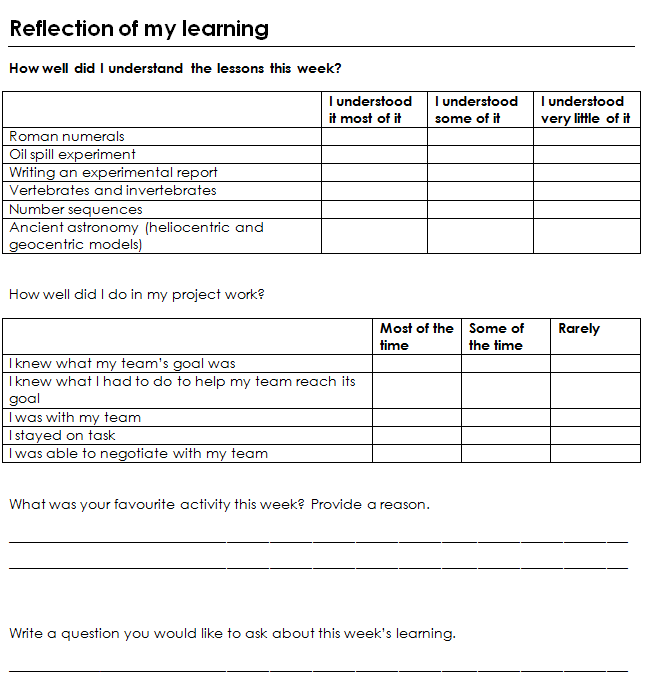
student survey results for self regulation

The data shows that a small group of students:

  • don’t know what the team’s goals were
  • did know what their team’s goals were but did not know what they can do to help their team achieve those goals
  • didn’t know how to negotiate with their team

From the data I think I had a few lost lambs in the classroom, who knew they were meant to be creating a video, who had done their scripting and storyboarding, but couldn’t piece them together.

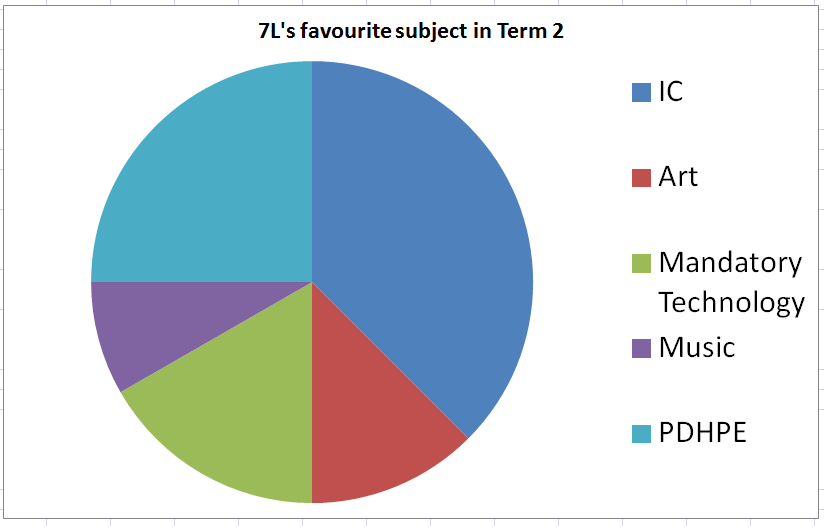
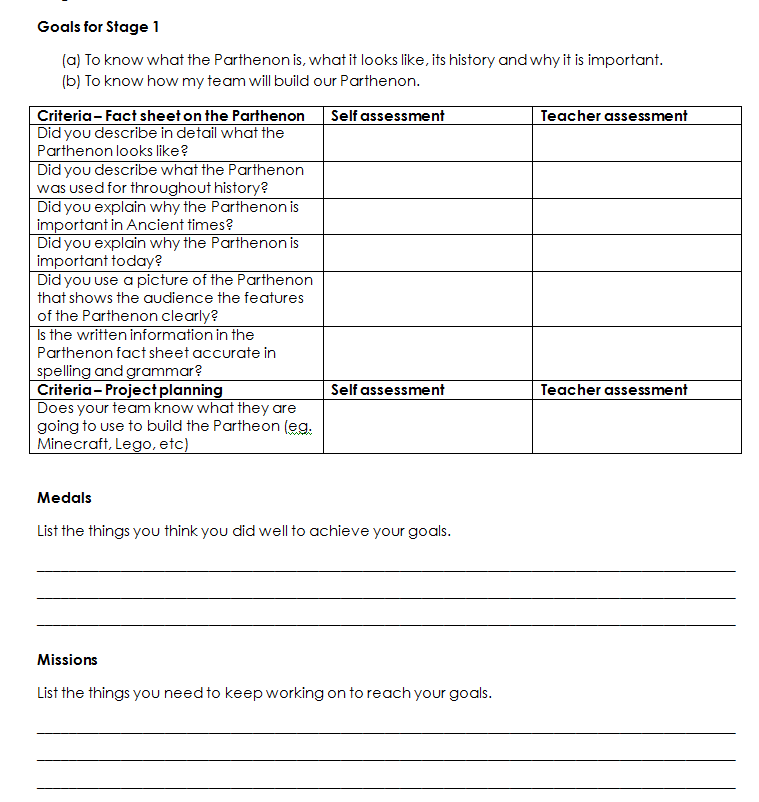
So for their next project, I will be embedding feedback cycles in the form of goals, medals and missions, which we already use for our writing tasks. Our next project will be The Parthenon Project. It will involve Year 7s building a model Parthenon that follows the golden ratio, a somewhat “magical” number that the ancient Greeks used a lot in their architecture and art (and we still use today). Year 7s will be able to construct their Parthenon in Minecraft or with other materials like Lego. The project will have four stages: (1) Research and project planning; (2) Planning the Parthenon; (3) Constructing the Parthenon; and (4) Presenting the Parthenon. Each stage will involve student self assessment and teacher self assessment to allow students to monitor their own progress and learning process. The assessment will be based on a product that students produce at the end of each stage.

project outline for Parthenon Project

self assessment sample for Parthenon project

Students will continue to complete their weekly survey and that data will be used to see whether the feedback cycle will have any impact. The Parthenon Project starts this Friday. I’ll keep you updated. 🙂

Lessons learnt from project based learning

This year I embarked on a journey of project based learning with my year 7 class. The Year 7s have been doing mini projects in the first term. They have made infographics, videos and models. These mini projects allowed them to develop team work skills, time management skills and self-regulation skills.

At the moment, my Year 7s are doing their first long-term project. They are now working in teams to make a one-minute long video to explain an astronomical concept (the occurrence of day and night, seasons, tides, etc). They will enter the video into the 60 second science competition.  This project didn’t involve a simple point-and-shoot video. The project had four phases: (1) Research; (2) Pre-production (scripting and storyboarding); (3) Filming; and (4) Post production. Students were guided through the processes of scripting, storyboarding and using video editing software for post-production.

We have 4 hours of “project time” a week and most students are on task. Each team needs to state their goals and also say why they needed certain equipment (such as iPads and laptops) before they started.

So far most teams are progressing well:

  • One team is extremely well prepared. They have spent time and effort into their script and storyboard. They have organised props and are filming against a Chroma key background. They will soon be working with a teacher who specialised post production skills to edit their video. This group is doing really well.
  • One team is highly experienced in creating videos, especially animated videos. They now spend their dedicated project lessons doing highly technical things that they learn from watching video tutorials.
  •  One team is now up to their post –production phase. This group was a little less prepared than the other teams in their scripts and storyboarding, so they found it difficult to negotiate during filming as each person had a different idea of how it should be done. In the end (with some suggestions on how to negotiate and compromise), they were able to finish their filming.
  • One team is using GoAnimate to make their video. This team has also completed a fairly detailed script and storyboard so their filming process was also straight forward.

However, one team is not progressing as well. They have changed their scripts and storyboard multiple times and is the only group who haven’t started filming. This team works well in traditional classroom activities, but seems to be overwhelmed in project based learning. Even when they state their goals at the start of a session, the goals would often change.

So the lessons I have learnt so far is:

  • Have more checkpoints in the project phases – Even though I broke up the project into the stages of research, pre-production, filming and post production, I should’ve built in checkpoints within each phase. For example, students had to get feedback from another group about their storyboard after drawing three scenes. This would’ve helped students gain more regular feedback.
  • Have a half session checkpoint where each group needs to report on the progress in reaching their goal.
  • Have restrictions placed on the task – Next time I would not only specify the video is 60 seconds long, but only contains a certain number of scenes. This would’ve prevented students from going overboard and becoming overwhelmed with the process.
  • Have small sessions on how to work in a team, how to communicate effectively and how to negotiate and compromise.
  • Have each group nominate a project manager who is responsible for making sure the team stays on track.

I am just a beginner in project based learning and I am learning a lot of lessons. What lessons have you learnt from project based learning?

Working, sharing & collaborating as 21C teachers

When we talk about student learning in the 21st century, we often talk about learning (and sharing that learning) anytime, anywhere. Social media and online collaborative spaces have allowed all of us to connect and collaborate 24/7 on our desktop computers, laptops and mobile devices. This shouldn’t just be student learning. It should also be how teachers work.

When I stepped into the role of Head Teacher Science two years ago, I wanted to initiate a structure and process to allow my faculty to collaborate more effectively. One of these ways is to be able to collaborate anytime, anywhere. I wanted to start with the way we accessed and modified our teaching and learning programs. Instead of having these programs trapped on the school network, this year our faculty uploaded them on a wiki via Wikispaces (I was inspired by how Ben Jones, benpaddlejones, set up an online space for the Integrated Curriculum team through a wiki). The obvious advantage is the anywhere anytime access. We can now access our programs on our mobile phones when we’re waiting for a bus if we wanted to. Having the programs on a wiki also allows resources such as worksheets and online videos to be linked in the online document. Instead teachers trying to find a worksheet in a folder in the staffroom, teachers can now click on the worksheet name in Wikispaces, download the worksheet as a Microsoft Word document and modify it to suit their class’ needs. The main benefit of this has been collaboration. Teachers who are leading programs for a particular year group gather the feedback from other teachers and change the program as we teach it. This has now transformed our programs from a relatively static document to a living document that constantly revises itself.

a screenshot of our faculty's wiki

We have a resources page on our faculty wiki where teachers upload websites, videos, worksheets and other resources to share with the faculty. Previously, teachers would photocopy the resource and place it on everyone’s desks. Sadly the worksheet sometimes get lost or filed incorrectly. If you wanted to modify it, you’d have to ask for the electronic version to be emailed to you. Even if the resource was emailed originally, the email can easily become lost in a mass of other emails. We are finding that uploading resources onto a wiki helps keep everything in one place. Sharing has definitely become easier. When things become easier, it gets done more often. 🙂

We also communicate via the wiki. A lot of our intra-faculty communication and faculty organisation are now done through the wiki rather than email. Not only has this decreased our need to constantly delete emails to keep our email storage space in check, but it has kept messages more organised because they are stored in one space. This has also reduced the need to trawl through emails to find, for example, an important message sent two weeks ago.

So this is our faculty’s journey so far in using an online collaborative space to enhance how our processes. My next goal for the faculty will be to use the discussion function to further enhance communication and collaboration.

Project based learning – a continuing journey

I have been embarking on a journey this year that is transforming my teaching practice. I have always liked to experiment with different teaching and learning strategies, but they’ve always had constraints that were beyond my immediate control, which included running them within one hour periods and within one subject area (when I knew it had so much potential for cross curricular opportunities)

Now that I’m teaching a year 7 class in English, maths, science, geography and history, I have more opportunities to try things like project based learning. I see my year 7 class the whole day on Mondays and Fridays and they’re our “project days”. That just means on Mondays and Fridays we have at least two to three hours where students work in teams on projects. These projects span from one week to a few months. They all involve students working in teams,, determining their project goals, working out a timeline to achieve those goals and producing a product that they think best demonstrates their learning. The process of getting to the end product is just as important as the end product itself. the process of the project is adapted from the design process.

design process

To build student capacity to undertake such activities, we started with relatively small projects that were heavily scaffolded. These projects were completed within a few hours over a couple of days so that students can get used to working in a team and practise self-regulatory behaviours. Students then moved onto a project that required a couple of weeks to complete and involved them designing a question about the people of the school, creating a survey to answer the question and then creating a more complex infographic than the previous project. Some students chose to draw graphs on a poster, while others decided to make a video.

In each project, students completed an ‘evaluation of my learning’ activity, which involve students reflecting on:

  • whether they have achieved their goals and why (most students are quite honest with this question, often citing the completion of some tasks were held back because they were distracted for some period of time)
  • how they knew they’ve done a good job
  • how they can improve on their next project (we still need to work on this more as many students still say “work faster”)

Students then review each other’s work and give feedback to each other. We then upload the learning products onto our class blog, Too School for Cool, so that a global audience can comment on the students’ work.

The project the year 7s are doing now is the 60 second science video challenge, which is their first long term project. The project involves students working in teams to create a one-minute video to explain a science concept. The project is divided into four phases: research, pre-production, production and post production. Most year 7 teams have completed their research, a draft script and a draft storyboard for their video. We have also learnt some of the easier script/screenplay conventions and also camera angles for the storyboard.

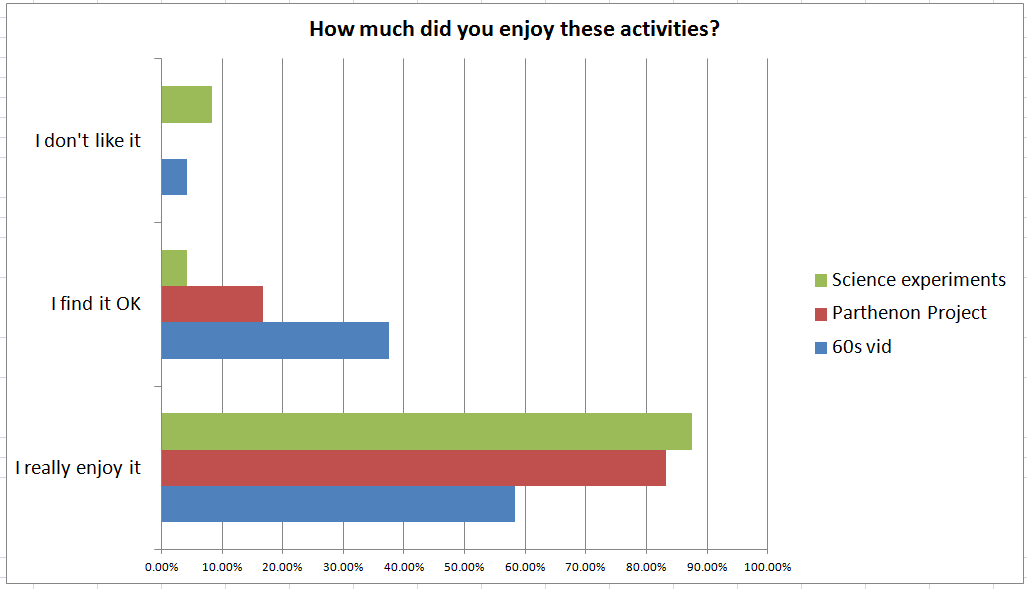
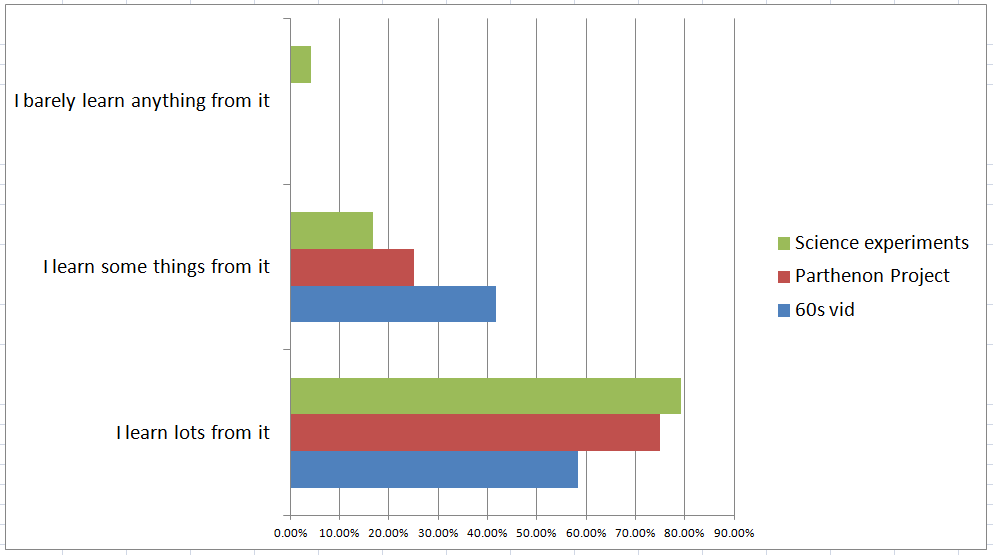
So these projects with year 7s have been working well so far. When I surveyed the class, the majority of students said they enjoyed doing the projects, learnt a lot from doing them and would like to continue doing projects in the following term.

For me personally, it is a continuing learning journey. I have experimented with similar project based learning activities last year, mainly with games based learning. However, this is the first time where I have been able to implement project based learning continuously for a much longer time. I think it does make learning more meaningful for students and allows them to create products that demonstrate their understanding, that shows me much more on what my students can do and need to improve on in comparison to traditional lessons that lead up to a topic test. Lessons also place a lot of emphasis on the process of learning, which is often lacking in more traditional-styled lessons.

However there are some challenges that I am exploring and implementing strategies for, such as:

  • Continuing to build some students’ abilities to negotiate in teams (some teams often break up as they can’t agree on minor details like whether to do a presentation or a video and we had to play some games and do role plays to show the importance of communication in team work)
  • Some students needing much more help in self regulation than others
  • Students being up to different parts of their project – This sounds relatively minor but it’s the biggest challenge I face at the moment. For example, in the last few weeks of term 1, some teams were still researching, other teams were writing their scripts and about three teams were ready to do their storyboards. It was difficult to determine when I should stop the whole class and have a quick session on how to draw storyboards because three teams were up to it or teach it to each cluster of teams when they were ready to do the storyboards. One of the biggest challenges are towards the end of projects when a few teams finish and some teams haven’t. This isn’t like some kids finishing a worksheet a few minutes before the others. Since these are projects spanning weeks, some teams might finish a few hours or a few days before others


Overall I find project based learning requires a lot more effort to design learning experiences for than the more traditional lessons, but projects provide more intellectual rigour and allow students to enjoy learning rather than seeing it as ‘school work’.

I’m more than happy to continue this journey and I don’t see myself turning back.

21st century learning – what do you think it is?

I recently attended an education forum where the main focus was on the role of technology in 21st century learning and education. The typical 21st century skills were shown. Personally I am not a big fan of 21st century skills because I don’t think these skills are unique to this century. To be able to collaborate, innovate, communicate, etc, have always been important skills, even back in the 12th century. 21st century learning is certainly not about interactive whiteboards and learning management systems. One of the speakers at the forum showed two photos of teaching that really got the room thinking. What exactly is the difference between the photo on the top and the photo on the bottom?

teacher teaching from a blackboardteacher teaching from IWB

While technology certainly plays a large role in education, I think for effective learning to occur in the 21st century and beyond relies on how teachers, educators and society perceive how technology is shaping knowledge and content.

Our current education and schooling system is built upon the premise that content is  scarce. When mass education started, content was difficult to access. Content was recorded in books that were expensive and only a limited number of these books were printed. Only a small number of people had access to this content and this is why children had to be crammed into a classroom to learn this content from someone who knows it. You had to memorise content because it is so difficult to find again. You memorise it or copy it so that you have access to it later on.

Now that we’re in the 21st century, do we still need an education and schooling model that is based on content being difficult to access? We now have YouTube, Wikipedia, Khan Academy and various other online resources that makes content available 24 hours a day, regardless whether you are in the city or rural areas or whether you are at home or on the train. Even children in developing countries have access to this. So why are we still making students come to a particular room at a particular time to access content that they can access online anytime anywhere?

Some people will at this point jump to the conclusion that a computer cannot replace a teacher. I agree. Just having access to content doesn’t make you understand that content. What teachers need to do is to develop students’ abilities in identifying what their learning needs are, how to find the resources for these needs and how to decide whether the resources are suitable. Teachers will need to help students clarify their understanding and develop students’ abilities in assessing and evaluating their own progression. In addition, teachers will also need to develop students’ abilities to collaborate with a global community.

And here’s where I think strategies such as the flipped classroom, games based learning and problem based learning come in. They are about learners owning their own learning processes in an environment where knowledge is at their fingertips and the teacher is not the source of all knowledge that just tells learners what they need to know. Unless teachers truly grapple with the concept that knowledge is now widely accessible to anyone and that learning can happen anywhere anytime (often without them being there), it doesn’t matter how much we talk about 21st century learning, how many interactive whiteboards we install or how many laptops are made available to schools, teachers will still transmit knowledge like the 19th century.

Level Up! Using games culture to enhance learning & innovation

Level Up! is a project that involves embedding games elements into everyday classroom practice. The project involves games based learning, gamification and games design. The brochure and poster presented at the Microsoft Asia Pacific Partners in Learning conference are shown below. Click here to access the virtual classroom tour details from the Microsoft Partners in Learning website.

poster presented at the PIL c onference

Innovation – what exactly is it?

innovation road sign picture

I’ll be heading to Auckland, New Zealand to represent NSW in the Microsoft Partners in Learning Teacher Awards. In 2011, I was selected as the NSW winner of this award, which is largely based on implementing technologies in an innovative way.

But what is innovation, and what exactly makes an innovative teacher? I’d like to start with what I think innovation ISN’T

Innovation isn’t about:

  • the latest technology – having the latest iPad doesn’t automatically equal innovation; neither does reading an e-textbook from an iPad
  • change only or change or the sake of change – just because it’s different it doesn’t mean it will make learning better
  • using technology – while technology is often related to education innovation, technology by itself is not innovation. For example using an interactive whiteboard to show PowerPoints to support lecture-style teaching isn’t innovation

I think innovation is more to do with teacher qualities rather than things and strategies per se. Innovation MUST also be able to enhance and improve student learning.

I think innovation is:

  • the willingness to take risks to try new things (technologies, strategies, etc) then reflect and evaluate on how this affects students’ learning.
  • not being afraid to “fail” and be able to see these “failures” as a learning process to grow as an educator
  • being able to  see that education is no longer based on a “knowledge is scarce” model, recognise that knowledge is now available to students at an instant and change as a teacher accordingly
  • thinking ahead; being proactive in understanding and predicting learning needs rather than being responsive and playing catch-up
  • being able to inspire others to join you

In the end, innovation in education, whatever it may be, must focus on improving student learning. As an educational leader, I also think it is vital that schools are environments where teachers are stimulated to be innovative. Schools should be environments where teachers feel that it is OK to try new things, it is OK when something new being implemented doesn’t go to plan and teacher successes in the classroom are celebrated and shared.

What do you think innovation in schools look like? How does your school encourage innovation?

Maths … it doesn’t have to be every odd question in Ex 2.3

This year I’m teaching an integrated curriculum for Year 7. This means Year 7s are learning English, Maths, Science, Geography and History through cross-KLA concepts.

Last week we had a lesson on scaled drawings and maps, which covered both ratios in Maths and map reading in Geography. The traditional (and perhaps easier) way is for me to show them how to work with ratios and different types of scales is to do a few examples on the board and then the students do a bunch of maths and geography questions. I then tell them whether they’re right or wrong.

But I decided to do it differently. I wanted my students to show their understanding in their own way, not through a set of questions that someone has set for them. It is also my school’s goal to allow students to negotiate their learning, and to prepare them for this I wanted to let them make negotiations on small parts of the task.

The “lesson” lasted for 5 periods. In the first 2 hours we discussed ratios, scales and how they were applied in real life (in maps, scaled models, toys, etc). Then we made “desk maps”, which were scaled drawings of our desks in the classrooms using scales such as 1 cm = 10 cm, with various objects (also drawn to scale) on the desk. This was followed by measuring scaled distances of a street map showing the local area.

The class then broke into teams. Their task was to make an explanation on how to draw a scaled diagram to someone who doesn’t know how to draw scaled diagrams. They had to plan according to these 3 questions:

1. What is my goal for this task?

2. What will my explanation for the scaled diagram be?

3. How will I present my explanation? Why have I chosen to present it in this way?

The planning process involved students spread across the whole classroom. Some students stayed at their regular desks. Others moved to the lab benches for more space. Others used the whiteboard on the other side of the room. It is more chaotic then the regular classroom, but it’s good chaos 🙂

Most students chose to do a video (for some reason my Year 7s love to make videos; I think it’s because they want to use the iPads). Their reason was because it’s easier to understand how to do maths when you can see and hear the explanation. Other groups chose to make posters. Their reasoning was because the posters can be pinned up in the classroom and students can refer to them if they needed to.

The groups then started to make their products. This involved students spreading out even more. Students who made videos went out into the playground or the storeroom next to the classroom to make their recordings. Students who made posters stayed in the classroom.

The last hour of the lesson involved students evaluating their learning process. I emphasised the process of making their product was just as important as the product. Students had to reflect on these questions:

1. What have I learnt this lesson?

2. How do I know I’ve done a good job?

3. Did I know what I had to do during the lesson? If not, how did I find out?

4. Was I able to stay on task? Why or why not?

5. Was I able to complete my task on time? Why or why not?

6. If I did the task again, how will I do an even better job?

I planned for the class to watch the videos and look at the posters after their learning evaluations, but we ran out of time. We’re going to do that next lesson where each group has to come up with a “wow” and “wonder” for each product. The “wow” is something that was done well in the product. The “wonder” is a question raised from the product such as “I wonder if you could show other scales besides 1cm=10cm to show more difficult calculations”. We’ll see how it goes.

Here’s part of one group’s videos.

http://youtu.be/eVMtvjSTrC0

A new year, a new challenge

It’s now been a week into the 2012 school year. For me, this year is a little different – I am only teaching one class! At my school we are implementing an integrated curriculum for year 7 as a middle years strategy (and it’s actually a proper integrated curriculum; not just me teaching multiple subjects). Year 7s have one teacher for English, Maths, Science, Geography and History, and I’m lucky enough to be one of those teachers.

I see my Year 7s all day Monday and Friday and two hours on Tuesday and Wednesday. This is a huge change from I was used to. I see this as an opportunity to really get to know my students and implement a lot more problem based learning (PBL). There has been many learning activities I want to implement and some I have implemented that are long-term projects and did not work as well as they could have due to the rigid high school timetable. Seeing students for large chunks of time makes PBL a lot easier.

So here’s some of the things I’ve done differently this year:

I have rearranged my classroom

I know this doesn’t sound like a big deal, but I have moved my desks from rows to groups. I wanted the physical space to reflect how my students will learn best. My classroom is actually a science laboratory so it’s double the size of regular classrooms. There is enough space for students to work in groups on the regular tables and move to the practical benches if they need to work independently or in smaller groups away from the rest of the class. I eventually would like my students to choose the space that would allow them to work the best for a particular activity.

classroom layout


I don’t have a front-of-the-classroom

There is no front of the classroom. There are three sides of the room where information are displayed – the interactive whiteboard (IWB), the side wall and a regular whiteboard on the opposite side of the room. The side wall holds learning intentions and success criteria for the lesson and the IWB and the regular whiteboard are used by students.

learning intentions board

I let my students negotiate on their learning

Year 7s came up with 5 class rules. We then used Class Dojo to come up with positive behaviours and negative behaviours that would gain points or lose points respectively. Year 7s devised a reward system where 5 points would gain a merit award and every 15 points they accumulate will allow them to “level up” and choose a new avatar for themselves on ClassDojo.

reward system negotiated by students   class dojo screenshot

Letting students sustain their own learning community

When I first used Edmodo last year, I used it as space to upload files. Lesson resources, worksheets and quizzes were uploaded onto Edmodo. Half way through last year I started using Edmodo as an online space for students to share and collaborate. Students started to share links, samples of work and PrimaryPad was embedded for groups of students work collaboratively. This year I wanted to continue this and extend it further. It’s good to see that when I scan the page of my year 7 Edmodo group, most of the posts are made by students and NOT me.

This year is going to be very different. It’s going to be challenging, but at the same time a really good opportunity to explore learning. I’m really looking forward to further exploring PBL and going further with I’ve been doing with games based learning. I am also leading some new initiatives in my faculty, which I will write a blog post on later. Watch this space. 🙂