Action learning with Minecraft – Cycle 1

Last term I decided to undertake an action learning project to see whether using feedback will improve students’ self regulation skills in project based learning. This came from my observations that some of my  Year 7 students, who work well in traditional, teacher-centred learning activities, displayed a lot of off-task behaviours in project based learning, which included being not staying with their teams, constantly changing their minds about their projects and other actions, which resulted in a very low-quality learning artefact being produced (see my previous post for more details). This happened in their 60 second science project, where they worked in teams to create a 60 second video on an astronomical phenomenon. Their latest project was to create a model Parthenon in Minecraft where the architecture followed the golden ratio. This project was broken into 4 stages where each stage had a goal and students and I had to assess on how well they have achieved their goal in the form of medals and missions.

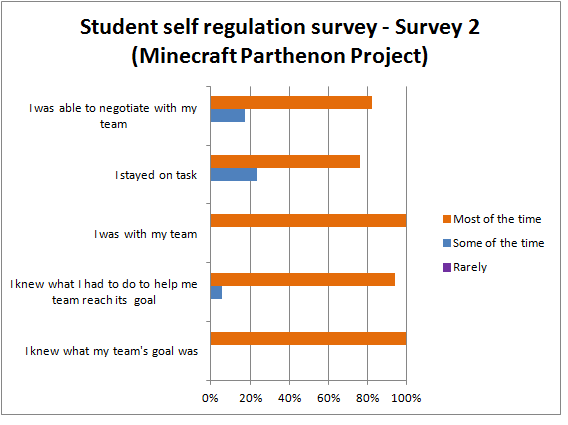
Based on informal classroom observations, more students were on task than the previous project. From their survey data, more students said they knew what their team’s goal was, knew how they could help their team achieve that goal, stayed with their team and were on task.

Note: The first graph shows the survey data from the 60 second science project while the second and third graphs show the data from the Minecraft Parthenon project. (Sorry, the categories have been listed backwards in surveys 2 and 3.)

student survey results for self regulation

shows the data from the Minecraft Parthenon project

shows the data from the Minecraft Parthenon project

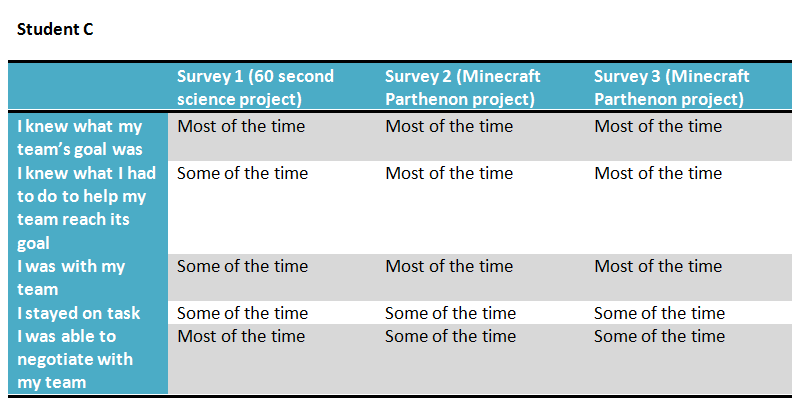
There were also selected students who struggled with self regulation skills more than the rest of the class in the 60 second science project. Let’s call them Student A, Student B and Student C. When I compared their data, this is what it showed:

student A's survey data over time

student B's survey data over time

student C's survey data over time

When I combine the students’ survey data with my own classroom observations, I can conclude that these three students have worked a lot better during our project sessions. They weren’t “perfect” though, but they did improve. I did see them looking up their own houses on Google Maps a few times while they were meant to be working on their Minecraft Parthenons.

However, I don’t think I can just conclude that giving effective student feedback will cause students to have better self regulation skills in project based learning. There were some major differences between the 60 second science project and the Minecraft Parthenon project:

  • Duration of the project – The 60 second science project lasted 8 weeks while the Minecraft Parthenon project only took 3 weeks. Students might work more effectively in shorter-duration projects.
  • General appeal of the project – While the class in general enjoyed both projects, there was a more heightened excitement about using Minecraft. The games based learning aspect might have affected students’ work ethic. Many students are also very familiar with Minecraft, while the 60 second science project involved students learning and applying unfamiliar concepts such as scripting and storyboarding.
  • Structure of the projects – The 60 second science project involved students working in a range of learning spaces. At any one session, some students were in our main classroom, some students were in another classroom to film, some students were in another classroom so they can record audio. This created a slightly chaotic atmosphere even though it was organised chaos. In the Minecraft Parthenon project, all students were on the mezzanine level of the library. For students who are easily distracted, such an environmental difference might also affect their ability to self regulate.

I’m now coming up to cycle 2 of my action learning project. The next project will involve year 7s creating their own newspapers to report on the London Olympics. I’m staying with feedback and self regulation but will make a few changes to the way data is collected:

  • Student surveys will have additional questions that ask them how well they understood the feedback and how well they know how to act on that feedback
  • Observations from other teachers – I’d like someone else to come into the class and observe Student A, Student B and Student C as well as the rest of the class and note what they are doing at what times of the project session

Cycle 2 will begin in week 2 of Term 3 so watch this space for updates. Also watch this space for updates on how my team of science teachers have been using action learning to improve student learning in science at our school.

Project based learning – a continuing journey

I have been embarking on a journey this year that is transforming my teaching practice. I have always liked to experiment with different teaching and learning strategies, but they’ve always had constraints that were beyond my immediate control, which included running them within one hour periods and within one subject area (when I knew it had so much potential for cross curricular opportunities)

Now that I’m teaching a year 7 class in English, maths, science, geography and history, I have more opportunities to try things like project based learning. I see my year 7 class the whole day on Mondays and Fridays and they’re our “project days”. That just means on Mondays and Fridays we have at least two to three hours where students work in teams on projects. These projects span from one week to a few months. They all involve students working in teams,, determining their project goals, working out a timeline to achieve those goals and producing a product that they think best demonstrates their learning. The process of getting to the end product is just as important as the end product itself. the process of the project is adapted from the design process.

design process

To build student capacity to undertake such activities, we started with relatively small projects that were heavily scaffolded. These projects were completed within a few hours over a couple of days so that students can get used to working in a team and practise self-regulatory behaviours. Students then moved onto a project that required a couple of weeks to complete and involved them designing a question about the people of the school, creating a survey to answer the question and then creating a more complex infographic than the previous project. Some students chose to draw graphs on a poster, while others decided to make a video.

In each project, students completed an ‘evaluation of my learning’ activity, which involve students reflecting on:

  • whether they have achieved their goals and why (most students are quite honest with this question, often citing the completion of some tasks were held back because they were distracted for some period of time)
  • how they knew they’ve done a good job
  • how they can improve on their next project (we still need to work on this more as many students still say “work faster”)

Students then review each other’s work and give feedback to each other. We then upload the learning products onto our class blog, Too School for Cool, so that a global audience can comment on the students’ work.

The project the year 7s are doing now is the 60 second science video challenge, which is their first long term project. The project involves students working in teams to create a one-minute video to explain a science concept. The project is divided into four phases: research, pre-production, production and post production. Most year 7 teams have completed their research, a draft script and a draft storyboard for their video. We have also learnt some of the easier script/screenplay conventions and also camera angles for the storyboard.

So these projects with year 7s have been working well so far. When I surveyed the class, the majority of students said they enjoyed doing the projects, learnt a lot from doing them and would like to continue doing projects in the following term.

For me personally, it is a continuing learning journey. I have experimented with similar project based learning activities last year, mainly with games based learning. However, this is the first time where I have been able to implement project based learning continuously for a much longer time. I think it does make learning more meaningful for students and allows them to create products that demonstrate their understanding, that shows me much more on what my students can do and need to improve on in comparison to traditional lessons that lead up to a topic test. Lessons also place a lot of emphasis on the process of learning, which is often lacking in more traditional-styled lessons.

However there are some challenges that I am exploring and implementing strategies for, such as:

  • Continuing to build some students’ abilities to negotiate in teams (some teams often break up as they can’t agree on minor details like whether to do a presentation or a video and we had to play some games and do role plays to show the importance of communication in team work)
  • Some students needing much more help in self regulation than others
  • Students being up to different parts of their project – This sounds relatively minor but it’s the biggest challenge I face at the moment. For example, in the last few weeks of term 1, some teams were still researching, other teams were writing their scripts and about three teams were ready to do their storyboards. It was difficult to determine when I should stop the whole class and have a quick session on how to draw storyboards because three teams were up to it or teach it to each cluster of teams when they were ready to do the storyboards. One of the biggest challenges are towards the end of projects when a few teams finish and some teams haven’t. This isn’t like some kids finishing a worksheet a few minutes before the others. Since these are projects spanning weeks, some teams might finish a few hours or a few days before others


Overall I find project based learning requires a lot more effort to design learning experiences for than the more traditional lessons, but projects provide more intellectual rigour and allow students to enjoy learning rather than seeing it as ‘school work’.

I’m more than happy to continue this journey and I don’t see myself turning back.

Mucking around

My current attempt to integrate Xbox racing games into science is generating interest amongst a fair few teachers. My class loves it. As one student said today “All classes should have an Xbox”.

So why aren’t more classes using the Xbox?

A few weeks ago I ran a professional learning session for science teachers on how they can integrate Xbox games into teaching Newton’s laws of motion. I suggested an array of activities to cater for students of a range of abilities. Yet the Xbox booking sheet only holds my initials as no other teacher has requested it for their classes. As the faculty’s head teacher and the school’s technology coordinator, I want to reflect on how to encourage teachers to implement what they learn in professional learning sessions, particularly with technology.

There are many reasons why teachers may not implement what they learn in professional development courses. However, I want to focus on the need to ‘muck around’. With technology in particular, it’s essential to muck around and spend time to explore the software before deciding how to use it to enhance learning. In a reading I had to do for uni Richardson (2009) highlighted that teachers need to make a personal connection with the technology before being able to consider the pedagogical implications of the technology for their classroom practice. IMHO, to make this personal connection, you need to muck around.

With the Xbox, I spent a lot of time mucking around (playing three different racing games to decide on the best game for my class, which game mode to use, which race track, difficulty level and how much freedom students had in choosing players and racing tracks to ensure time efficiency). Then there was mucking around with hardware. Which data projector was best? What cables did I need? Overall it involved two weekends of playing Xbox at home, several visits to video game shops and several hours of playing the Xbox at school. And I thoroughly enjoyed every minute of it! 🙂

In contrast, the other teachers didn’t have this opportunity.  All they had was a half hour session of me showing them how to set up the Xbox, how to play Formula 1 2010 and the various activities they can implement for their classes. They didn’t have the chance to discover for themselves how the Xbox worked and the potential it can have on their students’ learning. They didn’t have the chance to muck around for hours playing different types of games and reflecting how the games can be used in their teaching.

The hard part now is how do I create these opportunities where teachers can muck around, self explore and reflect? How do I create opportunities for teachers to want to muck around?

Note: The school’s teachers have been fantastic at adopting other technologies such as IWBs and 1:1 laptop initiatives. Perhaps the Xbox takes relatively longer to get used to.

Xbox and Isaac Newton

 I have recently acquired an Xbox 360 for the science faculty at my school. I’ve always been an enthuaistic gamer (more into Nintendo games like Zelda) and have been investigating games based learning for a while and was deciding whether to try out the Xbox, PS3 or Wii in the classroom. But then an Xbox 360 was handed to me!

My Year 10 class are studying Newton’s laws of motion at the moment. I liked the idea of using commercial games to support learning rather than using educational games. I came up with the idea of using a car racing game for students to learn about Newton’s laws. They will work in small groups where the gameplay will be recorded, then imported into a video editing software and add text annotations to explain the motion of the race car using Newton’s laws. Their end product should be something similar to this.

Now that the activity is in place, the next step was to find the most appropriate game. I tried out Need for Speed Shift as it came free with the Xbox console. While the graphics were awesome and the game gave a “real driver experience”, the game took too long to load and there were too much of the storyline to get through before you could play the game. I needed to get my whole class playing the game in two to three lessons and Need for Speed Shift just takes too long.

The next game I tried was Formula 1 2010. The initial game set-up took a while (choosing teams, driver names, etc), but once that’s done, you can just race around a grand-prix track in one or three laps – perfect for students in the classroom. After spending a weekend trying out all the tracks, I worked out that Melbourne and Montreal were the easiest. I might get all the kids to be Mark Weber and race in Melbourne just to be patriotic!

All I’ve got to do now is to actually implement the activity, which will be in two days time. All equipment are set, activity sheets (Xbox project newtons laws_wordpress) are done, other teachers have been trained, and one of the deputy principals will be visiting to see how it goes. Wish me luck!