Plague Inc – Learn while you infect the world

It’s the summer holidays here in Australia. This means I get to play more games than usual. Rather than spending my evenings planning lessons, I get to sit on the couch with my tablet and play games while watching the Australian Open.

Last week I stumbled across a game called Plague Inc, available on iOS an Google Play. The goal of the game is to design a disease that will become an epidemic that wipes out humanity. You as the player chooses where you start the disease, the symptoms of the disease, how the disease will be transmitted and the defence mechanisms it will have such as drug resistance.

The game is an authentic simulation of epidemiology. While it is not 100% scientifically accurate, it is accurate enough to reflect the following epidemiological aspects:

  • The location of the origin of the disease affects where and how fast the disease is transmitted. For example, a disease originating in a third world country with limited health care resources will spread faster than the same disease originating from a first world country. The disease will also spread via transport routes.
  • To design a disease that will kill everyone on Earth, the player needs to balance the rate of transmission, the severity of the disease and how lethal the disease is. Making the disease too lethal early in the game will result in doctors noticing the disease and research on a cure will begin too soon.
  • Islands are harder to infect. In the game it is often difficult to spread the disease to Greenland and Madagascar.
  • The transmission of disease follows trade and travel routes.

Plague Inc has a lot of potential in games based learning. I am planning to use it as an introductory activity for students to think about how diseases are spread on a global scale and how scientists approach epidemics. The game can be used to discuss evolution of pathogens and vectors of diseases. The game can also be used for students to test out how wealth and regional location affect a country’s ability to respond to epidemics.

Plague Inc also throws in some ethical issues. In the later stages of the game, it shows how countries begin to respond to massive numbers of people dying. Some countries’ governments are overthrown, some countries fall into anarchy and some countries bomb areas with large numbers of infected people in order to control the spread of disease. This can be used as a stimulus for a whole variety of learning that spans across many subjects.

I am planning to use Plague Inc with my Year 9 class this year when we are learning about diseases. I am going to use the game in the beginning and have students come up with questions they would like to explore and mould that into a project based learning opportunity.

Plague Inc is a bit morbid and perhaps not entirely politically correct, so it is best to check with your principal if you are thinking about using Plague Inc in your classes as well.

Along came SOLO

I had an epiphany in the Christmas holidays. All of sudden everything I have learnt about learning from university teacher education, academic readings, personal experiences as a student and my day-to-day experiences as a teacher gelled together into a completed puzzle.

I have always been a teacher who likes to try new things. That’s because I always want to improve my students’ learning and achievements. However everything I have done seems to be in pieces and it felt like I was moving from one fad to another. The list below briefly lists all the learning strategies I have implemented in my past 5 years of teaching:

  • Project based learning
  • Games based learning
  • Gamification
  • Social networking
  • Assessment for learning
  • Habits of mind
  • Goals, medals and missions model of feedback

This list doesn’t include all the whacky science experiments that attempt to increase student engagement and students’ understanding of abstract concepts. The list doesn’t include the large array of online tools I use with students. The list also doesn’t include the large number of classroom management strategies I have tried.

Not only did it feel like I was moving from one new fad to another, I have always questioned the effectiveness of these strategies. My students were engaged and achieving. I knew this from their work samples and survey responses. However, how do I know each and every one of my students were having their achievement and learning maximised by whichever strategy I was using. All of the strategies I used require intensive effort from the teacher. How did I know the pay-off was balanced by the effort put in?

And along came SOLO …

SOLO isn’t new to me. I have always had a good understanding of SOLO from working on ESSA and NAPSL. SOLO is a framework for classifying different levels of understanding. In some ways it is similar to Bloom’s taxonomy.

But before the Christmas holidays, SOLO was one of the things on the long list of strategies. However during the holidays, I read two books that finally pieced everything together – Visible Learning for Teachers: Maximizing Impact on Learning and Using SOLO as a framework for Teaching.

The key messages I got from Hattie’s books are:

  1. Teachers are activators and evaluators of learning
  2. Goal setting, self monitoring, concentration and deliberate practice are among the most effective strategies

This really spoke to me because it felt like someone finally have said to me I was on the right track for having my students complete all those surveys, exit passes, regular quizzes, etc so that I knew how they were going and change my teaching accordingly. Also it was always my gut feeling from my first year of teaching that this mind set was what set brilliant teachers apart from the others.

But then I asked myself how am I going to do this? How am I going to evaluate learning effectively? How am I going to develop my students’ skills in self regulation? How will I lead my faculty in doing this?

This is where SOLO comes in. SOLO can be used to develop learning intentions and success criteria for units of work. Learning intentions are the aims of a lesson (or series of lessons) while success criteria are what students have to do to be successful in that lesson. The success criteria are classified by the SOLO taxonomy, which lets both the student and the teacher know how the student is progressing and adjust the teaching and learning process accordingly. The book Using SOLO as a framework for Teaching has a process for teachers to develop units of work, including learning attentions and success criteria.  I have created some draft learning intentions and success criteria for the first units I’ll be teaching this year using the process from the book.

One star = uni/multistructural

Two stars = relational

Three stars = extended abstract

The success criteria let students know where they are now and where they are to go next. It lets students know what they need to do or know to demonstrate a surface level and deep level of understanding. It actually fits very nicely with the goals, medals and missions model of feedback.

What I have done is also use the SOLO-based learning intentions and success criteria to design PBL units of work. The success criteria shown above is part of a PBL unit based on the driving question “Sharks: Friends or Foes” where students have to make a critical judgement on the roles of sharks in an ecosystem and the impacts of sharks on humans. I have also created pre-tests and post-tests (some of these are short quizzes and some use the ‘letter-to-a-friend’ strategy) so that my students and I know whether learning has been effective. I will also be attempting to measure effect sizes.

For me SOLO ties together all those strategies I have tried before. They are no longer bits and pieces that I pluck out for different years for different classes. SOLO provides an anchor for me. For example, I can now say I am using games based learning/project based learning/etc for this because it will help my students move from uni/multistructural to extended abstract for these learning intentions. SOLO provides me (and hopefully my faculty in the near future) with a learning framework to base our discussions of learning and evaluation on.

I am also going to use SOLO-based learning intentions and success criteria to design programs for the Australian Curriculum.

So this year will be a journey into SOLO. Watch this space for updates 🙂

Learning about learning from the London Underground

I am currently on holidays in London. London is a fairly easy city to get around if you speak English fluently, but I have an extremely bad sense of direction (I sometimes still get lost in my hometown of Sydney). I am just someone who just takes a little longer when getting my bearings with a new place.

I am in London with my partner. He has an extremely good sense of direction and learns his way around new places quickly.In London, he has been the one leading the way from our hotel to the nearest underground station, Southwark. He has been the one figuring out which stations we need to change at and which colour lines we need to go on. I’ve just been daydreaming while following him. Even though I have walked from the hotel to the Southwark station many times, I wouldn’t be able to tell you how to get there. I looked like I knew what I was doing, and I was successful at getting from A to B, but really I had no idea what I was doing. I didn’t even bother looking at or carrying a map of the Tube, because I knew I didn’t have to use it. I can just follow my partner.

Today my partner was sick. While he was resting in the hotel room, I ventured out into London city by myself for the first time. The first thing I noticed was that there were orange light poles that pointed to where Southwark station was, telling you when to keep walking straight and when to turn a corner. I never noticed these before. I made it to Southwark station without getting lost at all. I wanted to get to the British Natural History Museum and worked out I needed to change at Westminster station for the green district line. I was much more aware of signs that gave clues to where I was supposed to go. If I was with my partner, I would never have noticed those signs because there was no need to notice them.

This experience has made me reflect on the way I have designed learning for some of my students. Some students generally take more time to do some things (like how I am with learning new directions). This may be team work, a mathematical concept or extended writing. In these situations many teachers, including myself, often hold our students’ hands and lead them from A to B; just like how I was led from A to B. We give our students scaffolds that tell them exactly what to do. We work through questions in worksheets as a whole class so all students have to do is copy the answers from the board or write down what they heard from another student. Students look like they know what they are doing, but really they were like me, just following someone who knows what they are doing.

But what if we just let our students get from A to B by themselves? Why are we so scared of letting them find their own way? They might take a little longer, or take the wrong turn and have to double back. Instead of assigning an extended writing task and giving them a scaffold straight away, why don’t we let students figure it out by themselves, but provide the clues for them. Figuring out something by yourself is one of the most powerful learning experiences. How can we design learning experiences that allow our students to do that? How can we design learning experiences that strike a balance between giving students the freedom to discover things for themselves and enough guidance so that they are set up for success?

Learning in Term 3

Now that Term 3 has come to an end, I am again analysing the data from Year 7’s evaluation of their learning. Year 7s complete a weekly reflection on their learning as well as an end-of-term evaluation. Their end-of-term evaluations gives me an idea on how they feel about how I structure their learning activities so that I can adjust the next term’s learning accordingly.

For Term 3 our project based learning focus has been on newspapers. For 8 weeks, students deconstructed the language features of news articles and put together a range of articles on the Olympics, the Paralympics and other newsworthy items. Some of these articles were written in groups and some were written individually. Year 7s then selected some of these articles to put together a newspaper using Microsoft Publisher. Each news article involved students revising the article at least twice using the goals, medals and missions structure of feedback. In Term 3 we also did science experiments on Tuesdays that were based on sport science under the theme of the Olympics. For half of Term 3 the class worked with Year 6 students from Merrylands East Public School on Murder under the Microscope, an online environmental science game where students acted as forensic scientists to solve a crime involving the pollution of a catchment area. One new activity I introduced in Term 3 were weekly revision quizzes. These quizzes were essentially thirty-minute pen-and-paper-exams that tested Year 7’s understanding of concepts we have learnt during the week. However, they were allowed to refer to their books if necessary (I just think this is more realistic of real life. When in your life do you come across something you can’t do and force yourself to sit there for 30 minutes without makin any attempt on finding out how to do it. I also think it gives a purpose to students’ book work and instil in them a routine of what revision and studying looks like and feels like.) With these weekly revision quizzes, students mark each other’s work. The quiz is divided into concept areas such as algebra, language features of newspapers and scientific investigations and marks are awarded separately to each concept. Students then look at their performance for each concept area and write a short reflection on what they are good at and what they need to improve on.

So this week, Year 7s completed an end-of-term evaluation of their learning on Survey Monkey.

Term 3’s evaluation consisted of these questions:

  • What is your favourite subject?
  • What makes this subject your favourite subject? What do you like about it?
  • Rate how much you enjoy the following activities (students choose from “I enjoy it”, “I find it OK” and “I don’t enjoy it”
    • Project work
    • Science experiments
    • Maths and numeracy
    • Murder under the Microscope
    • Edmodo homework
    • Rate how much you learn from the following activities (students choose from “I learn lots from it”, “I learn some things from it” and “I barely learn anything from it”)
      • Project work
      • Science experiments
      • Maths and numeracy
      • Murder under the Microscope
      • Edmodo homework
      • Do you want to continue doing project work on Mondays and Fridays?
      • What are 3 things you have learnt from the newspaper project?
      • List 3 things you want to improve on next term.
      • If you were the teacher of 7L, what would you do to improve learning for the class?

So here are the results:

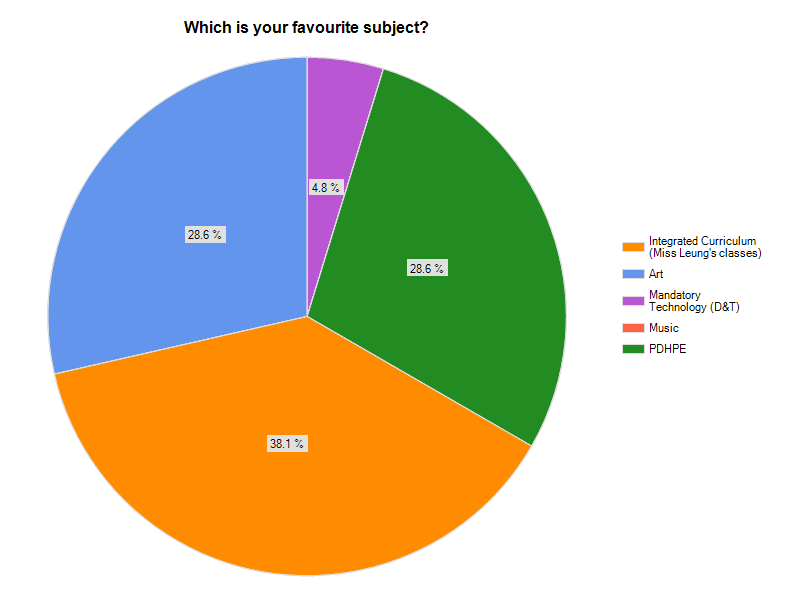
What is your favourite subject?
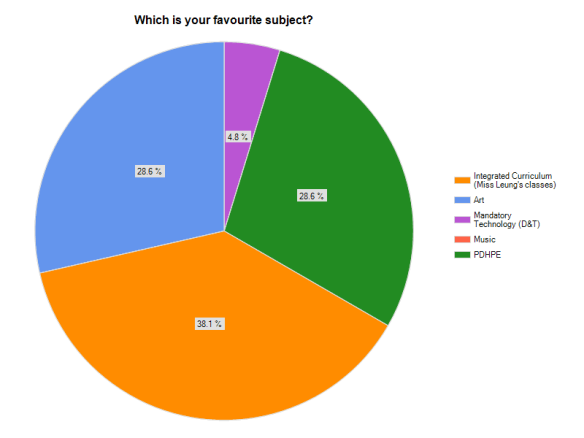
A pie chart of Year 7's favourite subject

I’m going to conclude by just saying it takes a lot to beat PDHPE as students’ favourite subject.

Reasons why integrated curriculum is their favourite subject

Below are some of the responses from students who chose integrated curriculum as their favourite subject:

Because we get to have fun in those classes and do interesting stuff.


The experiments we do and how all the subjects are put into one class.


It involves technology.


There are so many opportunities to do fun activities and showing people my work.


Some of the major themes from this question are that students find integrated curriculum classes “fun”. They also like using technology such as laptops and tablets for their learning, as well as having 5 subjects embedded into one class.  Some students enjoy having their work showcased on the class blog.

Rate how much you enjoy the following activities
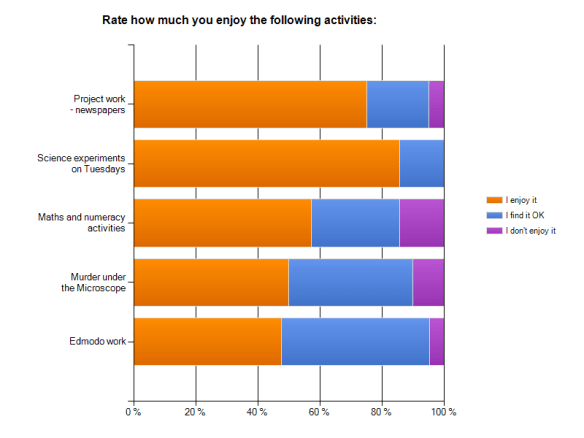
A sector bar graph showing year 7's enjoyment rating of different activities

Rate how much you learn from the following activities
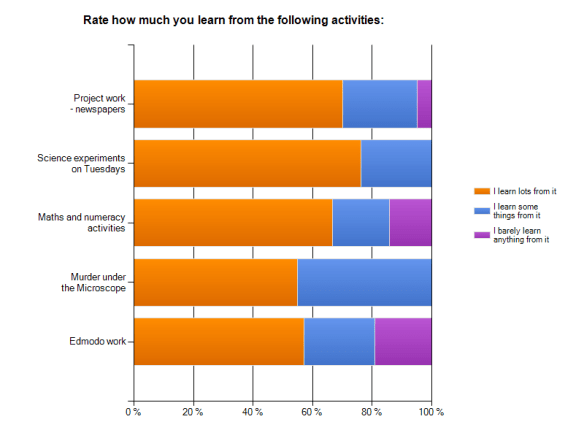
A sector bar graph showing how much year 7s learn from different activities

What are 3 things you have learnt from the newspaper project?

 A word cloud was created for students’ responses to this question where the larger the word in the word cloud, the more frequent that word appeared in the responses.

A word cloud showing what students have learnt in the newspaper project

List 3 things you want to improve on next term.

This term was the first time students wrote features of effective team work for their improvements for the following term. In previous end-of-term evaluations, students often listed relatively superficial things they’d like to improve on such as write faster or finish work faster. For this term’s evaluation, the majority of students listed features of team work skills such as listening to other students, working as a team and self control. Many students also identified specific areas of content they’d like to improve on such as algebra or types of scientific variables. This is in contrast to how they listed their improvements in previous evaluations where many students wrote umbrella terms such as numeracy or literacy.

For me, this shows an increased level of maturity in the way they assess their learning. While I can’t attribute the cause of this change to any particular strategy I’ve used, I do have a strong feeling it is to do with the goals, medals and missions structure of providing feedback in their PBL tasks and also their weekly reflections on their revision quizzes. Over a term I think most Year 7s have increased their self-awareness of their own learning.

What have I learnt?

For most of this year I have been experimenting on strategies on guiding students to become more effective learners. The PBL initiatives, the goals-medals-missions structure of feedback, the weekly revision quizzes and weekly reflections of learning have all been things aimed at allowing my students to further develop into effective learners. While I always knew that features such as working together and being self-aware of your strengths and areas for improvement are equally important as understanding subject-specific concepts, I think teaching my Year 7s for 5 different subjects have really made that clear to me. When I think back to how I structure my learning in previous years for my science classes it has always been more focused on content rather than developing students into effective learners. When I do eventually return to teaching science classes only, the way I will structure learning for those classes will be very different to how I used to structure them. Teaching an integrated curriculum has so far been one of the best professional learning I’ve had.

Learning from failure

My Year 7s had a go at designing their own experiments this week.  Year 7s were designing experiments to compare their reaction times. As an introductory activity, we did the classic ruler reaction time test, where students had to catch a falling ruler as fast as they can.

They then worked in groups to design an experiment to compare the reaction times of two groups of people. They had a choice of comparing the reaction times between teachers and students, students who play sports often and students who did not; or boys and girls.

For some reason, all groups except one decided to do experiments that had nothing to do with the ruler reaction test. These groups had variations of a method of throwing balls at test subjects without warning and counting how many times the each person catches and misses the ball. Their method designs were quiet creative but very complex and required very efficient team work. And this class does not have the team work skills to pull it off.

I knew that some students will fight to be the leader of the group; some students will not listen to the instructions from other students; and other groups do not have a common understanding of the method amongst all group members that it will result in the experiment falling apart. Now usually I will say no to the experiment design. I would force them to go back and re-design their experiment. I might even force them to do the ruler experiment instead. I would explain to them that they need to choose a leader in their group and have roles assigned to each group member. I would go to lengths to avoid the potential chaos that was about to happen.

But this time I didn’t do it.  And yes, chaos followed and all my predictions were correct. There were groups where multiple students were giving instructions so overall no one knew what to do. One group had one student becoming extremely frustrated, yelling “No one is listening to me!”

So yes, the experiment was a failure. A lot of students went back to the classroom feeling defeated. They knew they have failed to achieve their goal. They don’t like to fail.

But that was what I wanted them to do – fail. I knew they had lousy team work skills. However, instead of me lecturing them on the importance of effective team work before they headed off to do their experiment, they experienced first-hand what ineffective team work feels like. When we returned to the classroom, we had a debrief activity where students identified what went wrong and what they would do next time. The effective team work elements came from them rather than me. We also discussed the emotions associated with failing. I knew some of them were quite upset because they couldn’t do the experiment the way they had planned it. We discussed the importance of acknowledging those emotions and that it is OK to feel that way. As a class we then agreed that we can feel sad for a little while, but we need to go back and try again because if we don’t, we will never be able to achieve the goal.


This whole activity reflects some elements of gaming. In a game, the game doesn’t tell you what you exactly have to do to win the game. You start playing, you fail, you work out what you did that made you fail and not do it again. In games, players go through a repeated cycle of fail, learn and re-try. Even if you succeed, you can re-play that level and work out how to improve your score.

So why doesn’t this cycle replicated at school. Students often feel the need to master the understanding of a concept or skill straight away. Schools often don’t allow opportunities for students to fail. There is a pressure for students to succeed the first time. When students do an exam, they don’t get to re-sit that exam and show what they’ve learnt from it. When students complete an assignment, they don’t get to re-do that assignment to improve on their previous performance. It’s like school is setting up students to rage quit.

When playing games, players go through the cycle of fail, learn and re-try many times. This leads to risk taking, trial and error and persistence – skills that many teachers want their students to develop. It also allows students to develop resilience. Students need to be able to bounce back from their failures, self assess what they need to do differently and be aware of what their strengths and weaknesses to turn the failure into a success.

So let your students fail. Teach them how to fail. Teach how to bounce back from a failure.


You don’t create groups on Edmodo. You create learning communities.

You don’t create groups on Edmodo, you create learning communities

I have been using Edmodo as an online learning tool for a little over 1.5 years now. Back at the beginning, I viewed Edmodo as an easy way to post content for my students online, for students to submit their work online and for me to send my students urgent important messages outside of school hours. The way I used it was very one way – teacher to student. The first Edmodo group I set up was for a Year 11 Physics class. When I analyse that page, almost every single post was made by me. Most of these posts have no replies. There were a small number of posts made by students, which were questions directed at me as a teacher and I answered them. This group wasn’t a learning community. It was just a website that had information posted by me.

This year I have been using Edmodo with my Year 7 Integrated Curriculum class, which I teach for English, Maths, Science, Geography and History. Our Edmodo group page looks very different to the year 11 page. Firstly there are heaps of posts, probably 5 times as many posts as the Year 11 Physics group. And most importantly, a significant number of those posts are made by students.

I went through the Year 7 Edmodo page and categorised all posts made in August 2012 and here are the stats:

  • There were 71 posts during this month
  • 46 out of 71 posts were by me
  • 25 out of 71 posts were by students
  • 62 out of these 71 posts involved a discussion
    • This means that these 62 posts had more than one reply comment. These reply comments included students commenting on each other’s work, answering each other’s questions or holding a discussion that was of interest to them
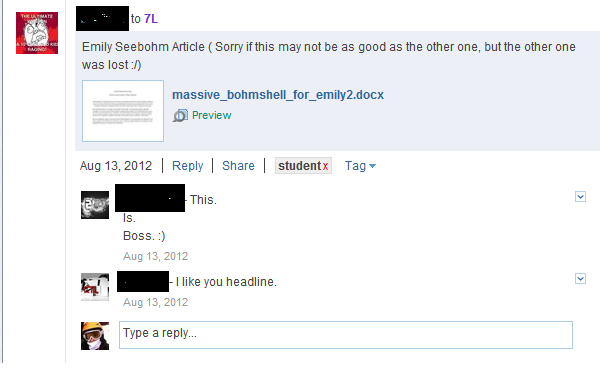
Students sharing and commenting on each other's work on Edmodo

Students sharing and commenting on each other’s work on Edmodo

Students sharing and commenting on each other's work on Edmodo

Students sharing and commenting on each other’s work on Edmodo

For me this year, Edmodo has transformed from a free alternative to a learning management system to a tool for enhancing a learning community. It is an online space that allows my students to learn from each other beyond the four walls of the classroom and beyond 9am to 3pm. The Year 7 Edmodo group is a much more dynamic and successful learning community than my previous Year 11 group. Why?

Just do a search in Google for creating a successful online learning community and most sites will give you very similar tips.

  • An online community is like a traditional community, built on shared qualities, characteristics and purpose.
  • A successful online learning community must create value for its members. The online community must be worthwhile for its members to visit regularly.
  • Individuals must be supported and empowered to share their knowledge, information and user-created content. A successful learning community must have a majority of members sharing ideas and content that is of value to that community.

So how did I ensure the above three features of the Year 7 Edmodo group this year?

Shared qualities, characteristics and purpose

Year 7s knew from the start of the year that the group was for them to share their learning. While they also post their homework on there too, one of the first things I did was to have them share a summary of a news item of their interest (most reported on NRL pre-season news) and reply to another student’s post with something they have learnt from that student’s posts. Questions asked by students were answered very quickly by me, which assured students that Edmodo was a worthy tool for communication. This set up a sense of shared purpose for the Edmodo group very early on.

Creating value

One of the ways of creating value in an online community is to allow users to personalise the space. For my Year 11 physics group, I gave them the Edmodo group code and went from there. I didn’t spend time to let them set up their profiles and change their profile pictures. For Year 7s we spent an hour setting up their Edmodo accounts, filling out their Edmodo profiles and choosing an avatar that most represented them. This was done in the second lesson of the school year. So straight away Year 7s was given an opportunity to value Edmodo; this opportunity was not given to Year 11s.

Support and empowerment

Year 7s often post things up that are not 100% related to our school work. Posts like personal art projects they have done, their successes in weekend sport, their views of internet censorship and the death of Niel Armstrong. I actually don’t know why my Year 7s feel empowered to share things they have created or news they think are worthy for their classmates to know on Edmodo. This started very early on in Term 1. Perhaps because their early activities on Edmodo was all to do with sharing their personal interest projects and news. Perhaps in our face to face classes we emphasise on sharing our learninh artefacts. Whatever the impetus is, I hope it stays there because it is one of the strongest driving forces of our learning community.

Note that the above features of successful online learning communities are all related to how people relate and interact with each other and how they emotionally connect with the online space. How come this is rarely discussed in professional dialogue associated with such online tools? I think teachers often do misjustice to educational social networking tools like Edmodo when we promote it to other teachers in professional learning or in conversation when all we talk about are how Edmodo allows students to complete self-marking quizzes. These are all excellent tools for learning but rarely are our conversations and professional learning about the dynamics of human relationships in such online environments. Yet it is these intricate dynamics of human relationships and interactions that would make or break an online learning community. Unless these are made explicit for teachers about to make the online learning journey, we are almost setting them up for failure. It doesn’t matter whether teachers are using Edmodo, Moodle or any other online learning community tool, we must talk about human relationships and interactions.

Saying goodbye to the computer room

On Friday I said goodbye to the computer room. The computer room that I have been hogging for at least 4 hours a week since the start of the year. I have spent so much effort making sure I made books as advanced as possible for that computer room so that my Year 7 integrated curriculum class can use it. I felt guilty every time I did that. My students needed to use it, but I also felt as though I was removing a shared resource from other students and teachers. Having taught in a 1:1 learning environment for the past 3 years, teaching only Year 7s this year, where they were not entitled to their own laptops as part of the Digital Education Revolution, really killed me. I was so used to designing learning using collaborative spaces like Edmodo that it felt like all that was taken away from me in the first two terms this year.

However on Friday August 3, my Year 7s received a class set of laptops as part of our school’s middle years strategy and our connected learning strategy. Year 7s received 12 Lenovo Thinkpads, which makes the official laptop to student ratio in my class 1:2.5. The real ratio is 1:2 as some students bring their own devices.

For some people I have talked to, they found it strange that I’m so excited about getting 12 laptops when a computer room offers 20 computers. I would rather have 12 laptops in the classroom than 20 desktop computers that are bolted in a room because:

  • For my Year 7 integrated curriculum class, we used computers mainly for project based learning. So far we have made infographics, science videos and built Parthenons in Minecraft just to name a few. For these projects, students are required to do a mixture of activities that require technology and activities do not require technology. A lot of the times, some students are on computers and other students are working in another area as they are discussing their project or that part of their project does not require a computer. My students will choose the tools that best fit their learning needs at a particular time. Laptops in the classroom do this so much better than computer rooms.

  • Computer rooms are often restrictive learning spaces. They are often built where the only thing you can do is go on computers for the entire lesson. We have 4 computer rooms at the school and I only ever booked one computer room. That’s because this particular room allowed students to spill out into an adjacent area with couches where they can have discussions about their learning rather than being squashed in front of a computer for hours at a time.

  • Having laptops in the classroom allows more flexibility in learning design. Laptops allow the learning to drive the need for technology, not the other way around. When laptops are in the classroom you can use them for lengthy periods of time or in short bursts, depending on the learning need. When computers are fixed in computer rooms, you need to make sure that the whole lesson requires the use of computers so that you’re not wasting the computer room as a resource. You don’t want to book into a computer room if the learning only requires students to be using computers for 15 minutes out of a 60 minute lesson.
  • Laptops in the classroom allows anytime, anywhere learning. If there is a need, my Year 7s can jump on a laptop to go online, to watch an animation that explains a concept, etc. My Year 7s can take their laptops anywhere in the school. They can use it to connect their data loggers to measure features of the environment and they can enter data into a spreadsheet when we are using an outdoor space. If they need to go to a quiet space to record audio, they can take their laptops to that quiet space rather than trying to do so in a computer room with 29 other students. Laptops not only allow learning to drive the need for technology, but it also allows learning to drive the need for a particular style of learning space.

Finally I really hate the concept of computer rooms. To me it’s like going into a calculator room to use a calculator, or a pen room to use a pen. Technology is part of our daily lives now that we shouldn’t have to move to a specialised space to use it. Unless you are doing some hard core 3D animation that requires a high end computer, there should be no need to move to a computer room.

So on Friday my Year 7s and I waved goodbye to the computer room. I have been waiting for that moment for the whole year.

3 learning myths I hate

Here are 3 learning myths that bug me:

  1. A neat book equals effective learning. A messy book equals ineffective learning. No book equals no learning.

This isn’t to say that students should have no work book at all. I still think that some activities are more effectively done by hand and the humble exercise book will still have its place in education for years to come. However, it is shortsighted to think that learning should be presented by work in exercise books only. Students should be regularly making learning artefacts such as videos, posters, models and whatever else is suitable and publish them to an authentic audience. Students should be making products that is authentic in real life. I have yet been able to find a job where your annual performance review is to show your boss your exercise book.

  1. Compliance equals learning.

A lot of teachers and students judge how effective students are learning by how well they are follow teacher instructions. While it is important for students to follow teacher instructions at all times due to safety and other reasons, learning doesn’t directly result from compliance. Just because students are quiet and looking at your as the teacher, it doesn’t mean they are learning. Just because they are writing notes, it doesn’t mean they are learning. Just because they look like they’re learning, it doesn’t mean they are learning. Just because they do what you tell them to do, it doesn’t mean they are learning.

  1. More time equals better learning

When students are asked about how they can improve on their achievements, many would say “study harder”. Many teachers often say something line “Student Y will improve if he revised more”. While some students will benefit from going over their class work more often, many students often do not understand a concept because they don’t understand an underlying principle. For example, many students don’t understand osmosis because they don’t understand concentration, concentration gradient and/or random movement of water particles. It won’t matter how many times these students read over osmosis, if they don’t work on understanding concentration gradient, all the studying in the world would do nothing. I’m not bagging out revision or studying, but unless they are targeted at a concept or a learning need, it will make minimal impact.

Do you have any learning myths you hate?

Project based learning – a continuing journey

I have been embarking on a journey this year that is transforming my teaching practice. I have always liked to experiment with different teaching and learning strategies, but they’ve always had constraints that were beyond my immediate control, which included running them within one hour periods and within one subject area (when I knew it had so much potential for cross curricular opportunities)

Now that I’m teaching a year 7 class in English, maths, science, geography and history, I have more opportunities to try things like project based learning. I see my year 7 class the whole day on Mondays and Fridays and they’re our “project days”. That just means on Mondays and Fridays we have at least two to three hours where students work in teams on projects. These projects span from one week to a few months. They all involve students working in teams,, determining their project goals, working out a timeline to achieve those goals and producing a product that they think best demonstrates their learning. The process of getting to the end product is just as important as the end product itself. the process of the project is adapted from the design process.

design process

To build student capacity to undertake such activities, we started with relatively small projects that were heavily scaffolded. These projects were completed within a few hours over a couple of days so that students can get used to working in a team and practise self-regulatory behaviours. Students then moved onto a project that required a couple of weeks to complete and involved them designing a question about the people of the school, creating a survey to answer the question and then creating a more complex infographic than the previous project. Some students chose to draw graphs on a poster, while others decided to make a video.

In each project, students completed an ‘evaluation of my learning’ activity, which involve students reflecting on:

  • whether they have achieved their goals and why (most students are quite honest with this question, often citing the completion of some tasks were held back because they were distracted for some period of time)
  • how they knew they’ve done a good job
  • how they can improve on their next project (we still need to work on this more as many students still say “work faster”)

Students then review each other’s work and give feedback to each other. We then upload the learning products onto our class blog, Too School for Cool, so that a global audience can comment on the students’ work.

The project the year 7s are doing now is the 60 second science video challenge, which is their first long term project. The project involves students working in teams to create a one-minute video to explain a science concept. The project is divided into four phases: research, pre-production, production and post production. Most year 7 teams have completed their research, a draft script and a draft storyboard for their video. We have also learnt some of the easier script/screenplay conventions and also camera angles for the storyboard.

So these projects with year 7s have been working well so far. When I surveyed the class, the majority of students said they enjoyed doing the projects, learnt a lot from doing them and would like to continue doing projects in the following term.

For me personally, it is a continuing learning journey. I have experimented with similar project based learning activities last year, mainly with games based learning. However, this is the first time where I have been able to implement project based learning continuously for a much longer time. I think it does make learning more meaningful for students and allows them to create products that demonstrate their understanding, that shows me much more on what my students can do and need to improve on in comparison to traditional lessons that lead up to a topic test. Lessons also place a lot of emphasis on the process of learning, which is often lacking in more traditional-styled lessons.

However there are some challenges that I am exploring and implementing strategies for, such as:

  • Continuing to build some students’ abilities to negotiate in teams (some teams often break up as they can’t agree on minor details like whether to do a presentation or a video and we had to play some games and do role plays to show the importance of communication in team work)
  • Some students needing much more help in self regulation than others
  • Students being up to different parts of their project – This sounds relatively minor but it’s the biggest challenge I face at the moment. For example, in the last few weeks of term 1, some teams were still researching, other teams were writing their scripts and about three teams were ready to do their storyboards. It was difficult to determine when I should stop the whole class and have a quick session on how to draw storyboards because three teams were up to it or teach it to each cluster of teams when they were ready to do the storyboards. One of the biggest challenges are towards the end of projects when a few teams finish and some teams haven’t. This isn’t like some kids finishing a worksheet a few minutes before the others. Since these are projects spanning weeks, some teams might finish a few hours or a few days before others


Overall I find project based learning requires a lot more effort to design learning experiences for than the more traditional lessons, but projects provide more intellectual rigour and allow students to enjoy learning rather than seeing it as ‘school work’.

I’m more than happy to continue this journey and I don’t see myself turning back.

Level Up! Using games culture to enhance learning & innovation

Level Up! is a project that involves embedding games elements into everyday classroom practice. The project involves games based learning, gamification and games design. The brochure and poster presented at the Microsoft Asia Pacific Partners in Learning conference are shown below. Click here to access the virtual classroom tour details from the Microsoft Partners in Learning website.

poster presented at the PIL c onference