Learning in Term 3

Now that Term 3 has come to an end, I am again analysing the data from Year 7’s evaluation of their learning. Year 7s complete a weekly reflection on their learning as well as an end-of-term evaluation. Their end-of-term evaluations gives me an idea on how they feel about how I structure their learning activities so that I can adjust the next term’s learning accordingly.

For Term 3 our project based learning focus has been on newspapers. For 8 weeks, students deconstructed the language features of news articles and put together a range of articles on the Olympics, the Paralympics and other newsworthy items. Some of these articles were written in groups and some were written individually. Year 7s then selected some of these articles to put together a newspaper using Microsoft Publisher. Each news article involved students revising the article at least twice using the goals, medals and missions structure of feedback. In Term 3 we also did science experiments on Tuesdays that were based on sport science under the theme of the Olympics. For half of Term 3 the class worked with Year 6 students from Merrylands East Public School on Murder under the Microscope, an online environmental science game where students acted as forensic scientists to solve a crime involving the pollution of a catchment area. One new activity I introduced in Term 3 were weekly revision quizzes. These quizzes were essentially thirty-minute pen-and-paper-exams that tested Year 7’s understanding of concepts we have learnt during the week. However, they were allowed to refer to their books if necessary (I just think this is more realistic of real life. When in your life do you come across something you can’t do and force yourself to sit there for 30 minutes without makin any attempt on finding out how to do it. I also think it gives a purpose to students’ book work and instil in them a routine of what revision and studying looks like and feels like.) With these weekly revision quizzes, students mark each other’s work. The quiz is divided into concept areas such as algebra, language features of newspapers and scientific investigations and marks are awarded separately to each concept. Students then look at their performance for each concept area and write a short reflection on what they are good at and what they need to improve on.

So this week, Year 7s completed an end-of-term evaluation of their learning on Survey Monkey.

Term 3’s evaluation consisted of these questions:

  • What is your favourite subject?
  • What makes this subject your favourite subject? What do you like about it?
  • Rate how much you enjoy the following activities (students choose from “I enjoy it”, “I find it OK” and “I don’t enjoy it”
    • Project work
    • Science experiments
    • Maths and numeracy
    • Murder under the Microscope
    • Edmodo homework
    • Rate how much you learn from the following activities (students choose from “I learn lots from it”, “I learn some things from it” and “I barely learn anything from it”)
      • Project work
      • Science experiments
      • Maths and numeracy
      • Murder under the Microscope
      • Edmodo homework
      • Do you want to continue doing project work on Mondays and Fridays?
      • What are 3 things you have learnt from the newspaper project?
      • List 3 things you want to improve on next term.
      • If you were the teacher of 7L, what would you do to improve learning for the class?

So here are the results:

What is your favourite subject?
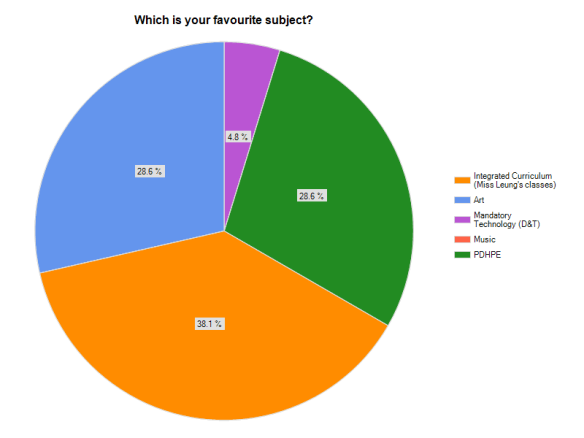
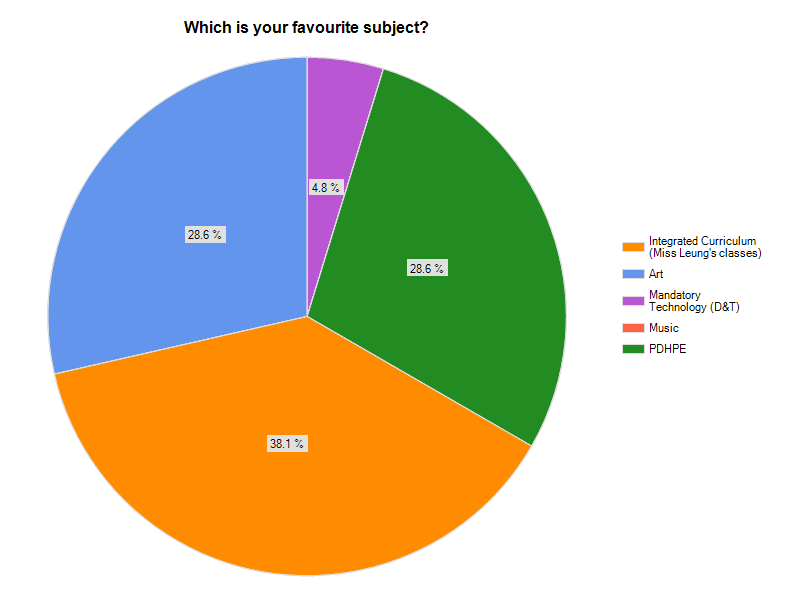
A pie chart of Year 7's favourite subject

I’m going to conclude by just saying it takes a lot to beat PDHPE as students’ favourite subject.

Reasons why integrated curriculum is their favourite subject

Below are some of the responses from students who chose integrated curriculum as their favourite subject:

Because we get to have fun in those classes and do interesting stuff.


The experiments we do and how all the subjects are put into one class.


It involves technology.


There are so many opportunities to do fun activities and showing people my work.


Some of the major themes from this question are that students find integrated curriculum classes “fun”. They also like using technology such as laptops and tablets for their learning, as well as having 5 subjects embedded into one class.  Some students enjoy having their work showcased on the class blog.

Rate how much you enjoy the following activities
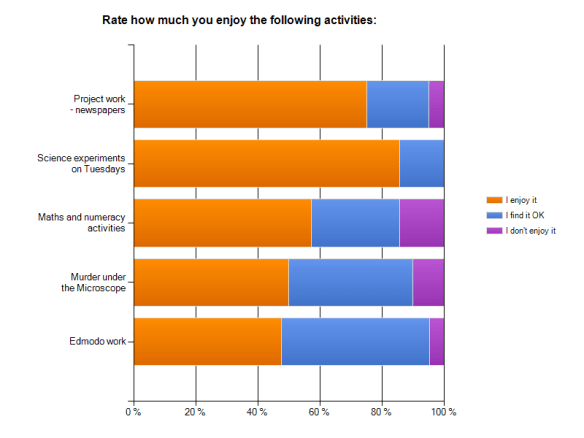
A sector bar graph showing year 7's enjoyment rating of different activities

Rate how much you learn from the following activities
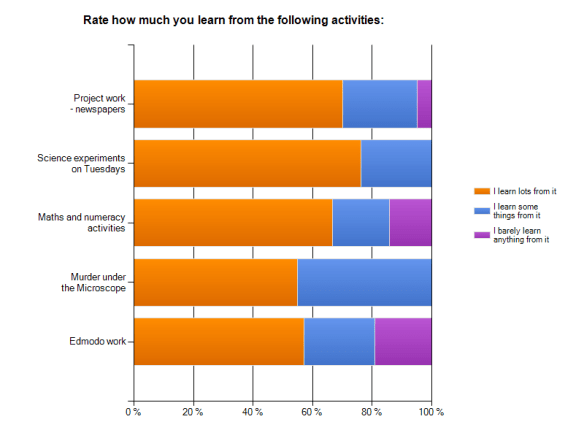
A sector bar graph showing how much year 7s learn from different activities

What are 3 things you have learnt from the newspaper project?

 A word cloud was created for students’ responses to this question where the larger the word in the word cloud, the more frequent that word appeared in the responses.

A word cloud showing what students have learnt in the newspaper project

List 3 things you want to improve on next term.

This term was the first time students wrote features of effective team work for their improvements for the following term. In previous end-of-term evaluations, students often listed relatively superficial things they’d like to improve on such as write faster or finish work faster. For this term’s evaluation, the majority of students listed features of team work skills such as listening to other students, working as a team and self control. Many students also identified specific areas of content they’d like to improve on such as algebra or types of scientific variables. This is in contrast to how they listed their improvements in previous evaluations where many students wrote umbrella terms such as numeracy or literacy.

For me, this shows an increased level of maturity in the way they assess their learning. While I can’t attribute the cause of this change to any particular strategy I’ve used, I do have a strong feeling it is to do with the goals, medals and missions structure of providing feedback in their PBL tasks and also their weekly reflections on their revision quizzes. Over a term I think most Year 7s have increased their self-awareness of their own learning.

What have I learnt?

For most of this year I have been experimenting on strategies on guiding students to become more effective learners. The PBL initiatives, the goals-medals-missions structure of feedback, the weekly revision quizzes and weekly reflections of learning have all been things aimed at allowing my students to further develop into effective learners. While I always knew that features such as working together and being self-aware of your strengths and areas for improvement are equally important as understanding subject-specific concepts, I think teaching my Year 7s for 5 different subjects have really made that clear to me. When I think back to how I structure my learning in previous years for my science classes it has always been more focused on content rather than developing students into effective learners. When I do eventually return to teaching science classes only, the way I will structure learning for those classes will be very different to how I used to structure them. Teaching an integrated curriculum has so far been one of the best professional learning I’ve had.

Using technology to enhance the learning of scientific language

I have always found teaching the separations topic in year 7 science difficult. This is the topic where students learn a range of separation techniques like sieving, filtering, evaporation and distillation. Students have to be able to explain how this separation techniques work based on the physical and chemical properties of substances, which at times involve them having a good understanding of particle and atomic theory. One barrier to this topic is the large amounts of scientific technical language. Students have to know the definitions of these words and know how to use them in their scientific explanations – solution, suspension, solute, solvent, dissolve, soluble, insoluble. These words are just a small proportion of the entire list of terms students are expected to learn.

So with my Year 7s this year I decided to test out how online tools can help make the learning of these words easier and more effective for students. Previously I’ll use a lot of literacy strategies like barrier games, spelling games and concentration games to give students lots of practice at using the words. This year I decided to do it a little bit different. Here’s what I did.

1)      Introduce the need to separate mixtures in the context of obtaining clean, drinking water by using an adaptation of the river story.

2)      Students played a game to learn the definitions of solution, suspension, solute and solvent using Student Response Network. These PowerPoint slides were used to play the game:

3)      Students then performed an experiment to have hands on experience on solutes, solvents, suspensions and solutions.

4) Students then used a science dictionary to construct a table of terms and definitions.

Excel illustrated science dictionary

4)      Students worked in groups using the table of terms and definitions to create multiple choice questions for each term via testmoz.com. Each group uploaded their quiz for the rest of the class to complete. I chose testmoz.com because it is easy to use for Year 7s, doesn’t require registration of any sign up and it gives students a URL to share their quiz with others.

I found that this sequence of activities exposed students to these terms multiple times without being too repetitive. In their weekly tests, this group of year 7s have grasped the definitions of these terms and are able to use them in a scientific context more readily than other groups of year 7 classes I have taught previously.

Learning from failure

My Year 7s had a go at designing their own experiments this week.  Year 7s were designing experiments to compare their reaction times. As an introductory activity, we did the classic ruler reaction time test, where students had to catch a falling ruler as fast as they can.

They then worked in groups to design an experiment to compare the reaction times of two groups of people. They had a choice of comparing the reaction times between teachers and students, students who play sports often and students who did not; or boys and girls.

For some reason, all groups except one decided to do experiments that had nothing to do with the ruler reaction test. These groups had variations of a method of throwing balls at test subjects without warning and counting how many times the each person catches and misses the ball. Their method designs were quiet creative but very complex and required very efficient team work. And this class does not have the team work skills to pull it off.

I knew that some students will fight to be the leader of the group; some students will not listen to the instructions from other students; and other groups do not have a common understanding of the method amongst all group members that it will result in the experiment falling apart. Now usually I will say no to the experiment design. I would force them to go back and re-design their experiment. I might even force them to do the ruler experiment instead. I would explain to them that they need to choose a leader in their group and have roles assigned to each group member. I would go to lengths to avoid the potential chaos that was about to happen.

But this time I didn’t do it.  And yes, chaos followed and all my predictions were correct. There were groups where multiple students were giving instructions so overall no one knew what to do. One group had one student becoming extremely frustrated, yelling “No one is listening to me!”

So yes, the experiment was a failure. A lot of students went back to the classroom feeling defeated. They knew they have failed to achieve their goal. They don’t like to fail.

But that was what I wanted them to do – fail. I knew they had lousy team work skills. However, instead of me lecturing them on the importance of effective team work before they headed off to do their experiment, they experienced first-hand what ineffective team work feels like. When we returned to the classroom, we had a debrief activity where students identified what went wrong and what they would do next time. The effective team work elements came from them rather than me. We also discussed the emotions associated with failing. I knew some of them were quite upset because they couldn’t do the experiment the way they had planned it. We discussed the importance of acknowledging those emotions and that it is OK to feel that way. As a class we then agreed that we can feel sad for a little while, but we need to go back and try again because if we don’t, we will never be able to achieve the goal.


This whole activity reflects some elements of gaming. In a game, the game doesn’t tell you what you exactly have to do to win the game. You start playing, you fail, you work out what you did that made you fail and not do it again. In games, players go through a repeated cycle of fail, learn and re-try. Even if you succeed, you can re-play that level and work out how to improve your score.

So why doesn’t this cycle replicated at school. Students often feel the need to master the understanding of a concept or skill straight away. Schools often don’t allow opportunities for students to fail. There is a pressure for students to succeed the first time. When students do an exam, they don’t get to re-sit that exam and show what they’ve learnt from it. When students complete an assignment, they don’t get to re-do that assignment to improve on their previous performance. It’s like school is setting up students to rage quit.

When playing games, players go through the cycle of fail, learn and re-try many times. This leads to risk taking, trial and error and persistence – skills that many teachers want their students to develop. It also allows students to develop resilience. Students need to be able to bounce back from their failures, self assess what they need to do differently and be aware of what their strengths and weaknesses to turn the failure into a success.

So let your students fail. Teach them how to fail. Teach how to bounce back from a failure.


You don’t create groups on Edmodo. You create learning communities.

You don’t create groups on Edmodo, you create learning communities

I have been using Edmodo as an online learning tool for a little over 1.5 years now. Back at the beginning, I viewed Edmodo as an easy way to post content for my students online, for students to submit their work online and for me to send my students urgent important messages outside of school hours. The way I used it was very one way – teacher to student. The first Edmodo group I set up was for a Year 11 Physics class. When I analyse that page, almost every single post was made by me. Most of these posts have no replies. There were a small number of posts made by students, which were questions directed at me as a teacher and I answered them. This group wasn’t a learning community. It was just a website that had information posted by me.

This year I have been using Edmodo with my Year 7 Integrated Curriculum class, which I teach for English, Maths, Science, Geography and History. Our Edmodo group page looks very different to the year 11 page. Firstly there are heaps of posts, probably 5 times as many posts as the Year 11 Physics group. And most importantly, a significant number of those posts are made by students.

I went through the Year 7 Edmodo page and categorised all posts made in August 2012 and here are the stats:

  • There were 71 posts during this month
  • 46 out of 71 posts were by me
  • 25 out of 71 posts were by students
  • 62 out of these 71 posts involved a discussion
    • This means that these 62 posts had more than one reply comment. These reply comments included students commenting on each other’s work, answering each other’s questions or holding a discussion that was of interest to them
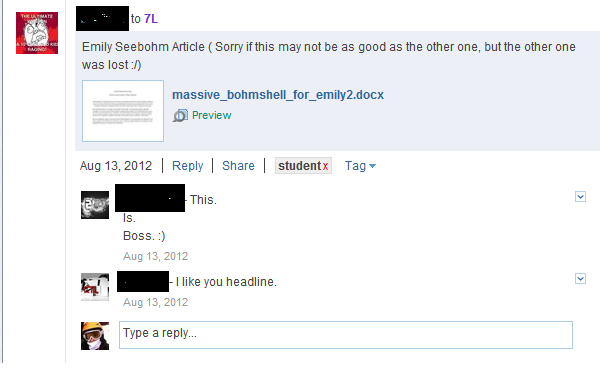
Students sharing and commenting on each other's work on Edmodo

Students sharing and commenting on each other’s work on Edmodo

Students sharing and commenting on each other's work on Edmodo

Students sharing and commenting on each other’s work on Edmodo

For me this year, Edmodo has transformed from a free alternative to a learning management system to a tool for enhancing a learning community. It is an online space that allows my students to learn from each other beyond the four walls of the classroom and beyond 9am to 3pm. The Year 7 Edmodo group is a much more dynamic and successful learning community than my previous Year 11 group. Why?

Just do a search in Google for creating a successful online learning community and most sites will give you very similar tips.

  • An online community is like a traditional community, built on shared qualities, characteristics and purpose.
  • A successful online learning community must create value for its members. The online community must be worthwhile for its members to visit regularly.
  • Individuals must be supported and empowered to share their knowledge, information and user-created content. A successful learning community must have a majority of members sharing ideas and content that is of value to that community.

So how did I ensure the above three features of the Year 7 Edmodo group this year?

Shared qualities, characteristics and purpose

Year 7s knew from the start of the year that the group was for them to share their learning. While they also post their homework on there too, one of the first things I did was to have them share a summary of a news item of their interest (most reported on NRL pre-season news) and reply to another student’s post with something they have learnt from that student’s posts. Questions asked by students were answered very quickly by me, which assured students that Edmodo was a worthy tool for communication. This set up a sense of shared purpose for the Edmodo group very early on.

Creating value

One of the ways of creating value in an online community is to allow users to personalise the space. For my Year 11 physics group, I gave them the Edmodo group code and went from there. I didn’t spend time to let them set up their profiles and change their profile pictures. For Year 7s we spent an hour setting up their Edmodo accounts, filling out their Edmodo profiles and choosing an avatar that most represented them. This was done in the second lesson of the school year. So straight away Year 7s was given an opportunity to value Edmodo; this opportunity was not given to Year 11s.

Support and empowerment

Year 7s often post things up that are not 100% related to our school work. Posts like personal art projects they have done, their successes in weekend sport, their views of internet censorship and the death of Niel Armstrong. I actually don’t know why my Year 7s feel empowered to share things they have created or news they think are worthy for their classmates to know on Edmodo. This started very early on in Term 1. Perhaps because their early activities on Edmodo was all to do with sharing their personal interest projects and news. Perhaps in our face to face classes we emphasise on sharing our learninh artefacts. Whatever the impetus is, I hope it stays there because it is one of the strongest driving forces of our learning community.

Note that the above features of successful online learning communities are all related to how people relate and interact with each other and how they emotionally connect with the online space. How come this is rarely discussed in professional dialogue associated with such online tools? I think teachers often do misjustice to educational social networking tools like Edmodo when we promote it to other teachers in professional learning or in conversation when all we talk about are how Edmodo allows students to complete self-marking quizzes. These are all excellent tools for learning but rarely are our conversations and professional learning about the dynamics of human relationships in such online environments. Yet it is these intricate dynamics of human relationships and interactions that would make or break an online learning community. Unless these are made explicit for teachers about to make the online learning journey, we are almost setting them up for failure. It doesn’t matter whether teachers are using Edmodo, Moodle or any other online learning community tool, we must talk about human relationships and interactions.

Learning with mobile phones

This sign is the type of sign that many schools have in relation to mobile phone use by students at school.

a sign showing mobile phones are banned

While mobile phones can cause distraction to students’ learning, they can also be a powerful learning tool, and I’m not talking about using educational apps or educational apps. Mobile phones can be an extremely powerful tool for students to demonstrate higher order thinking skills, which a colleague and I presented at the NSW Secondary Principal’s Council conference.

Mobile phones are a high quality camera

A lot of students now have a smart phone (iPhone, Android, Windows phone). These are also high quality cameras for still photos and video cameras. Never in the history of education can a teacher walk into a classroom and have almost a 1:1 ratio of high quality cameras at students’ fingertips to create learning artefacts.

As an example, my Year 7s were learning about magnetic forces last week. Typically such a lesson will involve a practical activity with bar magnets, followed by some comprehension questions. Instead of getting my year 7s to answer textbook-style questions to show that they understood magnetic forces (which they did for homework), they made a photostory to show what they have learnt. They had to take photos of their experiment and insert captions to show the properties of magnetic fields. They used their mobile phones to capture the photos and used Windows Live Movie Maker to create the photostory.

This teacher-led explanation, the practical activity and the creation of the photostory was completed in under 2 hours.The photostory isn’t intended to be a high end production. The photostory acts as a quick creation for students to show their understanding. One of the photostories is shown below. Minimal editing was involved and the photostory was used as a stimulus for a class discussion on magnetic forces.

What will your students do with their mobile phones?

Can you see the thousands of dollars?

My year 7 has had laptops now for a few weeks. The class received 12 laptops, which is a costly investment. A colleague once wisely said if that much money was spent you should be able to walk into a classroom/school and notice a difference. You should be able to visibly see that investment’s impact on student learning. So I asked myself exactly that question – Is the learning different in my classroom now? Is the learning better in my classroom now?

I’d like to say yes, and here’s my evidence:
-Students now use their laptops in small groups to demonstrate their understanding, often with higher order thinking skills. Today we explored the properties of magnets. Instead of doing the prac activity from the textbook and writing a prac report, students made a photo story to explain to other year 7s the magnetic properties they have discovered. This took 2 hours. Minimal editing was involved as I wanted the students to focus on the explanation of science, not on fancy video transitions.

-Laptops are used to differentiate learning. Year 7s have been learning about area of composite shapes and expressing area and perimeter through algebraic expressions. Students had to self assess whether they needed more practice in composite shapes or were ready to move onto algebra. Students who selected to refine their skills in composite shapes worked on a self-marking quiz on the laptops while the rest had small group instruction on algebra.

These are just 2 activities where laptops have enhanced learning. When you walk into my classroom, you can see, hear and feel those thousands of dollars making an impact.

Are your thousands of dollars of investments visibly making a difference?

20120821-222310.jpg

20120821-222357.jpg

Saying goodbye to the computer room

On Friday I said goodbye to the computer room. The computer room that I have been hogging for at least 4 hours a week since the start of the year. I have spent so much effort making sure I made books as advanced as possible for that computer room so that my Year 7 integrated curriculum class can use it. I felt guilty every time I did that. My students needed to use it, but I also felt as though I was removing a shared resource from other students and teachers. Having taught in a 1:1 learning environment for the past 3 years, teaching only Year 7s this year, where they were not entitled to their own laptops as part of the Digital Education Revolution, really killed me. I was so used to designing learning using collaborative spaces like Edmodo that it felt like all that was taken away from me in the first two terms this year.

However on Friday August 3, my Year 7s received a class set of laptops as part of our school’s middle years strategy and our connected learning strategy. Year 7s received 12 Lenovo Thinkpads, which makes the official laptop to student ratio in my class 1:2.5. The real ratio is 1:2 as some students bring their own devices.

For some people I have talked to, they found it strange that I’m so excited about getting 12 laptops when a computer room offers 20 computers. I would rather have 12 laptops in the classroom than 20 desktop computers that are bolted in a room because:

  • For my Year 7 integrated curriculum class, we used computers mainly for project based learning. So far we have made infographics, science videos and built Parthenons in Minecraft just to name a few. For these projects, students are required to do a mixture of activities that require technology and activities do not require technology. A lot of the times, some students are on computers and other students are working in another area as they are discussing their project or that part of their project does not require a computer. My students will choose the tools that best fit their learning needs at a particular time. Laptops in the classroom do this so much better than computer rooms.

  • Computer rooms are often restrictive learning spaces. They are often built where the only thing you can do is go on computers for the entire lesson. We have 4 computer rooms at the school and I only ever booked one computer room. That’s because this particular room allowed students to spill out into an adjacent area with couches where they can have discussions about their learning rather than being squashed in front of a computer for hours at a time.

  • Having laptops in the classroom allows more flexibility in learning design. Laptops allow the learning to drive the need for technology, not the other way around. When laptops are in the classroom you can use them for lengthy periods of time or in short bursts, depending on the learning need. When computers are fixed in computer rooms, you need to make sure that the whole lesson requires the use of computers so that you’re not wasting the computer room as a resource. You don’t want to book into a computer room if the learning only requires students to be using computers for 15 minutes out of a 60 minute lesson.
  • Laptops in the classroom allows anytime, anywhere learning. If there is a need, my Year 7s can jump on a laptop to go online, to watch an animation that explains a concept, etc. My Year 7s can take their laptops anywhere in the school. They can use it to connect their data loggers to measure features of the environment and they can enter data into a spreadsheet when we are using an outdoor space. If they need to go to a quiet space to record audio, they can take their laptops to that quiet space rather than trying to do so in a computer room with 29 other students. Laptops not only allow learning to drive the need for technology, but it also allows learning to drive the need for a particular style of learning space.

Finally I really hate the concept of computer rooms. To me it’s like going into a calculator room to use a calculator, or a pen room to use a pen. Technology is part of our daily lives now that we shouldn’t have to move to a specialised space to use it. Unless you are doing some hard core 3D animation that requires a high end computer, there should be no need to move to a computer room.

So on Friday my Year 7s and I waved goodbye to the computer room. I have been waiting for that moment for the whole year.

Action learning with Minecraft – Cycle 1

Last term I decided to undertake an action learning project to see whether using feedback will improve students’ self regulation skills in project based learning. This came from my observations that some of my  Year 7 students, who work well in traditional, teacher-centred learning activities, displayed a lot of off-task behaviours in project based learning, which included being not staying with their teams, constantly changing their minds about their projects and other actions, which resulted in a very low-quality learning artefact being produced (see my previous post for more details). This happened in their 60 second science project, where they worked in teams to create a 60 second video on an astronomical phenomenon. Their latest project was to create a model Parthenon in Minecraft where the architecture followed the golden ratio. This project was broken into 4 stages where each stage had a goal and students and I had to assess on how well they have achieved their goal in the form of medals and missions.

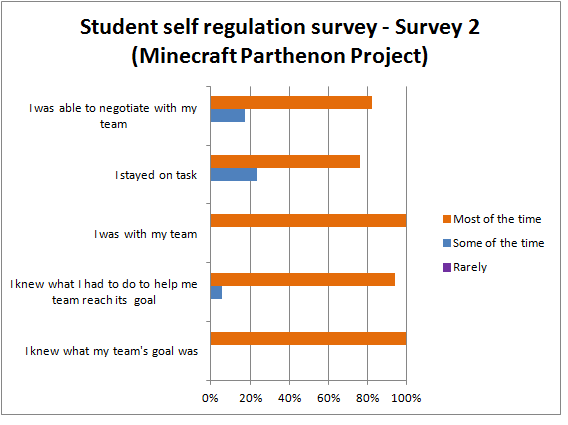
Based on informal classroom observations, more students were on task than the previous project. From their survey data, more students said they knew what their team’s goal was, knew how they could help their team achieve that goal, stayed with their team and were on task.

Note: The first graph shows the survey data from the 60 second science project while the second and third graphs show the data from the Minecraft Parthenon project. (Sorry, the categories have been listed backwards in surveys 2 and 3.)

student survey results for self regulation

shows the data from the Minecraft Parthenon project

shows the data from the Minecraft Parthenon project

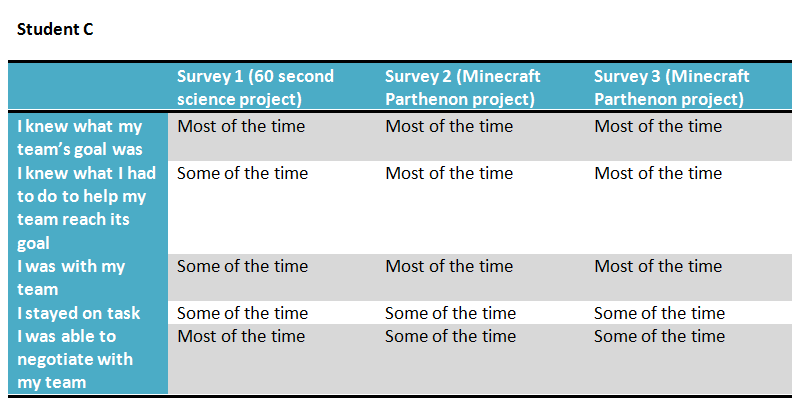
There were also selected students who struggled with self regulation skills more than the rest of the class in the 60 second science project. Let’s call them Student A, Student B and Student C. When I compared their data, this is what it showed:

student A's survey data over time

student B's survey data over time

student C's survey data over time

When I combine the students’ survey data with my own classroom observations, I can conclude that these three students have worked a lot better during our project sessions. They weren’t “perfect” though, but they did improve. I did see them looking up their own houses on Google Maps a few times while they were meant to be working on their Minecraft Parthenons.

However, I don’t think I can just conclude that giving effective student feedback will cause students to have better self regulation skills in project based learning. There were some major differences between the 60 second science project and the Minecraft Parthenon project:

  • Duration of the project – The 60 second science project lasted 8 weeks while the Minecraft Parthenon project only took 3 weeks. Students might work more effectively in shorter-duration projects.
  • General appeal of the project – While the class in general enjoyed both projects, there was a more heightened excitement about using Minecraft. The games based learning aspect might have affected students’ work ethic. Many students are also very familiar with Minecraft, while the 60 second science project involved students learning and applying unfamiliar concepts such as scripting and storyboarding.
  • Structure of the projects – The 60 second science project involved students working in a range of learning spaces. At any one session, some students were in our main classroom, some students were in another classroom to film, some students were in another classroom so they can record audio. This created a slightly chaotic atmosphere even though it was organised chaos. In the Minecraft Parthenon project, all students were on the mezzanine level of the library. For students who are easily distracted, such an environmental difference might also affect their ability to self regulate.

I’m now coming up to cycle 2 of my action learning project. The next project will involve year 7s creating their own newspapers to report on the London Olympics. I’m staying with feedback and self regulation but will make a few changes to the way data is collected:

  • Student surveys will have additional questions that ask them how well they understood the feedback and how well they know how to act on that feedback
  • Observations from other teachers – I’d like someone else to come into the class and observe Student A, Student B and Student C as well as the rest of the class and note what they are doing at what times of the project session

Cycle 2 will begin in week 2 of Term 3 so watch this space for updates. Also watch this space for updates on how my team of science teachers have been using action learning to improve student learning in science at our school.

Let the games begin!

The London Olympic games will be starting on July 27. My Year 7 class will be studying a unit of work based on the Olympics that combines English, Maths, Science, Geography and History. So when I saw the Xbox game London 2012, I couldn’t help but test it out and see whether I can incorporate games based learning into parts of the unit.

London 2012 is available on Xbox and Playstation 3. On the Xbox some games are also able to be played via the Kinect motion sensor. Players can compete in over 45 Olympic events including track and field, swimming, archery, gymnastics, cycling and diving.

cycling in london 2012 game

I tried the events with both Kinect and the controller. I found the controller much more enjoyable. While some reviewers have said that using the Kinect gave the game more of an authentic feel, I would disagree. For example in the spint events, there is no need to run. All you need to do is to wave your arms wildly.(This is possibly because the game is also designed for Playstation Move, which can’t detect whether your legs are moving or not.) The KInect is nowhere sensitive enough to play table tennis properly (the ball sort of flies through the middle of your body). Archery was quite fun on the connect. If you want to play the events with Kinect, I find that Kinect Sports is much, much better (and cheaper the moment).

There were some events that were really enjoyable with the controller. I particularly liked trampoline and gymnastics, which required you to perform different routines based on pressing different combinations of buttons. Kayaking, weightlifting and shooting were also very good.

The game does have a lot of detail and gives an authentic Olympic feel. You can choose to play as different countries and when you win a gold medal, a shortened version of the national anthem plays. Each event is played at the real location of the London Olympics.

Overall, the game is OK. If your class is doing a unit on the Olympics in Term 3, it is a quite good game to use as a hook for your class. However, I find Kinect Sports to be a much better game. If you already have Kinect Sports, it might not be worth getting the London 2012 game as Kinect Sports‘ game play is much more sensitive and intuitive, cheaper, and will have a longer lifespan. Kinect Sports also has lot of the same track and field events, and in Kinect Sports, you actually need to run in the running events.

Kinect Sports game cover

 Games based learning activities using London 2012

If you are thinking about getting London 2012 for your classroom, here are some games based learning activities;

  • Experiencing unfamiliar sports

Students can play sports that they may be unfamiliar with like the different routines in gymnastics and trampolining. Students can describe how these sports are judged. This can also include the venues that the sports are being played in.

  • Science of angles and wind resistance

In javelin and discus, players are required to throw at an optimum angle in order to achieve the maximum distance. In archery, wind resistance plays a part in how you aim the arrow. Learning can be designed where the London 2012 game can be used as a launch pad into more discoveries on projectile motion and wind resistance.

  • Evaluating the authenticity of the events

Most events require players to time their button pressing. For example in swimming you have to time when you press particular buttons so that it simulates smooth strokes. In sculling you have to press the buttons at the right time and maintain a consistent rhythm to gain speed. Students can learn about the techniques used in each sport and evaluate how well the game has tried to replicate that.

  • Use the game as a stimulus for students to create and host their own mini Olympics games

The London 2012 game will give students the experience to learn how different sports work and they will be able to choose their events for their Olympics, create a schedule and create processes for judging.

There are heaps more ways to integrate games into Olympic-themed learning experiences. What are your ideas?

Project based learning in an integrated curriculum – students’ perspectives

As Term 2 draws to a close I have surveyed my students again on their perception of classroom learning. I regularly gather and analyse feedback from my students in order to inform my future directions in designing their learning activities. Every week my students complete a “Reflection of my learning” survey and at the end of each term they complete a survey where they evaluate the teaching and learning of the term.

a screenshot of the reflection of my learning survey

This term has been my second term teaching an integrated curriculum class. I teach just one Year 7 class this year. I have this class for English, Maths, Science, Geography and History. This means that lessons often have content from a mixture of KLAs. This is a middle years initiative my school is implementing for the first time. The aim is to allow a smoother primary-secondary transition and to implement best practices in teaching and learning for middle years students.

Over the last two terms, I have also been experimenting with project based learning. My Year 7 class work on long term projects where on two hours every Monday and Friday, they work in teams on their projects. Our two latest projects are the 60 second science project (a combination of Science and English) and the Parthenon Project (a combination of History and Maths). In these projects, each team work at their own pace and they have choice over certain aspects of the project such us the method of presentation, the content, etc. To see some work samples from these projects, visit our class blog.

So what do the students think? Here are the main themes from the results:

Integrated Curriculum is most of the students’ favourite subject. (Note that in Term 1 PDPHE was most students’ favourite subject)

A pie graph showing students' favourite subjects

The reasons cited by students for Integrated Curriculum being their favourite subject followed several themes, which were:

  • Having learning activities they thought was fun and interesting
  • Having an enthusiastic teacher who makes the class fun and interesting
  • Students noticing how they improved – We have been implementing the goals, medals and missions model of feedback over these two terms. I don’t give out marks or grades.
  • Project based learning – Students mentioned how they liked having more freedom and choice over the way they presented their learning in these projects. One student mentioned that most lessons are about getting “the right answer” while she is able to express herself more creatively in projects
  • Learning different subjects together
  • Doing science experiments – The most interesting thing from this was that students mentioned how they enjoyed doing experiments where they did not know what will happen. They also mentioned how they liked experiments that allowed them to see changes overtime. We have been doing a lot of science experiments where the content was a mixture of science and geography. They were environmental science activities from Murder Under the Microscope where experiments required observations over several days. Students did not mention they enjoyed science experiments because they involved explosions or flames, which are often mentioned by students in previous year groups.
Students were also asked how much they enjoyed particular types of learning activities and how much they thought they learnt from them. The top three activities that students enjoyed learning were also the activities they felt they learnt the most from.
bar graph showing students' enjoyment of activities
bar graph showing how much students thought they learnt from different activities

When asked in the survey whether they would like to continue project based learning in Term 3, 100% of students answered yes. In my observations and conversations with students, they clearly enjoy project based learning and are on task most of the time. From my observations they are also learning important skills in self-regulation, time management and team work, which will become increasingly important in their later years of high school. From my conversations with students, many of them often say Mondays and Friday’s are their favourite days because they have “project time” and they get very disappointed when I have to sometimes move their project sessions to different days due to learning spaces and resources being booked out.

So where to now?

Well for one thing, I really want to lead my faculty in using data such as these weekly reflections and surveys to drive future directions in teaching and learning. I have found the weekly surveys to be an invaluable source of information to inform my teaching. Yes they take a long time to analyse but I have felt that my own teaching has improved massively because of it.

I am also going to continue project based learning. PBL has been a highly stressful experience at times (see my previous posts). Students enjoy doing them and feel they are learning lots from it. Their formal assessment results also show they are achieving highly as well. So it’s a win-win situation 🙂

I find it interesting that the results show such a positive response for science. There is a trend for students in Year 7/8 to lose interest in science. Many science teachers think that students need to be engaged through explosive experiments. My Year 7s’ survey responses show a different story. They liked experiments which were long term and where they did not know the results before doing the experiment. This data will allow us to better design science learning for our other students.