What to do when you’re stuck

I’ve been getting quite a few requests for the “What to do when you’re stuck” posters that I mentioned in my previous post. These posters were created in Canva with the help of Pip Cleaves and Jane Logan. They’re a take on “Ask 3 Before Me” and “C3B4ME” The purpose of them is to enable students to independently think and solve their own learning problems BEFORE asking the teacher for help. I have placed them in a prominent place in my classroom and will be constantly referring to them this year.

The posters are licensed under a Creative Commons Attribution-NonCommercial-ShareAlike 4.0 International License.

My #EduGoals for 2016

In many areas of Australia, the new school year is about to start. In the state of New South Wales, many schools return this week. As the new school year beckons, I’m like many teachers who are thinking about their educational goals (EduGoals) for the new year. Here’s my 3 EduGoals for 2016:

1. Using learning spaces to further enhance teaching and learning

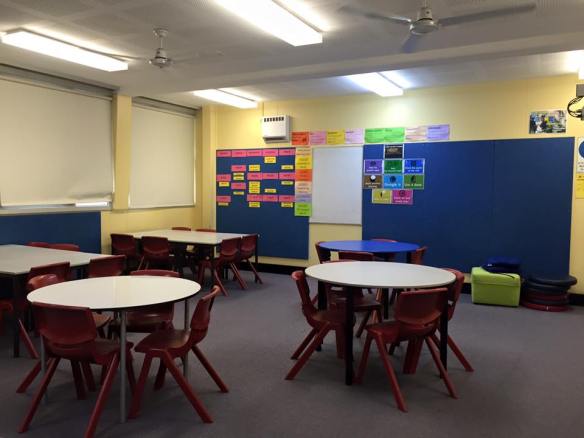
classroom

My classroom this year

Last year I was very lucky to have received a bunch of more flexible furniture from John Goh. To put things in context, I’ve always been very lucky to have a “nice” learning space. The science lab I’m in was only refurbished in 2010 so my classes and I have always worked with new furniture. However, when I began my project based learning journey in 2012, I realised that the standard two-seater rectangular tables were no longer working. Students wanted a space where they can easily transition from whole-class instruction/discussion, to small group work and to individual work. The space, as it was, was very effective for whole class instruction, but not for small group work where students needed to collaborate and often worked on different projects at different paces. For the next few years, students spilled out into the hallways, took up nearby classrooms if they weren’t being used and even moved out into the quad in order to work on their projects as a team.

I’m hoping that with this new set up, more space is created. John enlightened me last year when he told me that it’s not about furniture, it’s about space. For a long time I’ve always looked at how to get round tables or pac-man shaped tables so that 30 students can have their own desk. It isn’t about that. It’s about creating space to learn. At the moment there’s only enough table space for 24 students. However, students can sit on the floor or move over to the “wet” area of the lab where there are standing desks. I gave away lots of my original furniture in order to do this. I think I still need to get rid of more.

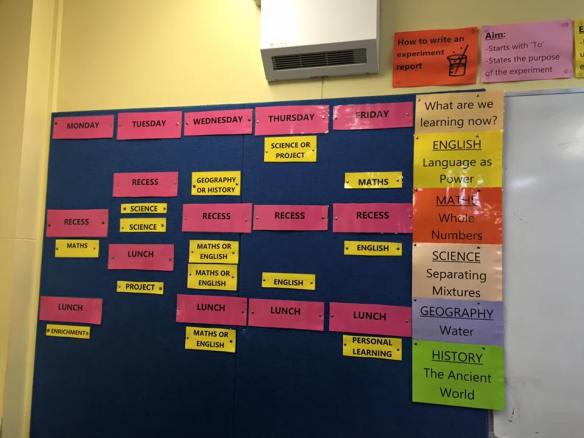
I’m continuing to ensure the walls of the classroom is used for learning. I visited a New Zealand school a few years ago where the teacher said: “Anyone, doesn’t matter if it’s a student, teacher, parent or someone else, should be able to walk into a classroom and know what the class is learning and doing immediately without asking anyone.” I haven’t used my classroom walls for “decoration” for a few years now. The walls are filled with our learning routines, our “topics”, current projects, relevant learning strategies and displays of student work.

stuck posters

Posters of strategies to encourage independent thinking and problem solving

classroom wall

Timetable and posters showing current topics for different key learning areas


2. Using technology to further enhance teaching and learning

Last year, I played around with OfficeMix. I really like how it is an addition to PowerPoint and can create videos that work across all platforms. This year I’m going to be using OfficeMix to create a flip classroom for maths. I’m planning to have students sign in so that I can get analytics and use that to inform my future practice. I’m also going to get back into OneNote. I’ve been following the work of Pip Cleaves in how she is using OneNote to create staff and class notebooks. I’m keen to see how it can work for me, my faculty, my students and my school.


3. Using video to improve my practice

Classroom observations is a key strategy in teachers reflecting on, and further improving on their practice at my school. I’d like to step it up this year and include video analysis when a colleague observes me. Having a video recording to look back on would seem to enrich the feedback from the colleague in the post-observation meeting. I know video analysis of teacher practice is done regularly at some schools and I’d like to try that personally.


4. Finding work/life satisfaction

Last year was my first year of full time work after returning from maternity leave. My baby is now 18 months old. Being a parent and a full time teacher plus a leader is challenging. My online PLN often talks of work life balance. However, Jason Borton said to me on Twitter that he calls it “work/life satisfaction” and not “balance”. I really like the term “satisfaction” than “balance”. To me, balance is more quantitative. Something like ‘I must spend equal amounts of time doing work, spending time with my family and doing things I enjoy.’ On the other hand, “satisfaction” seems more qualitative to me. ‘Am I happy?’ “Satisfaction” is also more personal. Work/life satisfaction is different to each individual and it doesn’t have to be 50/50 all the time.


baby V

Baby V

YES TV – a student-led live stream on YouTube

This week a team of of my students ran their own live stream on YouTube called YES TV. YES TV (Youth Eco Summit TV) was a live stream from the Youth Eco Summit. This summit allows students and teachers to to gain first-hand experience at how to be more sustainable at school and in their everyday lives. YES TV was an one-hour live stream on YouTube where students interviewed participants at the summit so that a global online audience can also learn about sustainability.

YES TV was a massive risk in learning for me and my students. It was one of those “say yes, then learn how to do it later” projects. YES TV was essentially a live TV talk show that students ran almost all by themselves. I have zero experience at running a live TV talk show. The students also had no experience. However, it was one of the most authentic learning experiences for all of us.

Firstly YES TV showed me and the students that we can push the boundaries and take on a challenge. So what if we didn’t know how to run a live TV talk show. We can learn how to do it. I applied everything I learnt from being in the audience of a live show called QandA a few years ago. We watched breakfast news TV clips on YouTube to learn how hosts improvise based on the guest’s responses to their questions. We devised and assigned roles. There were 2 anchors, 3 interviewers, camera operator, “audio person”, a student who held up signs like “hurry up” and “ready for next guest”, students who monitored social media feeds for online questions, a student who held up a mini whiteboard telling the on-camera crew who the next guest was, “runners” who were in charge of organising guests before they went on camera. And then me. I had no idea what my roles were called but I decided which guests were on next according to the schedule and told the kids with the signs and whiteboard what to do. These roles are probably nothing like the roles in a real live TV talk show but we pulled it off and it worked for us. The students and I were in awe that we did pull it off. YES TV proved to all of us that passion, initiative and determination enable us to rise to any challenge.

YES TV was also an authentic experience for students to learn job-ready skills. The actual live stream for YES TV was 2 hours. But a lot more other hours were spent preparing for it and this included liaising with the guests on YES TV. Students learnt how to make phone calls in a professional manner to YES TV guests (I modelled this to them first by having my phone on speaker) and writing professional emails. This might not sound like much but many students don’t know how to do these things and they’re often not taught in traditional subjects. Students involved in YES TV mentioned how they appreciated learning how to write and respond to emails in a professional manner, using formal language.

Finally for me as a teacher, YES TV provided validation for me to continue to push the boundaries and to continually seek out new learning opportunities for my students.

Speak up – #MentalAs

This week is Mental As Week on ABC TV. For those who don’t live in Australia, it is a week where Australia’s national broadcaster focuses on mental health and wellbeing and it coincides with World Mental Health Day on October 10 2015. In the spirit of raising awareness of mental health and wellbeing, I’m going to share my story.

Me and Baby V
I have always been a “worrier” since I was a kid, but being a worrier didn’t really impact on my life until I had my baby. Baby V was born on July 2014 and I have previously blogged about her. My worrying felt like it exploded exponentially after she was born. Is she getting enough sleep? Is she getting enough milk? Am I breastfeeding her correctly? Is it OK if she falls asleep in my arms rather than on her own? On top of this was my expectation to continue my pre-baby life, and in the first few weeks of Baby V being born, I did. When she was 3 weeks old, I went into school for Project Mars. I had Skype meetings. I worked on units of work for the new syllabus. I also was not used to the unpredictability of a newborn baby. I placed a lot of pressure on myself to make sure that I was doing it “right” for Baby V and to continue working in the same way as I did before she was born, to the point where I wasn’t taking care of myself. This all built up for about 3 months and that’s when I started having trouble sleeping. There was 5 nights in a row where I could not sleep even though Baby V was sleeping. That’s when I was encouraged to see a worker from Tresillian (an organisation that supports families in the early years of their child’s life), who then referred me to see a psychiatrist. I was not diagnosed with anything clinical and I only saw the psychiatrist once. However, from this process I learnt about mindfulness and it led to me taking an online course from Mindspot for managing anxiety. The course taught me strategies to manage anxiety and how to look after myself, something I have neglected to do way before Baby V arrived.

I’m sharing this story because I want to build on the current momentum that issues associated with mental health and wellbeing should NOT be stigmatised and needs to be discussed in the same way as physical health. No one will bat an eyelid if someone says they have sprained their ankle, but too many people still see mental illness as a weakness. Mental health is no different to physical health. However, people are often hesitant to raise issues with their mental health because of the stigma. People are hesitant to seek help because they think they should be able to deal with it or get over it themselves.

Cartoon showing if physical illness was treated like mental illness

I am also sharing this story to emphasise the importance of teaching people on strategies of taking care of themselves and how to deal with difficult times. We are taught how to look after our physical health. We are taught about nutrition, dental care, exercise, etc. We also need to learn how to look after our mental health. We need to learn about strategies like mindfulness so we have a toolkit of strategies to use when it is needed.

Most of you who follow my blog know that I’m a teacher. Teaching is one of the most stressful fields and mental health and wellbeing is extremely important for teachers. It surprises me how many teachers open up about their mental health when I speak to them about my experiences with Baby V. A lot of mental health and wellbeing focus at schools are focused on students (which is fantastic) but the same amount of focus also needs to be placed on staff.

So in the spirt of Mental As, we should all be talking about mental health and wellbeing. Share your story. Ask someone whether they are OK. The more we talk about it, the better we will be as a community. Speak up.

3 things I’ve learnt from supporting teachers


This year one of my roles is to support teachers in using technology to further enhance teaching and learning for their students. I feel very privileged to have such a position because it is one of the best professional learning experiences I have; I learn so much from the teachers I support.

So here’s a summary of what I have learnt:

1. It’s not about me; it’s about them and their students

Those who know me knows that I like to try new things, especially with technology. I like to take risks with designing learning new experiences. I often go into the classroom with “this can go really well or it will blow up in my face” (Don’t worry. The usual result is option A). This doesn’t mean that other teachers have the same attitude and that’s OK. Some teachers like small steps and others like giant leaps. I have learnt that the best way to support a teacher to shift their practice is to find out what they and their students’ needs are. It’s not about how I would teach the class.

2. I do. We do. You Do.

The “I do. We do. You Do” strategy is one that many teachers use to teach students reading comprehension and writing. It’s otherwise known as “Deconstruction. Group Construction. Independent Construction”. When teachers teach students how to write or read for understanding, they would first model the process, then students do the process as a group then students do the process independently. Basically the aim is to make the teacher redundant. This is what I’ve been doing with the teachers and classes I’ve been supporting. My aim is to make my role redundant. For example, in Year 8 French, students and their teacher have been using Google Apps to enable a more efficient feedback model. My role was to teach students how to use Google Apps, teach the teacher how to use comments, editing modes and revision history to give students feedback and show students how to act on this feedback in Google Apps. Towards the last few weeks of the term, I wasn’t needed in the room. The kids knew what to do. The teacher knew what to do. In fact, the student starting using Google Apps for feedback with her other classes, without me helping her at all. The kids are now using Google Apps in their other subjects without their teachers directing them to and are showing their teachers how to use the technology. So I have made my role redundant.

3. From little things big things grow

In the beginning, I was supporting the classes with “little things” like resetting students’ computer and internet access passwords, helping them connect their devices to the school wifi, showing students how to access Google Apps, things that I considered “little” as they were basic technical steps. However, I’ve realised these “little things” are absolutely essential for many teachers and students. It enabled the teachers and students to get over hurdles that switch off a lot of them from trying new ways of teaching and learning with technology.

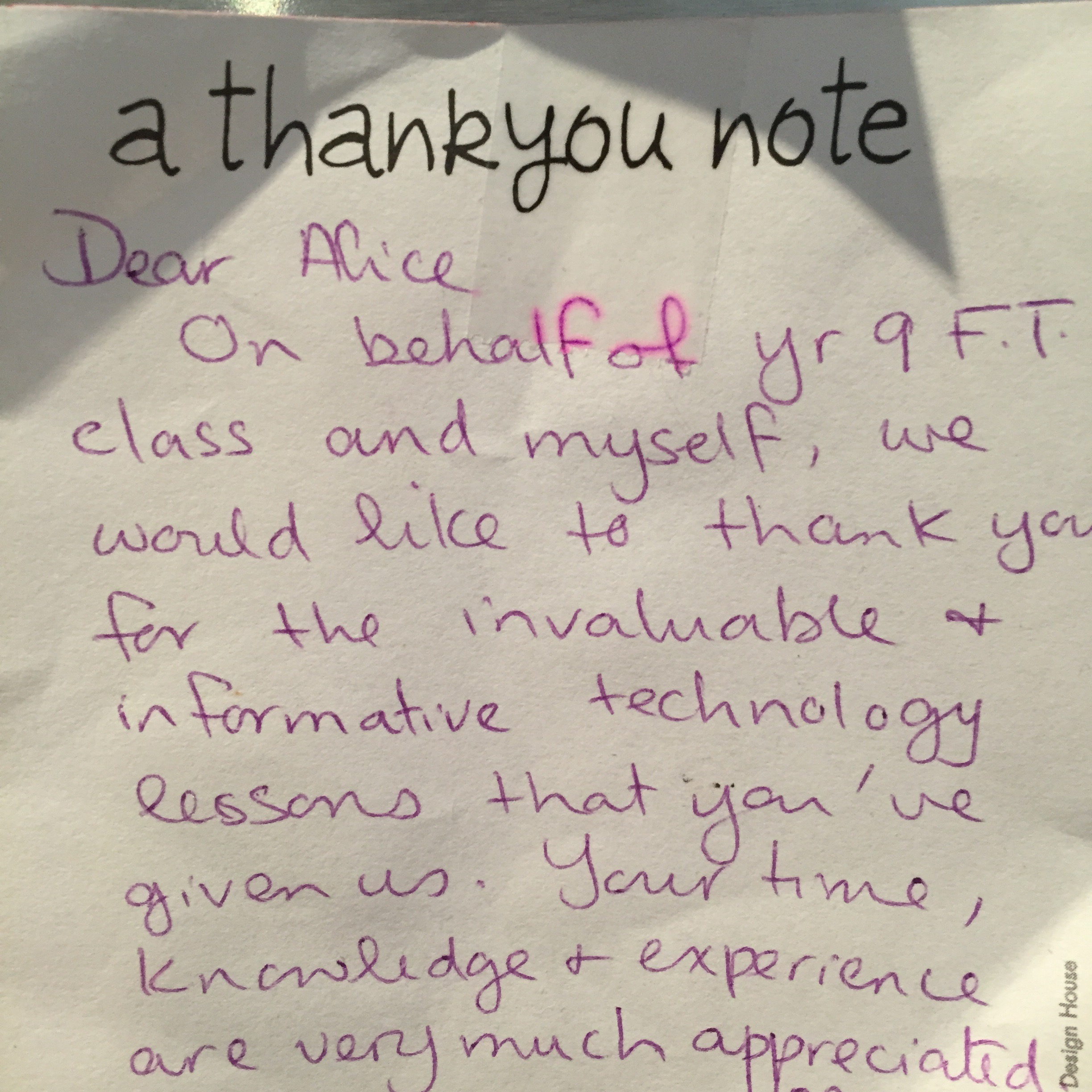
So I have one more term in this role of supporting teachers. I have loved every minute of it so far. While teachers have thanked me for teaching them, it is them who are teaching me new things.

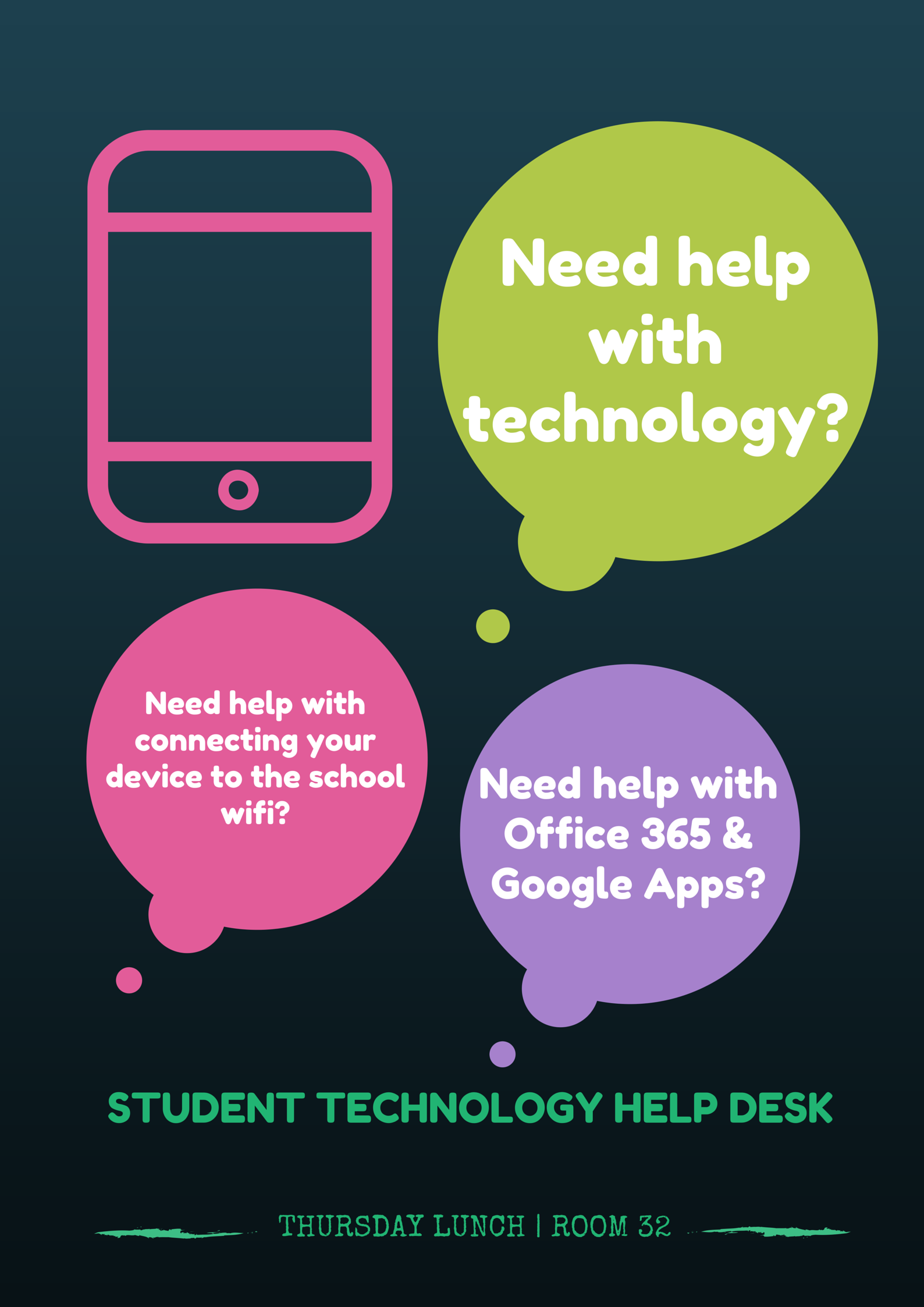
Student technology help desk for BYOD

student technology help desk poster

I’ve been leading my school in implementing BYOD for students for a few years now and one of the things we have noticed in our ongoing evaluation is students need technical support (eg. help in connecting their devices to the school wifi) and learning advice (eg. which apps to use for notetaking and for particular ways of presenting information for assignments) when they are bringing their own devices for schools. While many teachers believe that students are digital natives, we have noticed that many students are not as naturally competent and confident in using technology for learning as we think they are. Many students know how to use devices for social purposes but when it comes to enhancing their learning with their own devices, they need teachers to guide them. However, a major challenge is that teachers are also on the same learning journey as students. With BYOD, a teacher faces a large array of types of devices so it is a huge challenge to provide technical support or to be an expert in the thousands of apps that are available for students to use.

To meet this challenge, I’m currently experimenting with the Student Technology Help Desk. This is a service where students drop into a classroom at a certain time each week and get technical support or learning advice for BYOD from me and student digital leaders (who are trained to be tech-savvy). It is sort of like a Genius Bar. At the moment the Student Technology Help Desk is opened for 30 minutes a week and it every session has been non-stop from beginning to end. Staffing the help desk is me and three other students. There is a roster of which students staff the help desk so that each student gives up their time a maximum of twice a term. So far most help requests are for connecting devices to the school wifi, setting up Google Apps on devices and advice on apps to complete class tasks and assessments. So far it is working well and I think it’s a great way for help students bring their own devices to school and also a great learning opportunity for the student digital leaders.

Do you have BYOD at your school? Why not set up a Student Technology Help Desk as well?

OfficeMix in a BYOD classroom

Last term I had the privilege of team teaching with a colleague who is teaching a Year 7 class this year for English, Maths, Science, Geography and History (at my school Year 7s are taught these subjects by the same teacher as a middle years strategy). This class, like many classes, consisted of students of varying ability levels and were learning English as an additional language. We wanted to utilise technology in a way that enabled more differentiation. personalised learning and more opportunities for teachers to help students one-to-one.

So we decided to use OfficeMix to flip the classroom. We didn’t flip the classroom in the traditional sense of getting students to watch video tutorials at home and then do activities in class. Instead, we did a brief introduction of the lesson (eg. brainstorm, linking the lesson’s content to previous learning, pre-loading metalanguage) then students watched an OfficeMix presentation on their own devices with a follow-up activities (eg. quiz or a worksheet). Students were told they can watch the OfficeMix presentation as many times as they need to in order to complete the follow-up activities successfully. This meant some students only watched the OfficeMix presentations once or twice while other students watched it many times. When students found the follow-up activities challenging, they were able to watch the OfficeMix presentation to work out how to do it. This allowed me and the teacher I was team teaching with to offer intensive one-to-one support to the students who needed it most.

Here’s an example of one of the OfficeMix presentations we used for this class:

https://mix.office.com/embed/ny5p5aabe06m

Using video tutorials is not new but what I like about OfficeMix is that it utlises PowerPoint. PowerPoint is a software that many teachers are familiar with so it is an easy step-up for for them to use the OfficeMix add-on. Many teachers already have many existing content presented in PowerPoint so they can easily turn them into video tutorials with minimum workload. What I personally found the most useful is that OfficeMix presentations works on all devices. The class I was teaching in had students bringing Surface Pro’s, Windows laptops, Macbooks, iPads, iPhones and Android phones. OfficeMix worked on all of them.

My next step is to have students making their own OfficeMix presentations to show their learning.

What I would like from school development day

Like many of my colleagues working in NSW public schools, Term 3 is about to begin. For many of us this means school development day (SDD). SDD is a day where teachers, staff and parents engage in professional learning to further enhance student learning. SDD occurs at the start of Term 1, 2 and 3 and then on the last two days of Term 4. I value SDDs because it is a day where I can solely focus on my learning in order to better teach my students. Students do not come to school on SDDs so teachers can focus all of their efforts on learning. There are no relief work to set, no guilt over not being able to teach your classes due to attending professional learning and no classroom issues to follow-up from a day of being absent from your classes.

I greatly value the effort and commitment from the teachers who put together SDDs. It is a tough gig. I know so because I have coordinated SDDs in the past. It is extremely challenging to put together over 5 hours of professional learning that is relevant and engaging to ALL teachers. However, I have always felt something is missing from SDDs.

I guess I have always been an active learner in my professional learning. I don’t like to wait for someone to tell me what I should know. I am constantly reviewing what I need to learn and when a learning need arises, I seek out that learning almost immediately. This does mean a lot of hours spent searching and seeking help from my professional learning networks in my own time. This in turn also means I have explored a lot of things that are presented in SDD. For example, my school’s SDD last term was on literacy. I was presented with ideas and resources that I have known and used for several years. While many teachers at the school found the SDD useful, I was left feeling I wasted 5 hours of my time. I don’t want this to make me sound unappreciative. The SDD coordinators did and always do an awesome job.

What I would like from SDD is a more personalised experience. In NSW public schools, there are five SDDs in a year. It would be so awesome if just one of those SDDs allowed teachers to propose a professional learning experience that they would like to do. This could be visiting other schools, other educational institutions, collaborating with other teachers, reading educational literature, the list is endless. I visited the University of NSW during the school holidays to connect with university academics that I know can contribute to the learning of students at my school. I visited the Sydney Institute of Marine Sciences and learnt so many new practical activities that I can do with my students. These site visits are perfect examples of personalised professional learning activities for SDD. I recently learnt about a book called “Independent science challenges: fascinating science projects to challenge and extend able students“. I would love to spend a SDD reading parts of the book and putting together a plan together to implement the strategies in the book.

Some people might say that all schools have professional learning funds to release teachers to do personalised professional learning like attending subject-specific conferences, etc. However, this is during teaching time and many teachers do not like to miss out on teaching time. SDD is different. It is a time where every teacher is learning. There are no students. Your learning is not distracted by a casual teacher calling you to help with your class. I might be the only teacher who feels this way, but it seems that if teachers can differentiate and create personalised learning experiences for students, why can’t teachers themselves have personalised professional learning experiences. Just one SDD.

Are teachers stretched to the limit?

Note: I love my school and all staff and students who work at my school. This post isn’t about how my school works. It’s about teaching in general.

I read a post tititled, How far can you stretch a piece of elastic before it snaps, this week and it really resonated with me. The post highlighted how the increasing workload demands on teachers are affecting their wellbeing. When I first started my current position, an older, more experienced teacher told me to watch myself because schools are blood suckers. They will keep drawing your blood unless you set the limits. It doesn’t matter how much blood you give, they will find a way to draw more until you are sucked dry.

This is a rather gruesome analogy that I don’t believe in 100%. I do believe that my school and the people who work in it all respect each other’s wellbeing and look after each other. But the post with the elastic band strategy and the blood sucking analogy highlights something that is rarely spoken about in schools – the effects of workload on teacher health and wellbeing.

One of the reasons I think many teachers feel they are stretched to the limit is the sheer amount of work involved in teaching. The following is a list of some thing steachers do:

  • Plan lessons & create resources
  • Marking and providing feedback to students
  • Work with colleagues to plan cross curricular lessons like project based learning
  • Teach classes
  • Admin and paper work – registers, recording student achievement data, entering professional learning hours onto a database, etc
  • Organising and running excursions, incursions and other extra-curricular activities like training sporting teams
  • Meetings – faculty meetings, staff meetings, committee meetings, parent meetings (there are many more types)
  • Observing other teachers’ lessons & providing feedback to them
  • Following up on student learning issues with a range of people including parents, counsellors, other teachers, etc
  • Follow up on emails – many, many emails
  • Create and monitor budgets for the area you are responsible for – faculty, sport, special programs

This is not an exhaustive list. I have probably forgotten to list a dozen more things teachers do on a regular basis. My question is can these things be done within work hours? I’m not talking about a 9-3 school day. I’m talking about a 8-5 work day that most other people in society work. My feeling is teachers cannot do what they need to do in a 9 hour working day and this is 9 hours straight. Many teachers do not eat, drink or even go to the bathroom at work because that is just not enough time.

My next question is is this what we expect teachers to do. Is teaching a job where to do everything you need to do, you have to put in 9 hours straight with no breaks at school, then work another 3 hours at home and then work 8 hours over the weekend?

People who know me may say that this post is just me adjusting to working full time after the birth of my baby. It isn’t. I have felt like this for a long time.  Many other teachers with or without kids feel this way. Many don’t want to say anything because sharing these thoughts may result in getting labeled as unproductive, ineffective, or uncommitted to your students. The last one is the worst assumption.

Are you a teacher? Do you think a teacher’s work can be done in work hours with minimal impact on personal wellbeing? Are teachers stretched to the limit?

Managing impacts of staffing on your workload

As any leader of a curriculum area would know, when teachers you supervise call in sick, it can be an absolute nightmare on your workload. It can also cause a lot of stress during the day, particularly when multiple teachers take sick leave at the same time, which often happens during winter. I had such a day today when I had two teachers call in sick, both with a large number of lessons on their timetables. It took me over an hour to plan their lessons , organise all the printing and rolls for their relieving teachers. This meant starting the work at home at 6am. It is not a teacher’s fault when they call in sick. When you are sick, you are sick and there’s nothing you can do, but the impact on other teachers can be significant. I’ve spoken to some curriculum leaders for advice on how to better manage this impact on my workload as I don’t want it to impact my time with my baby. Before baby, I can go to school at 7am when multiple teachers call in sick. But now I can’t as my baby needs to be dropped off at daycare first and I don’t want to because I don’t want to sacrifice time I spend with baby in the morning. She shouldn’t miss out on time with her parent because others has called in sick. So here are some strategie I’ve been told:

(1) Unless a teacher is so sick they are in an emergency ward, they have to set their own relief work

I know this is a strategy in some schools but I don’t like it for several reasons. It encourages sick teachers to come to school because coming to school when you are too sick is easier than setting the relief work. This facilitates the spread of the illness and the next thing you know, more teachers are sick. I also think when you are sick, you should be resting and recovering, not setting relief work.

(2) A buddy system

Some have suggested that each teacher should be buddies with another teacher so that when one teacher is sick, the buddy has to set the relief work. I haven’t tried this but I think it’s a bit of a cop out from the curriculum leader. It’s almost like palming off your role to your staff. I personally will not implement this system by choice.

(3) Programming with relief work already in place

This is the strategy I like so far and would like to put in place from next term. Programs for units of work have one-off, relief teacher friendly work for each lesson. Teachers have to complete their registers day by day and leave them on their desks so that anyone can see where they are up to at any time. This strategy takes a lot of work to set up but will minimise stress and workload increase.
So how do you deal with the workload that comes with teachers taking sick leave?