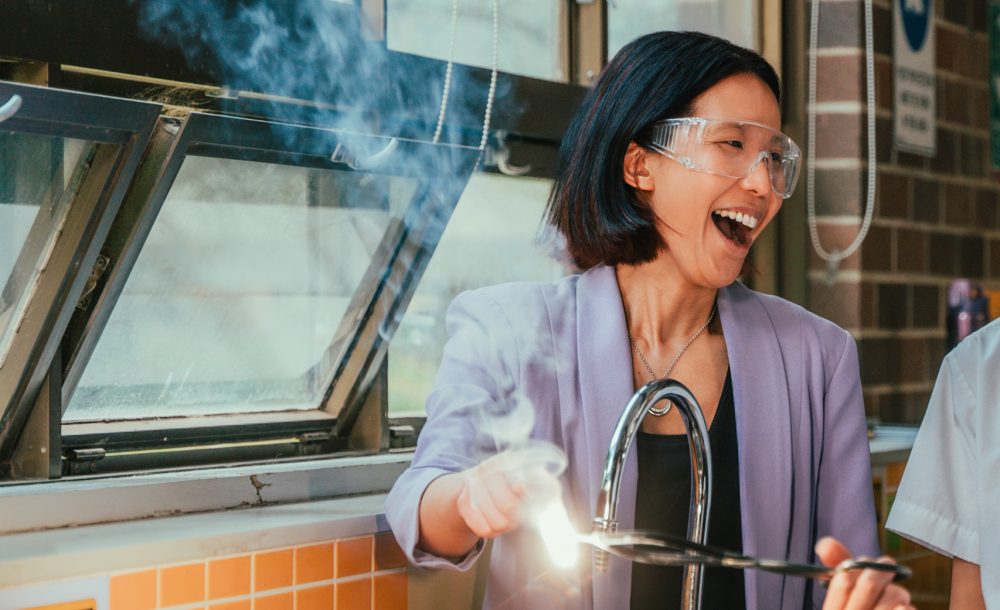
My Year 8s are currently learning about the periodic table. The periodic table is often not the most exciting thing for middle school students. A few months ago one of my students sent me a YouTube link to a song about the periodic table so I thought I’d use it in class to introduce the periodic table in a more interesting way.
The class absolutely loved it! Much more than I thought. When I played the video the first time, a student found some laminated periodic tables on my desk and started handing them out to everyone so they can look at the periodic table while following the song. I have never seen a 13 year old voluntarily getting a periodic table and spending 10 minutes just looking at it (they kept replaying the song as some of them set themselves the goal of learning the lyrics). This is a short video of how the class engaged with the song. (I had to place a visual effect over the video to protect student identities)
After the song, we did the usual worksheets where students look for the symbols of common elements, etc.
I often receive comments that using songs like these trivializes the science and perhaps “wastes” learning time. But I’d rather spend 20 minutes with this song and have students engaged and interested.
Today my Year 8s used lollies and toothpicks to model elements, molecules, compounds and mixtures. This isn’t anything new. Lots of teachers and students have done this before. However, I decide to allow students to film themselves explaining how the lolly models they made represent elements, molecules, compounds and mixtures as evidence of learning. For one group, I decided to record a question-and-answer conversation on my iPad.
The video showed that this student understood to a certain extent how particles are arranged in elements, molecules, compounds and mixtures. The student did accurately use the lollies for this, but upon questioning, she was confused about how many different types of particles made up her lolly models of compounds and mixtures.
I’d like this type of evidence of learning to be prominent in schools. As a system I think we rely too heavily on written exams and assignments to elicit student understanding of concepts. Having videos such as the one shown above is much more powerful to give feedback to students and to use as evidence of learning. Eventually I’d like each of teacher in my faculty to a collection of videos like this for professional discussions on our students’ learning.
So my school has decided to journey down the BYOD path. This is for several reasons, including students already bringing in their own devices (not just their own smartphones but quite a few students bring in their own laptops and tablets) and asking for them to be connected to the school WiFi and wanting to continue technology-rich learning post DER (DER stands for Digital Education Revolution, an Australian government initiative that gave Year 9 students their own laptops. The funding for this has ended.)
Several teachers have asked for a blog post on our BYOD journey so far so here it is …
Before we jumped on the BYOD bandwagon, we wanted to know what students thought of this. This involved chatting to students to explain what BYOD is and whether they would bring the devices they already at home to school. We put the feelers out to see what students, parents and teachers think. The students we spoke to in these informal discussions were very supportive of the idea of BYOD and wanted to be involved in the school’s exploration of possibly implementing BYOD.
At the same time, we also looked at the literature review into BYOD and did some further research, which included using the insights from Mal Lee’s Bring Your Own Technology. Once we had a good grasp of the educational research and grounding for BYOD, looked into other school’s journey into BYOD, looked at what we already knew about our school community, we decided to propose a BYOD model where students bring in whichever laptops or tablets they wanted as long as the devices connected to the school WiFi and had certain basic software and apps installed. We also seeked feedback from people with a bit more expertise than we did at BYOD (hat tip to Pip Cleaves and Stephen Turner in particular).
So at this stage, the senior executive team was happy, the students we spoke to were happy and the teachers we seeked out for the BYOD trial was happy with the model. At this stage, our Community Liaison Officer and P&C gave their support to the model and was able to help us explain our BYOD proposal to parents. This launched us into mass data collection stage. We had a fair idea of what devices our students already owned and the challenges that will face our students’ families if BYOD is implemented, but wanted to be 100% sure and to hear as many voices and ideas as possible.
We surveyed Year 7 and 8 students and their parents. From the student survey data, we chose a group of students that held a diverse range of views towards BYOD for student focus groups, which is also acting as a student advisory group for BYOD. The focus groups enabled students to explain their concerns towards BYOD in detail and as a group come up with solutions to address their concerns.
From all the data collection and consultation with the school community, there was overwhelming support for BYOD and the reasons cited include:
-students already being familiar with their own devices
-having access to their own devices in class caves time as they longer need to move from their regular classrooms to a computer room
-bringing their own devices to school will make learning more fluid between school and home
-technology being a part of students everyday lives
The main concerns that were raised were:
-how equity issues will be addressed
-safety and storage of devices
-digital citizenship
The main lessons we’ve learnt from our BYOD journey so far is to involve the school community as much as possible. This sounds obvious but from our experience it is the students and parents who have come up with the best solutions to address challenges of BYOD.
Our next step is to work with teachers and students on the next challenges, which includes leading a classroom with multi-platform devices and learning design that will best utilise students’ devices.
Student voice is something that I really value. In the perfect world students would have a complete say in what they learn and how they learn. But in the meantime the confines of syllabuses I still like to give my students a say in the learning that’s happening in the classroom. What things do they like learning about? How do they like to learn? Is what they are learning too difficult or too easy? What parts of the classroom learning design do they think needs improvement? What can I do as their teacher to make learning better for them?
My Year 8 class gave their feedback on their learning this week as Term 2 in NSW, Australia drew to a close. Here’s what they thought:
The main topic we studied in Term 2 was called Water Water Everywhere, which is essentially using the particle model to explain the properties of solids, liquids and gases and why one state of matter changes to another when energy is added or removed from the system. This topic is probably one of the most difficult and often disengaging topic for students because it involves an abstract concept. The particle model lends itself to a lot of student misconceptions and is generally something students find difficult to understand, which I have discussed in a previous post. To overcome this the learning was designed so to involve lots of interesting hands-on experiences such as making quicksand and using technology for students to increase their conceptual understanding and allow their misconceptions to be picked more and addressed more frequently.
From the students’ feedback, scientific metalanguage was emphasised as an area they thought needed improvement, so next topic there will be more activities that emphasise the use of scientific metalanguage.
What I also find interesting is students’ decisions on whether they will continue with Science in the post-compulsory years of schooling. What I find particularly interesting is that quite a few students who consistently say they find the learning in Year 8 science fun, interesting and related to the real world, do not want to study science in Year 11 & 12 because their chosen career does not need science. There seems to be a perception with my Year 8s that science in Year 11 and 12 are for people who want to be scientists. This perception is also found in evaluations completed by Year 9 and 10 students.
So one of my challenges for the rest of the year is how am I going to design the learning for these students value science and view it as important to learn, even though they aren’t going to pursue a career in science.
Calling all science teachers. I need some help. My Year 8s are currently learning about the particle model and states of matter. Like I mentioned in my previous post, many students have various misconceptions on the particle.
Today Year 8s made home made thermometers to learn how expansion and contraction (see image above)
They have already learnt about how movement of particles is related to the amount of energy they have, which then determines the state of the object. After they made their homemade thermometers and observed the liquid expanding and rising in hot water and the liquid contracting and falling in ice water, they wrote a paragraph using some sentence starters, that led them to use the particle model to explain their observations and explain how real thermometers work.
I had a one-to-one conference with each student to go through their explanations to make sure I identify their misconceptions. Here are some common misconceptions from my Year 8s:
-When particles are heated they expand
-When particles are cooled they contract
-Particles are inside matter (as opposed to matter being made of particles)
Many of my Year 8s are actually thinking that the particles themselves become larger and smaller. They are confusing the particles and the matter made out of these particles.
What can I do to challenge these misconceptions? I don’t want to just tell them to reword their explanation. I want to give them a learning experience that makes them realise their current understanding is wrong.
Many people frown upon PowerPoint, It has become rather unfashionable these days. Search ‘PowerPoint’ in Google and you’ll get websites with titles like:
“Be Less Boring: The 4 Best Alternatives to PowerPoint”
“Hate PowerPoint? Here are 5 Web-based Alternatives”
“5 PowerPoint Alternatives to Wake Up Your Presentations”
Anyway, since PowerPoint has been getting such a negative spin lately, I’d like to share some a learning activity that uses PowerPoint a little differently.
My Year 8 class are currently learning about states of matter and the particle model. It is one of the most conceptually difficult science topics for middle school students. The most difficult aspect is probably because the particle model is an abstract concept. There are also many misconceptions associated with this topic. Let’s take particles of water as an example. Students often think that:
particles in ice, liquid water and steam are physically different from each other
particles change in size as water changes from ice, liquid water and steam
There are also a few conceptually difficult ideas that students need to grasp such as:
Particles are inside objects (as opposed to particles actually making up the object)
One particle of water is actually two hydrogen atoms and one oxygen atom
The behaviour of the particles that cannot be seen is directly related to the behaviour of the macroscopic object they make up
The particle model is a model and every model has limitations in what they can explain
This is one of those topics where a lot of regular and frequent formative assessment is very beneficial as it allows you as the teacher to identify and tackle any misconceptions as they happen with each student. This is one of those topics where you don’t want to find out your students have completely misunderstood particle model at an end-of-topic test.
So with my Year 8s I decided to use PowerPoint to identify misconceptions. Their PowerPoint task looks something like this:
This is an unfinished audio slideshow made by some of my Year 8 students
This activity was done over three lessons, spanning three weeks. At the end of each of these lessons, students upload their progress onto Edmodo and I give them feedback based on the medals and missions model.
Here’s an example to illustrate what I mean.
And here’s my feedback to them on Edmodo.
And here’s my feedback to another group. From their progress I was able to pick up on one of their misconceptions.
From my observations of my Year 8 students doing this activity, I have found that they actively engage with the text when they are finding images to match different sections of the text. In their groups they were often arguing and justifying to each other which images were the best to use. I also think that this activity allows students to ‘talk science’, which will be particularly beneficial for students learning English as a second language. Setting aside time where students practise using scientific metalanguage to talk about science with each other is also something that is often neglected in high school science.
During this activity, it is also the students who are working the hardest to learn. It isn’t me showing pictures of circles and talking about the particle model. It is them talking about it and me regularly checking their understanding.
So don’t just think of PowerPoint as a boring presentation tool. It can be used as a very easy way to create a student-centred learning environment that frees up the teacher to tackle student misconceptions.
This term my Year 8 class has been running Science News. Science News is where each student in the class takes turns in presenting a science news item that they have found interesting. They have to showcase the science news item in a two minute presentation. The purpose of Science News is to expose students to the latest discoveries in science. I wanted them to know that science is everywhere.
However, Science News has also taught me new things and not just scientific things. One Science News item challenged how I was designing my learning for my students and how our education system designs learning for our students. Daniel talked about new discoveries on black holes. You can read Daniel’s speech to the class here. Right after Daniel finished his speech, half of the class’ hands shot up with questions.
“What exactly are black holes?”
“What happens when you go into a black hole?”
“I heard that time slows down when go inside a black hole. Is that true?”
“If we can’t see a black hole. How do we know it is there?”
“What is a light year?”
I was really happy that my students were so enthusiastic about learning more on black holes. So what did I do? I spent about 5 minutes skimming through the basics of gravity, dark matter and the speed of light and then I said, “OK. We actually learn about this stuff in Year 10. We need to stop now and continue learning about the ozone layer.”
While ozone in the Earth’s atmosphere is very important and Year 8s were also interested in ozone, I felt really guilty in almost extinguishing my students’ curiosity in black holes because the syllabus said that they should learn it in Year 10 and right now they should be learning about the ozone layer. I’m sure many teachers have faced this kind of situation before but it really got me thinking on how the current education system does so much to restrict the learning of our students.
Why do we have to learn about black holes in Year 10?
To be more accurate, students in NSW learn about black holes in Year 9 or 10 (It’s this thing we call Stage 5, which is Year 9 and 10). I understand that the need to learn age-appropriate concepts. For example, many early primary school-aged students may not have the cognitive ability to tackle abstract concepts (you know, because of all the Piaget stuff). However, I don’t see why if my Year 8s want to learn about black holes (and I know they will be able to), they can’t learn about it because the syllabus says they learn it in Stage 5. When you learn swimming, your age doesn’t determine what kind of things you learn, it’s how fast you are progressing and what you are ready to learn.
Why can’t we learn about black holes and the ozone layer?
Why couldn’t I have let my students go online on their phones and look up videos and websites that helped answer their questions about black holes and share it with the class, and then continue with the ozone layer? I wanted to, but I only have 3 hours with them a week and I only see them an hour at a time. Last year I had the same class for 14 hours a week in an integrated curriculum and I would’ve let them explore black holes and then continue with ozone layer because I had the flexibility to do so. However, now I am back to a more traditional and rigid timetable where learning starts and stops with the school bell. Previously I have blogged about the challenges of implementing project based learning in such a traditional school structure. The more I try to implement project based learning or anything that builds on students’ curiosity and passion or anything that personlises their learning, the more I want to knock down the existing school structure. A few days ago, I was in a workshop with Greg Whitby on teaching and learning in a Web2.0 world. He said the timetable is the one thing that is stopping effective learning and teaching. I couldn’t agree with that point more.
Greg also talked about agile learning spaces. I have to admit when I first heard of agile learning spaces a few years ago, I just liked the look of them. The bright colours and funky furniture looked particularly attractive when you are used to 1950s furniture in classrooms. But since I’ve started PBL, I get it a bit more. So going back to the black hole scenario … In an agile learning space style of learning, Daniel would’ve presented his science news to the whole cohort of Year 8 or a mixture of students from different year groups in one large space. The ones who were interested in learning more about black holes can go with one teacher and the others can go with the other teachers to continue to learn about the ozone layer. Teaching and learning is no longer restricted to one teacher teaching 30 students. Depending on the need, you can be teaching one student or 10 students or 80 students. The space enables you to do so. There are no walls that says you have to teach 30 students at a time. There are also no bells to tell you that you need to spend 60 minutes on learning something; you take as long as you need to. The video below gives you an idea of what learning is like in an agile learning environment.
And now I don’t how to end this post. I sort of feel disillusioned. I want to knock down the walls of my classroom but realistically that can’t happen. Not just yet anyway. So when the school week starts again, it will be back to the status quo. *Sigh*
Sound waves and waves in general are concepts that I’ve found many students have difficulty understanding. These are concepts that deal with understanding how energy is transmitted from one place to another through a scientific model. Why are these concepts difficult? Firstly it is abstract. You can’t see waves. When you speak or hear music you can’t see the waves coming out from the source and travelling to your ear. You can’t see the vibrations of particles. Secondly learning about the transmission of waves comes with a lot of academic language. Here’s just a sample of academic scientific jargon you’ll hear when you sit in a lesson learning about waves:
Equilibrium
Particles
Transmission
Transfer
Amplitude
Frequency
Period
Wavelength
Compression
Rarefaction
Due to this, learning about waves is particularly challenging for students who are also English language learners. Not only do they have to deal with difficult and abstract scientific concepts, they also have to deal with the intense bombardment of academic language.
This year I have a Year 9 class who are students learning English as a second language. I didn’t want to start the topic with a waveform diagram and pointing out what is an amplitude, etc. I planned a learning sequence that will move them from concrete to abstract, and from everyday language to academic language.
The first concept I wanted them to understand is that sound is vibration, or things shaking back-and-forth very quickly. We used the good ol’ tin can phones for this. We also did an experiment where students used a vibrating tuning forks to tickle their noses and make tiny splashes with a beaker of water (I thought they would find these experiments too boring, but they absolutely loved it). Every single student left that lesson knowing that sound is caused by vibrations.
The second concept I wanted them to understand is that we can represent sounds as waves. Students used Audacity to record their voices and experiment with how the loudness and pitch of their voice affected how the sound wave looked like on Audacity. We also experimented on whether saying “Hello, My name is ____” in English and students’ first languages had a difference in pitch.
Here’s a video on Audacity. It’s a free program that can be downloaded.
Students worked out from this Audacity activity that the higher pitched their voices were the more squashy the waves were. They also worked out the louder their voices were the taller the waves. I was happy for them to use the words “squashy” and “high” to describe the waves for the time being.
The following lesson I introduced frequency and amplitude. By now the students had a conceptual understanding of the relationship between sound and vibrations, the relationship between pitch and “squashiness” and the relationship between volume and the tallness of waves. They now just had to replace “squashy” with frequency and tallness with amplitude.
I really like the strategy of teaching a concept with everyday language first and then introducing the scientific terms after students have actually understood it. Science is hard enough without a bunch of difficult words bombarding students as well.
States of matter is one of those concepts that students often find boring. Just look in any textbook and you’ll find solids, liquids and gases is presented to students through activities such as watching an ice cube melt or watching water boil. Not the most exciting activities for a teenager. So when my Year 8 class started their unit on states of matter, I wanted to find something that will excite them and hook them in.
Along came fake quicksand. Fake quicksand is an experiment I found from the Steve Spangler website. It is a simple experiment; it uses just cornflour and water. My Year 8s made quicksand this week to explore the properties of solid and liquids. We also discussed real quicksand and non-Newtonian fluids (they’re not in the syllabus, but students were interested so why not let them learn something they want to learn).
So if you’re a science teacher, you must try this experiment. Kids love it and learn from it. The cornflour to water ratio is 10:1 to make the perfect quicksand so you can turn it into a numeracy activity as well.
So it has been about a week after #sologlobalchat, a TweetMeet (an online conversation on Twitter) that involved teachers from Australia, New Zealand and the UK. If you don’t know what SOLO is watch this video and read this.
From #sologlobalchat we created an Edmodo group to continue our conversations and collaboration. On that Edmodo group I shared an assessment that a colleague and I worked on for a unit of work based on SOLO.
For Part 2 we came up with some questions that will guide students’ evaluation of an existing public health campaign. When I uploaded it onto Edmodo, a teacher called Craig Perry from Christchurch, New Zealand, modified the part into a SOLO exploded map. Not only is the exploded map more visually appealing than a bunch of questions typed up on a sheet (which is essentially what I had at the start), but the exploded map also classifies each question into a SOLO level. (Note that Craig and I have never met. This once again shows how generous the teaching profession is.)
The exploded map demonstrates one of the main reasons why I love SOLO. SOLO lets teachers take a step back and analyse whether they are helping students develop higher order thinking skills. When we talk about 21st learning, we often criticise how traditional school tasks can be completed by students using Google. Using SOLO can help teachers overcome this. If a task only requires students to work the unistructural, multistructural and sometimes even the relational level, can be completed by Google. For something that is non-Googlable, it needs to be extended abstract.
How many of the tasks your students do are non-Googlable? Perhaps SOLO can help 🙂