Small changes can make a huge difference

Over the past few years I have been constantly changing the way I teach due to introduction of 1:1 laptop initiatives in some classes and a continually-developing understanding of how students learn. In a lot of cases it has involved turning things upside down and completely rewriting units of work. This is tiring. Worth it but tiring. But I found out recently that small, minor changes can make a huge difference too. The Student Research Project (SRP) has been around since I was in high school. It’s an oldie but a goodie. The SRP involves students planning, doing and reporting on an experiment of their choice. It is a compulsory activity for all Year 7-10 students in NSW, Australia. Each student must do at least one SRP once in Year 7 and 8, and another one in Year 9 and 10. By doing the SRP, students learn how to design a fair experiment, a must-have skill for all scientists! See here for more info on the SRP.

It was the Year 8’s turn to do the SRP in September this year. The traditional way of doing the SRP is for students to choose an experiment, plan it, do it and then submit a written report. This year my faculty decided to revamp it and not just rehash the status quo. However this didn’t involve major changes that would stress everyone out. It involved a few tweaks that would have the most impact. Like always we gave students the choice of whatever experiment they wanted. My class were doing experiments ranging from water absorption of different types of soils to whether particular types of video games would improve people’s reaction times to using Gary’s Mod to run a simulated experiment. However instead of forcing students to do a written report, we decided to let students choose how to present their SRP findings in whatever medium they wanted. Some students still chose to submit a written report (but by sharing it as a Google document to make the feedback process more efficient) while other students chose to create Prezis or videos. Students had to justify why their chosen medium would be the most effective in communicating their findings to others. At the conclusion of the SRP, students shared their findings with their class over a two-day conference, just like real scientists.

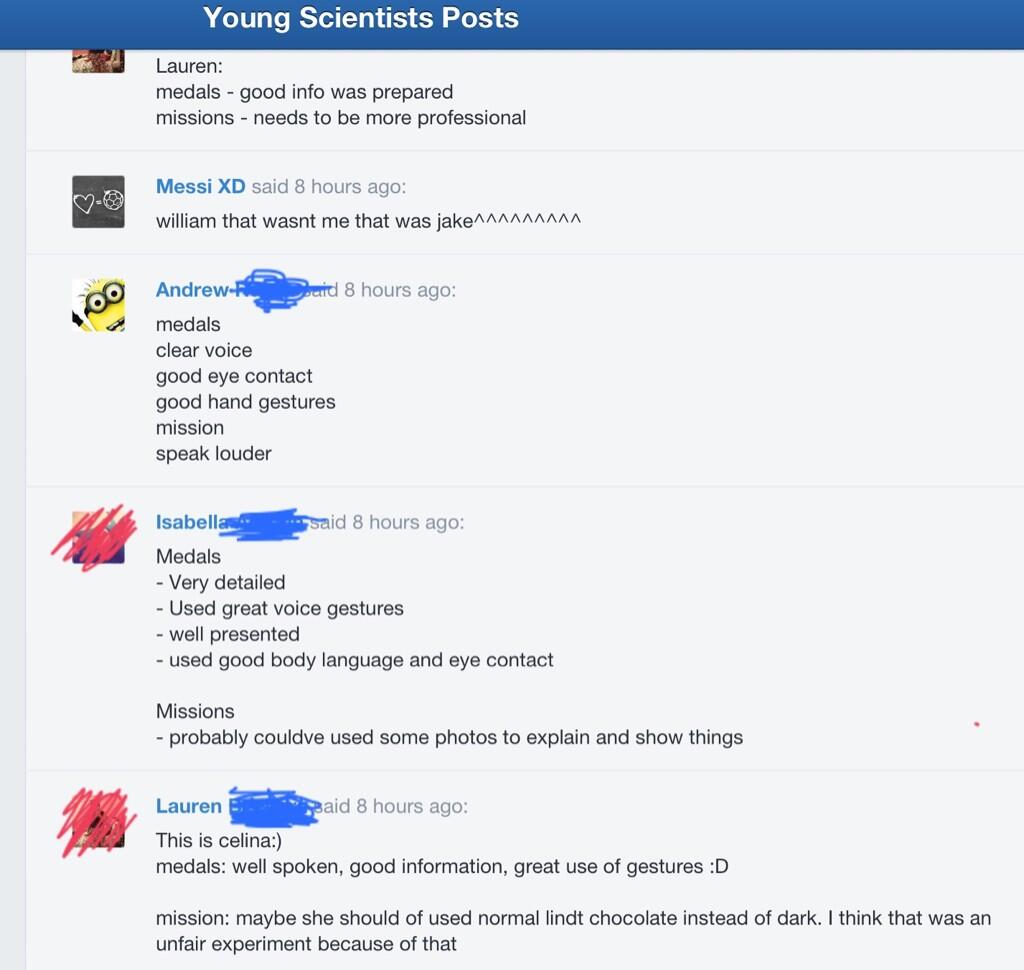
In the presentations I would usually get students to give each other feedback (one medal and one mission) by writing it down on a piece of paper, which I will take home and collate and then give back to students. This was a really inefficient way of doing it. Students had to wait at least 24 hours to get peer feedback and it took me time to type of the students’ feedback. This time I decided to create a backchannel on Edmodo that students used to give feedback to each presenter. Students did this by using laptops. A designated student had the role of creating a post for each presenter and then the whole class will reply to that post with a medal and mission for the presenter. Doing it this way meant that the presenter got the feedback as soon as they finished presenting; they didn’t have to wait till the next day after I’ve collated the class’ feedback. Students really liked the immediacy of the feedback they got from the Edmodo backchannel. There was also one student who made a video for his SRP, but he was ill over the two days of the presentations. His video was still shown and he was able to receive feedback on it at home from his peers via the Edmodo backchannel.

A sample of the Edmodo backchannel

So just with a little of tweaking, the good ol’ SRP has been thrusted into the 21st century. I didn’t have to completely re-write it or turn it upside down. Just by adding Google docs, more student choice and Edmodo, the SRP was made a million times better for students as a learning process. From the end-of-term evaluations, many students from across all Year 8 classes identified the SRP to be their favourite activity this term because it gave them choice, it let them use technology and they learnt by doing.

Next time I’d like to have students sharing their findings with a global audience, or at least with an audience beyond their class. But one small step at a time 🙂

All high school teachers should teach primary school

20130822-202405.jpg
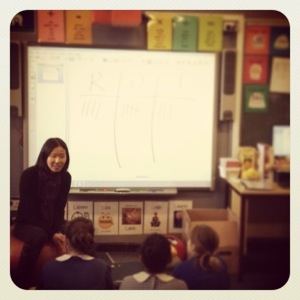
I am so lucky this year that I get to teach with my primary school colleagues from our partner primary schools. For the last two terms I taught Year 5s from Hilltop Road Public School and for the rest of this year I am teaching Year 5s at Merrylands East Public School and Merrylands Public School.

Teaching with primary school teachers have been one of the best professional learning experiences I have had. Here are the main things from primary schools that really speak to me:

-It’s all about students and learning. It isn’t about particular subjects and pushing content. Everything from what is displayed on the walls to the activities is all about the learner.
-Primary school students can do a lot more than you think. While I have never been one of those teachers who think Year 7 students are babies, the level and rigour of learning in primary schools continue to amaze me. Kids are making stop motion animations, blogging, producing their own news … The level of richness is their learning is often unknown to high school teachers.
-I learn so much from watching how primary school teachers structure learning. From how they break down complex tasks to how they use the wall space as another teacher. I have learnt so much from Brett Kent and Karlie Hindmarsh (@karliehindie)

So if you are a high school teacher, you should see whether you can teach with your primary school colleagues. It will be one of the best learning experiences. Plus you get to teach while sitting on a yoga ball. Why wouldn’t you want that experience! 🙂

No longer the solo crazy dancing guy

We have all seen the crazy dancing guy video. The video emphasises that a leader must start a movement. At the start you will be dancing like a crazy lunatic by yourself but eventually you will have your first follower, then more followers and dancing like crazy will no longer be crazy but the norm. The important thing is to get the first initial followers!

For a while I have felt like I was dancing alone, but not anymore. I knew that when my faculty was programming for the new syllabus for the Australian Curriculum and a teacher said “I think we should make the natural disasters unit project based learning” and other teachers agreed. It is no longer me who is suggesting new pedagogical approaches, but other teachers in the faculty.

I also had another teacher in my faculty move from very traditional styles of assessment to experimenting with new approaches. Instead of relying on written, research-based assessments, his Year 11 Physics class was given the challenge of teaching a historical model of the solar system to Year 8 students.

20130816-195154.jpg

Year 11 Physics students teaching Year 8s

There are heaps more examples of other teachers in the faculty embracing and driving change themselves. They are now becoming dancers as well and are encouraging others to dance with them. I am so proud of my faculty and how far we have progressed as a team, all with the aim of improving science learning for our students.

Student Research Project – crowd-sourcing feedback

This is a draft version of a Year 8 assessment task called the Student Research Project. It is quite a task that spans over a month where students plan, conduct, analyse and present on a scientific experiment.

This assessment task has already gone through a few feedback cycles within my school, but I’d like some feedback on it from educators, parents, scientists or anyone beyond that. The task is designed so that it caters for a range of teachers and students. For example the task leaves it up to the teacher and their students to decide HOW they will present the task (they can submit it as a traditional word-processed document or they can make a video, etc). The task can also be turned into project-based learning for those classes that have gone down that path.

“I didn’t feel like I was teaching” – journey in leading others in PBL

But I didn’t feel like I was teaching

One of the teachers on my faculty (let’s call her Ann for this post) said this to me during our scheduled discussion on her professional goals. At the start of the year, Ann said her professional goal for 2013 was to implement project based learning (PBL) in her Year 9 class.

After looking at the BIE website for a while and attending one of Ashley Cantanzariti’s PBL workshop, Ann created crowd-sourced a driving question for this term’s unit for her Year 9 class with a cross-school group of teachers (this happened in our school’s School Development Day which involved our community of schools). We came up with the driving question of “Will an earthquake or tsunami happen in Sydney?”. The only teacher-centred lesson that Ann gave was the introduction lesson to let the students know the expectations and organisation of their new project. The class sorted themselves into groups and brainstormed what they needed to find out for this project. Ann used Edmodo for students to collaborate and upload their progress of work so she could give them feedback. After several weeks, the groups of students presented their findings to the driving question by choosing whatever medium they thought was appropriate. Some groups chose GoAnimate while other groups made a diorama.

When we were discussing whether Ann thought PBL was very effective for her students to learn science, one of the most memorable things she said was

They found out what an epicenter was, the focus and all other features of earthquakes by themselves. I didn’t have to even tell them.”

This ties in with the first quote on this blog post. Ann expressed that she didn’t feel like she was “teaching” because the students were driving so much of the learning. She recognised that most of the “work” was done prior to the project in designing the driving question and the workflows of how students will submit drafts of work, receive feedback and revise their work, but it was so different to what she was used to she felt like she was not teaching. Her concept of teaching was changing from content deliverer to learning designer and facilitator.

I often feel this way as well. When my students are happily working in their groups, finding answers to their own questions, negotiating with others on what sort of product to make and reflecting on their goals, I often feel like I’m not their teacher or even needed in the classroom. I know that for effective learning to happen students are working harder than teachers (or just as hard) and an effective teacher makes themselves redundant overtime. However, both and I are still somewhat influenced by the traditional notion of teaching – that teaching is a teacher telling students what they need to know. This often challenged concept still has a lot of pull on what both teachers and students perceive learning to be.

Overall this is a step forward for our faculty in terms of changing pedagogies. Instead of only me doing PBL, we now have another teacher implementing PBL and talking to others about how good it is for students.

Using music to engage students in science

My Year 8s are currently learning about the periodic table. The periodic table is often not the most exciting thing for middle school students. A few months ago one of my students sent me a YouTube link to a song about the periodic table so I thought I’d use it in class to introduce the periodic table in a more interesting way.

The class absolutely loved it! Much more than I thought. When I played the video the first time, a student found some laminated periodic tables on my desk and started handing them out to everyone so they can look at the periodic table while following the song. I have never seen a 13 year old voluntarily getting a periodic table and spending 10 minutes just looking at it (they kept replaying the song as some of them set themselves the goal of learning the lyrics). This is a short video of how the class engaged with the song. (I had to place a visual effect over the video to protect student identities)

After the song, we did the usual worksheets where students look for the symbols of common elements, etc.

I often receive comments that using songs like these trivializes the science and perhaps “wastes” learning time. But I’d rather spend 20 minutes with this song and have students engaged and interested.

Using video as evidence of learning

Today my Year 8s used lollies and toothpicks to model elements, molecules, compounds and mixtures. This isn’t anything new. Lots of teachers and students have done this before. However, I decide to allow students to film themselves explaining how the lolly models they made represent elements, molecules, compounds and mixtures as evidence of learning. For one group, I decided to record a question-and-answer conversation on my iPad.

The video showed that this student understood to a certain extent how particles are arranged in elements, molecules, compounds and mixtures. The student did accurately use the lollies for this, but upon questioning, she was confused about how many different types of particles made up her lolly models of compounds and mixtures.

I’d like this type of evidence of learning to be prominent in schools. As a system I think we rely too heavily on written exams and assignments to elicit student understanding of concepts. Having videos such as the one shown above is much more powerful to give feedback to students and to use as evidence of learning. Eventually I’d like each of teacher in my faculty to a collection of videos like this for professional discussions on our students’ learning.

BYOD – the first steps

So my school has decided to journey down the BYOD path. This is for several reasons, including students already bringing in their own devices (not just their own smartphones but quite a few students bring in their own laptops and tablets) and asking for them to be connected to the school WiFi and wanting to continue technology-rich learning post DER (DER stands for Digital Education Revolution, an Australian government initiative that gave Year 9 students their own laptops. The funding for this has ended.)

Several teachers have asked for a blog post on our BYOD journey so far so here it is …

Before we jumped on the BYOD bandwagon, we wanted to know what students thought of this. This involved chatting to students to explain what BYOD is and whether they would bring the devices they already at home to school. We put the feelers out to see what students, parents and teachers think. The students we spoke to in these informal discussions were very supportive of the idea of BYOD and wanted to be involved in the school’s exploration of possibly implementing BYOD.

At the same time, we also looked at the literature review into BYOD and did some further research, which included using the insights from Mal Lee’s Bring Your Own Technology. Once we had a good grasp of the educational research and grounding for BYOD, looked into other school’s journey into BYOD, looked at what we already knew about our school community, we decided to propose a BYOD model where students bring in whichever laptops or tablets they wanted as long as the devices connected to the school WiFi and had certain basic software and apps installed. We also seeked feedback from people with a bit more expertise than we did at BYOD (hat tip to Pip Cleaves and Stephen Turner in particular).

So at this stage, the senior executive team was happy, the students we spoke to were happy and the teachers we seeked out for the BYOD trial was happy with the model. At this stage, our Community Liaison Officer and P&C gave their support to the model and was able to help us explain our BYOD proposal to parents. This launched us into mass data collection stage. We had a fair idea of what devices our students already owned and the challenges that will face our students’ families if BYOD is implemented, but wanted to be 100% sure and to hear as many voices and ideas as possible.

We surveyed Year 7 and 8 students and their parents. From the student survey data, we chose a group of students that held a diverse range of views towards BYOD for student focus groups, which is also acting as a student advisory group for BYOD. The focus groups enabled students to explain their concerns towards BYOD in detail and as a group come up with solutions to address their concerns.

From all the data collection and consultation with the school community, there was overwhelming support for BYOD and the reasons cited include:

-students already being familiar with their own devices
-having access to their own devices in class caves time as they longer need to move from their regular classrooms to a computer room
-bringing their own devices to school will make learning more fluid between school and home
-technology being a part of students everyday lives

The main concerns that were raised were:
-how equity issues will be addressed
-safety and storage of devices
-digital citizenship

The main lessons we’ve learnt from our BYOD journey so far is to involve the school community as much as possible. This sounds obvious but from our experience it is the students and parents who have come up with the best solutions to address challenges of BYOD.

Our next step is to work with teachers and students on the next challenges, which includes leading a classroom with multi-platform devices and learning design that will best utilise students’ devices.

What do students think of their learning?

Student voice is something that I really value. In the perfect world students would have a complete say in what they learn and how they learn. But in the meantime the confines of syllabuses I still like to give my students a say in the learning that’s happening in the classroom. What things do they like learning about? How do they like to learn? Is what they are learning too difficult or too easy? What parts of the classroom learning design do they think needs improvement? What can I do as their teacher to make learning better for them?

My Year 8 class gave their feedback on their learning this week as Term 2 in NSW, Australia drew to a close. Here’s what they thought:

infographic of evaluation results


The main topic we studied in Term 2 was called Water Water Everywhere, which is essentially using the particle model to explain the properties of solids, liquids and gases and why one state of matter changes to another when energy is added or removed from the system. This topic is probably one of the most difficult and often disengaging topic for students because it involves an abstract concept. The particle model lends itself to a lot of student misconceptions and is generally something students find difficult to understand, which I have discussed in a previous post. To overcome this the learning was designed so to involve lots of interesting hands-on experiences such as making quicksand and using technology for students to increase their conceptual understanding and allow their misconceptions to be picked more and addressed more frequently.

From the students’ feedback, scientific metalanguage was emphasised as an area they thought needed improvement, so next topic there will be more activities that emphasise the use of scientific metalanguage.

What I also find interesting is students’ decisions on whether they will continue with Science in the post-compulsory years of schooling. What I find particularly interesting is that quite a few students who consistently say they find the learning in Year 8 science fun, interesting and related to the real world, do not want to study science in Year 11 & 12 because their chosen career does not need science. There seems to be a perception with my Year 8s that science in Year 11 and 12 are for people who want to be scientists. This perception is also found in evaluations completed by Year 9 and 10 students.

So one of my challenges for the rest of the year is how am I going to design the learning for these students value science and view it as important to learn, even though they aren’t going to pursue a career in science.

How to challenge misconceptions of the particle model

20130618-195213.jpg

Calling all science teachers. I need some help. My Year 8s are currently learning about the particle model and states of matter. Like I mentioned in my previous post, many students have various misconceptions on the particle.

Today Year 8s made home made thermometers to learn how expansion and contraction (see image above)

They have already learnt about how movement of particles is related to the amount of energy they have, which then determines the state of the object. After they made their homemade thermometers and observed the liquid expanding and rising in hot water and the liquid contracting and falling in ice water, they wrote a paragraph using some sentence starters, that led them to use the particle model to explain their observations and explain how real thermometers work.

I had a one-to-one conference with each student to go through their explanations to make sure I identify their misconceptions. Here are some common misconceptions from my Year 8s:
-When particles are heated they expand
-When particles are cooled they contract
-Particles are inside matter (as opposed to matter being made of particles)

Many of my Year 8s are actually thinking that the particles themselves become larger and smaller. They are confusing the particles and the matter made out of these particles.

What can I do to challenge these misconceptions? I don’t want to just tell them to reword their explanation. I want to give them a learning experience that makes them realise their current understanding is wrong.