Running to read, write, listen and speak

Literacy in science has always been a huge focus for me. Not only is literacy a priority area for our school, but I like to be educating my students so they are young scientists and there’s nothing more important to a scientist than to be able to understand and communicate their ideas clearly.

I personally find reading and writing to be the easiest to integrate into high school science. However, listening and speaking are a little harder for me to embed. Just a few days ago I remembered a strategy called running dictation which I learnt from an English as a Second Language consultant a few years ago.

Running dictation is a game that students play in groups to practise their reading, writing, listening and speaking skills. The teacher puts a short passage somewhere in the classroom (in my case it was a passage on the atmosphere). Each group of students selects a reader and the rest are writers. The readers in each group need to run (or in my classroom, walk very fast as I don’t want any injures) to the passage, read it silently to themselves, remember as much as possible, run back to their team, recite what they remember to their team and the rest of the team writes it down. The first team that gets everything correct (the words, spelling, punctuation, etc) wins. You might think it’s a noisy game but because each team doesn’t want the others to hear and steal their work, they work very quietly. I did this with Year 8s the other day and they absolutely loved it. I like how it allows students the opportunities to work together as a team and speak about science.

Year 8 students in a running dictation activity

Year 8 students in a running dictation activity

I know running dictation isn’t new but I haven’t seen it used in science classes so I’d thought this blog might give other science teachers some ideas for literacy. I find that running dictation allows students to read, write listen and speak science in a fun way. It’s gets them up and moving and doesn’t make literacy seem like a drag like it sometimes is.

In future lessons I’m going to try some of these other ideas for running dictation to make it more challenging for my students.

Formative assessment with hexagons

Formative assessment is something I’ve been putting a lot more emphasis on over the past few years. I’m so sick of just relying of end-of-topic exams to gauge what students have learnt. I want my students to continuously question how they are going and make changes to their learning accordingly. This is one of the reasons that my faculty has embarked on a Structured Observed Learning Outcomes (SOLO) journey this year. One of the ways that many teachers using SOLO use to assess student learning is with SOLO hexagons.

SOLO hexagons involves the major concepts or ideas from a topic to be placed individually onto hexagons. Students then work individually or in groups to connect the hexagon concepts together and they must justify why they have made these connections. It is the justification where both the teacher and the student can assess the student’s learning. It is how students have connected the hexagons and their justification of WHY they have done it that way that allows their learning and thinking to then be assessed using the SOLO taxonomy (or not; the hexagon activity still works with no understanding of SOLO).

Here’s a video showing one way of using the SOLO hexagons in a UK science class.

Here’s an explanation of how to use SOLO hexagons from the SOLO guru, Pam Hooke.

I changed the hexagon activity slightly to suit the needs of my students. The picture shows the instructions that my students received.

instructions for hexagon activity

And here are the hexagons my students used (note that the hexagons were pre-cut for students and placed into zip lock bags with the above instruction card). My students worked in groups of 2 to 4. I used the SOLO hexagon generator to create the hexagons.

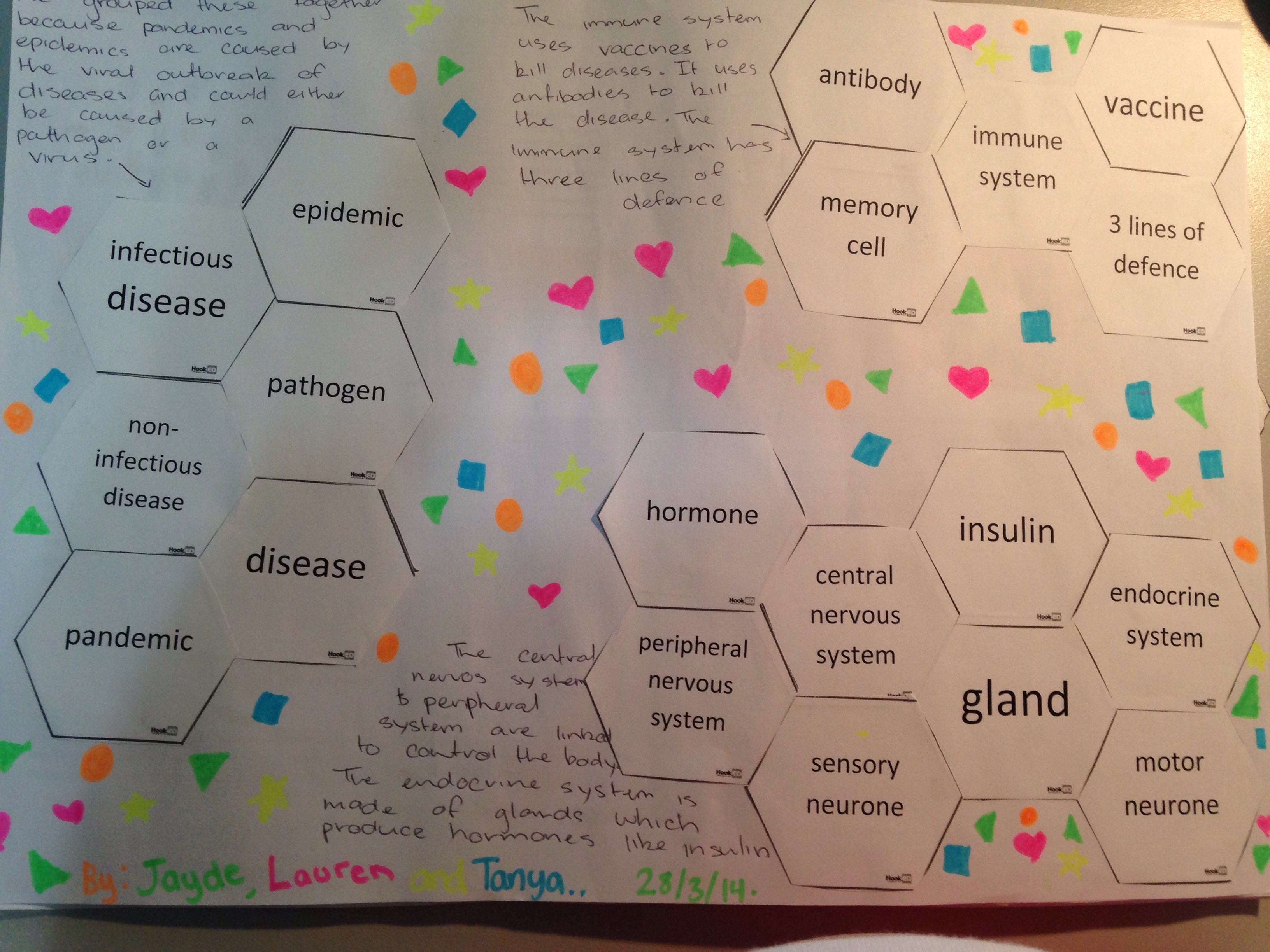
Here’s some samples of the hexagons my students made.

20140406-140303.jpg

20140406-140251.jpg

20140406-140235.jpg

Some things I noticed was that:

  • My students were all fantastic at explaining each hexagon concept
  • Some groups connected all the nervous system concepts and the endocrine system concepts together, showing they had an understanding that the nervous system and endocrine system worked together. However all the groups had the immune system concepts separate altogether. I did spend a lot of class time making it explicit that the nervous system and the endocrine system work together to control and coordinate the body. And while the students’ project was to make a fact sheet about how a particular disease/health issue affected the nervous system and the endocrine system, they seem to think that the immune system works on its own and is completely separate from the other systems.

From this activity we discussed their SOLO levels of understanding and how they can use their hexagon connections to see whether they were at a unistructural level, multistructural level, relational level or extended abstract level. Most students concluded they were at a relational level for most concepts and some thought they were extended abstract for some parts of the topic.

The SOLO hexagon activity is definitely something I will use again with my students. Now that they have done it once, the next time will run even better. Feedback from students was that they enjoyed talking about science with each other and that they learnt a lot from each other just by listening to what others had to say about each concept.