How schools and teachers can use Periscope

periscope

Periscope is a recently-released app from Twitter that allows you to live broadcast. What’s different about it in comparison to other digital tools for live broadcasting is that it lets you have a conversation with others viewing the live broadcast via ‘tweets’ (I don’t know the official name but when you watch a live broadcast on Periscope, you can type text in the ‘say something’ box and the text appears over the broadcast).

I’m currently playing around with Periscope for personal and professional use. Periscope has so many opportunities for schools. Here are some ideas:

Live broadcast major school events

Schools can live broadcast events like awards and carnivals. Parents, families and the community can watch these events live wherever they are.

Professional learning

This is where I think it’s the most exciting potential for Periscope for education. Learning from observing other teachers is one of the most valuable professional learning for teachers. However, a lot of the times it is restricted to observing colleagues at your own school. With Periscope, lessons can be live broadcasted. Multiple teachers can observe live online and ‘chat’ about the lesson via the text conversation feature of the app. The teacher being observed can then watch the saved video of this with the text conversation as feedback. This can also be used for pre-service teachers at university. They can watch a number of lessons back-to-back and have online conversations that is overlayed on the video.

There’s so much potential for Periscope in education. I can’t wait to see how teachers and schools use it. How are you and your school using Periscope?

Note: If you’re a teacher, please consult your Principal or education authority before using Periscope

A humbling experience 

Today at the bank a lady approached me and asked some questions to confirm who I was. She then told me she thought it was me and she followed my blog. I was in utter shock as I never knew my ramblings would result in being recognised in public. The lady walked away quickly as I think she was busy. But I was in such a surprise I was lost for words. Hopefully I didn’t seem rude. So if you are that lady, I’d like to say thank you for reading my blog. If we bump into each other again, I hope we will have more time to chat 🙂

Breastfeeding and being a teacher – how to make it work


Term 1 is over. I have survived 10 weeks of full time work while continuing to breastfeed my baby, who was 6 months old when I returned to work. In my last post, I shared my challenges to continue providing my baby with breastmilk while working full time. Since that post was published I have received many comments on this blog and from Facebook and Twitter from mothers-to-be and mothers soon returning to work on how the post has given them an insight into how they can continue to breastfeed their children when they return to work.

Continue to breastfeed while working full time is challenging for anyone. However, being a teacher is particularly challenging. A non-breastfeeding teacher will tell you how little time there is during the school day. Most teachers, without need to express breastmilk, are already so busy they do not have time to use the bathroom. Many teachers don’t even have time to eat.

So after completing a term of school, I’d like to share again my experience at breastfeeding my baby while working as a full time teacher. The main purpose of this post is like my previous post – to share my experience and hopefully someone else can benefit from it. It is also to get breastfeeding ‘out there’, as breastfeeding is often an issue that is hidden and not spoken about. This I believe is the main challenge of breastfeeding. The community knows almost nothing about it and the more everyone knows the more they can support breastfeeding mums returning to work.

As a teacher, these are the things to consider and talk with your school leaders before returning to work:

  • Where to express – Negotiate a place to express that is private, can be locked, has electricity and close to a fridge and freezer. The place preferably will have a sink with an area where you can leave your expressing equipment to air dry. Staff should know that this room is for mothers to express. I express in my classroom as it is not being used much this year for timetabled classes. I can leave my equipment there to air dry and it is extremely close to my staffroom where I use the fridge and freezer to store expressed breastmilk.
  • Let the relevant colleagues know that your availability is limited at recess and lunch (even if you are expressing at times outside of recess and lunch, you need these breaks to eat and drink). I told my faculty that I will be expressing twice a day. None of my students have asked about expressing yet. If they did, I would tell them like it is. This of course is a personal choice. It also means negotiating around recess and lunch staff meetings.
  • Let coordinators of whole day events like swimming carnivals of your expressing requirements. At my school’s  swimming carnival, I was able to use the pool’s freezer. I was assigned carnival duties that enabled me to leave and express twice. I had to express in my car in the pool car park but that’s ok for a one off event.
  • Be aware that whole day excursions will be extremely difficult. I let my school’s leaders know that I will not be able to go on excursions until my baby turns 1 year old.
  • Work out how you are going to handle student issues that are usually handled at recess and lunch. For example, recess and lunch detentions cannot be part of your classroom management plan if you are expressing during these times.

If you are a public school teacher in NSW, there is a breastfeeding policy. Ask for it from your principal. NSW DEC is very supportive of breastfeeding.

I am hoping that this post will make it easier to other mothers to continue breastfeeding when they return to work, particularly teachers. I’m also hoping that this post will raise awareness amongst all educators so they know what they can do to support their colleagues who are breastfeeding. Support from colleagues and the school is vital to making breastfeeding work when a mother returns to work, which is why I like to thank my wonderful colleagues and school for making my transition back to work such a positive experience.

What I wished I knew about returning to work from maternity leave

My baby at 7 months old. I returned to full time work when she was 6 months old.

My baby at 7 months old. I returned to full time work when she was 6 months old.

In my previous post I shared my concerns about how to balance taking care of a young baby and the demands of being a head teacher in a high school. It has now been five weeks since I have returned to work full time after maternity leave. My baby is now 7 months old. So I thought it was timely to share how I have found the juggle act between family and work so far.

To my surprise, I have not found the balancing act between workload and baby duty the most challenging. This is challenging but not the most challenging. The most challenging is expressing during school hours. For those who are not familiar with the needs of taking care of a baby under one year old, here’s a brief summary of what expressing means. Breast milk is the main source of nutrition for a baby up to one year of age. (A baby can be given formula, but I choose to continue to breastfeed my baby.) To work full time, you need to express breast milk so that your baby can be fed the breast milk via a bottle or cup by their carer when you’re at work. When you are away from your baby, it is optimal to express at times when you would be breast feeding. This is not just about making sure your baby has a sufficient amount of milk but it is also prevent you from getting mastitis.

So this means I have to express twice at school. Luckily the NSW Department of Education and Communities has a very supportive breastfeeding policy and mothers returning to work have the right to two thirty-minute breaks during school hours for expressing. My school is also extremely supportive. But it is still VERY CHALLENGING because it restricts the amount of time I’m available to support my faculty during class. Expressing needs to be done at certain time periods and it restricts you from doing anything else. This means for one hour a day I am unavailable to support my faculty. It is not like teaching a class or having a meeting where you can drop what you are doing and help another teacher. I’m lucky that being head teacher I have a reduced number of face-to-face classes, which makes it easier to fit in two expressing sessions. For classroom teachers, it would be extremely hard. I don’t even want to think about how challenging it would be for primary school teachers, who don’t have ‘free’ periods each day.

What I find surprising is that I didn’t know about these challenges of expressing until I have to go through it myself. It is just not spoken about. I wish I knew about the challenges of expressing at work. Not for my sake but for others who will also go through this.

Last year I had one teacher in my faculty who returned to work full time when her baby was 5 months old. Like me, she was also expressing so that her baby can continue to breast feed when she was at work. But because I was ignorant and didn’t even give a second thought to this, I don’t think I provided her with the support I should have. Doing things like scheduling meetings at lunch times probably did not make things easier for her. If I had known last year what I know now, I would’ve excused her from meetings at recess or lunch or negotiating a better time. I would’ve also offered to deal with any student issues from classes right before recess and lunch, and to start classes after recess and lunch if necessary.

Teaching is a very female-dominated profession and sometime in the future I’m sure I will be working with and/or leading a colleague who is returning to work from maternity leave when their baby is under one year old. At least next time I will know what kinds of support to offer.

Babies and school – how to find balance

IMG_0335.JPG

I haven’t posted a lot lately because I have had my first baby in July. She is definitely the best thing that has ever happened to me. However she is also the biggest challenge I have faced. It is more than the challenge of taking care of a tiny little person who is totally dependent on you round the clock. For me the biggest challenge has been adjusting to how I define myself and how I will find a work life balance.

I have always identified myself through my work, especially my work ethic. I pride myself in being able to dedicate 500% of myself to my students. This has meant long hours of work after school and on weekends to create the best learning opportunities and resources for my students. I pride myself in being able to juggle multiple roles. In addition to my roles at school, I also worked with UTS, UNSW and Microsoft. I rarely said no to any opportunities that came before me. Even before the baby arrived other teachers have said I was going to have a nervous breakdown because I was working so much.

And now the baby has arrived, I have realised I can’t continue doing what I did. I now need to say no. So far I have said no to working on the national assessment program for science literacy with UNSW, the summer school program with UTS and presenting in Singapore because I was either physically unable to or doing so will mean I will not be sleeping for months on end. Not saying no will no longer just impact on me, it will now impact on a little person as well. This is something I am really struggling with at the moment. It feels like I’ve lost a part of who I am.

However, the biggest challenge for me will be next year when I return to work full time. Baby will be 6 months. I am already thinking of how I’ll balance work commitments from school, my baby’s needs and my own wellbeing. Some things I have asked myself are:
-When should I do school work? Should I stay at school and finish everything at school? This would mean picking up baby from daycare late and by the time we get home, it will be time to put her to bed. If I pick up baby straight after school, I’ll get more time to spend with her but will I then be doing school work till the early hours of the morning and affecting my own health and wellbeing?
-Will I be able to dedicate myself to my students & my faculty as much as I used to?

I’d like to hear from other teachers who are parents and are already on this journey. What are your advice & tips? How do you balance your passion for teaching with your family’s needs, and your own needs?

Project Mars – learning science by being real scientists

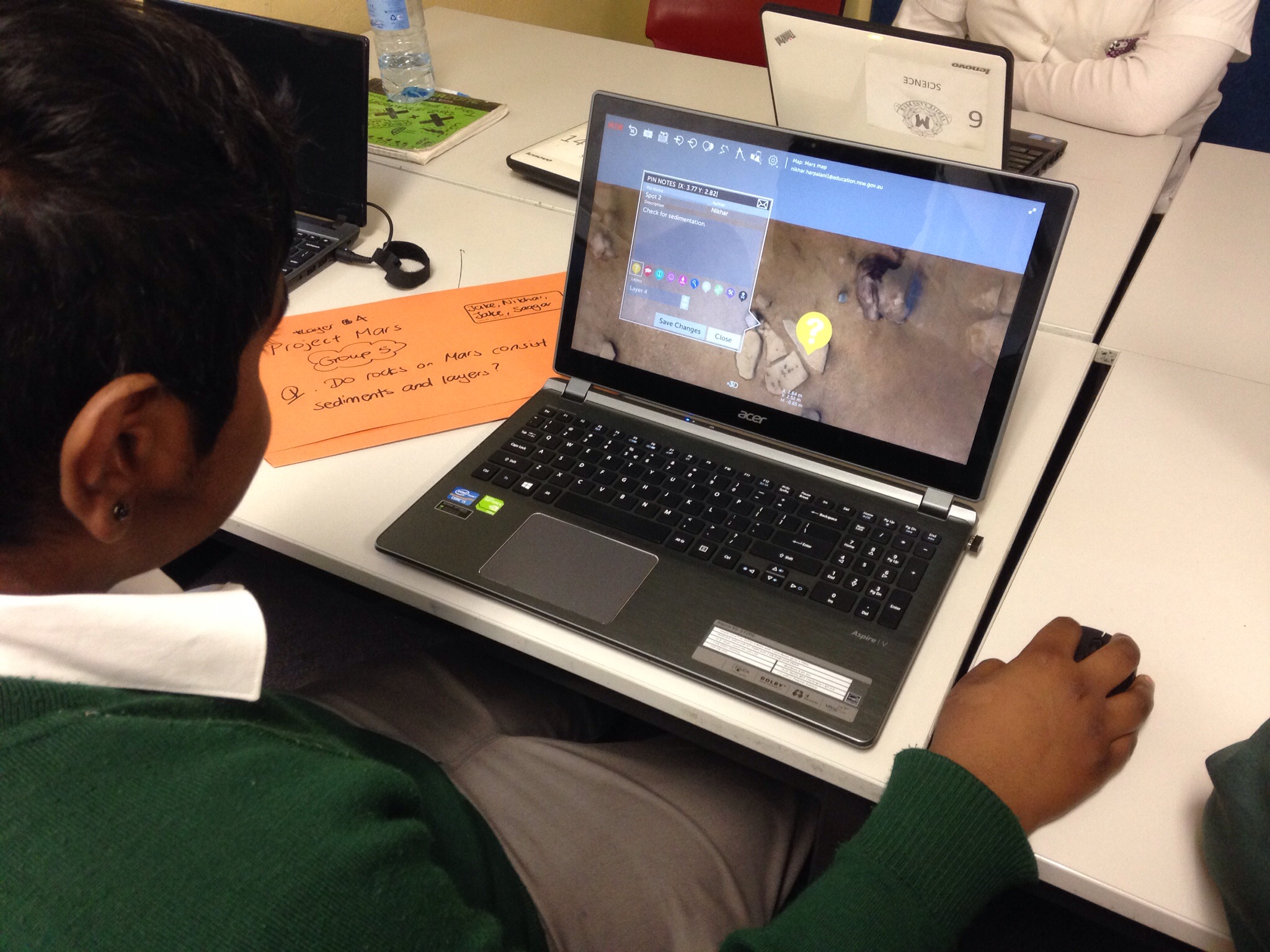
My Year9 class has just completed Project Mars, a project based learning unit in conjunction with the Powerhouse Museum where they get to take on the role as NASA space scientists and find out whether Mars can support life. This is done by remotely controlling a Mars rover on a recreated Mars surface, just like NASA scientists remotely control their Mars rover, Curiosity, on Mars.

The project involved Year 9s coming up with their own research questions and hypotheses for the driving question “Can Mars support life?” Some examples of the Year 9s’ research questions were: “Is there carbon on Mars?”, “Is there nitrogen on Mars?”, “Are there copper and cobalt on Mars?” And “Are there signs of water on Mars?”. All questions were based on what students already know about what is needed to support life. Eg. Life we know are all carbon based; nitrogen is needed to build DNA and amino acids; and copper and cobalt are needed to generate electricity, which is vital if Mars is to support human life.

Students worked in teams over a term on this project. They had to learn how to control the Mars Rover so that it will safely navigate the Mars surface (crashing it will waste the millions of dollars spent on getting the rover to Mars). They had to learn how the Mars Rover took samples of the Mars surface (through photos and lasers which generate data for spectrographs). They also had to learn the science content on how the Mars Rover gathered data and how to interpret the data, which involved learning about atomic structure, atoms, the wave theory and spectrographs.

Students and a mission day where they used laptops to remotely control the Mars Rover to gather the necessary data from places which they had previously determined from maps. The unit concluded with students presenting to, and received feedback, from the Powerhouse Museum, an astrobiologist from the University of NSW and their parents. We also had a Project Mars cake to celebrate the students’ achievements.

Overall this was a very challenging project, and year 9s rose up to the challenge and did a fantastic job. Also, this project would not be this successful if it wasn’t for Smriti Mediratta, who took over the last part of the project as I went on maternity leave. This project allowed students to experience what it’s like to work as a space scientist and enables them to participate in authentic science that engages them more than any textbook or whiz-bang experiments on atoms and waves could.

For more information on Project Mars, visit The Mars Lab.

IMG_2674.JPG

IMG_2439.JPG

IMG_2443.JPG

Learning with real scientists

Earlier this year, I wrote a post on my goals for 2014. My goal #1 was  to keep science real by connecting my students with real scientists. We regularly hear that STEM (science, technology, engineering and maths) will be essential to our economic future and hence it is vital to engage all of our students in STEM. However, there are many statistics that our students are switched off from STEM. From surveys in my own school, many students say they do not want to pursue post-compulsory studies of science because they don’t know what kind of careers science will lead them to. Ask any student what a scientist does and they will most likely give a very narrow, stereotypical view. Like I said in my previous post, most students will know an accountant, a plumber, a builder, a lawyer, but they are very unlikely to know a scientist.

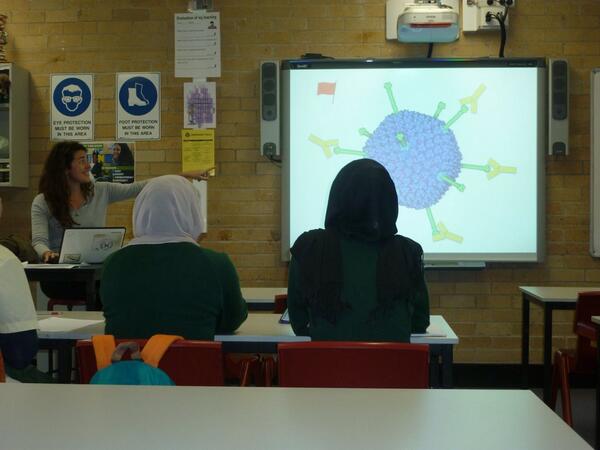
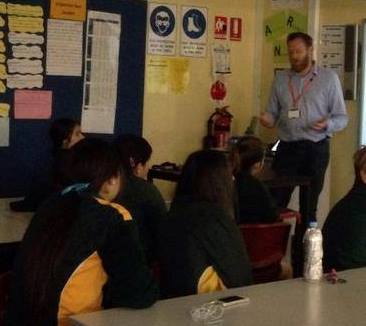
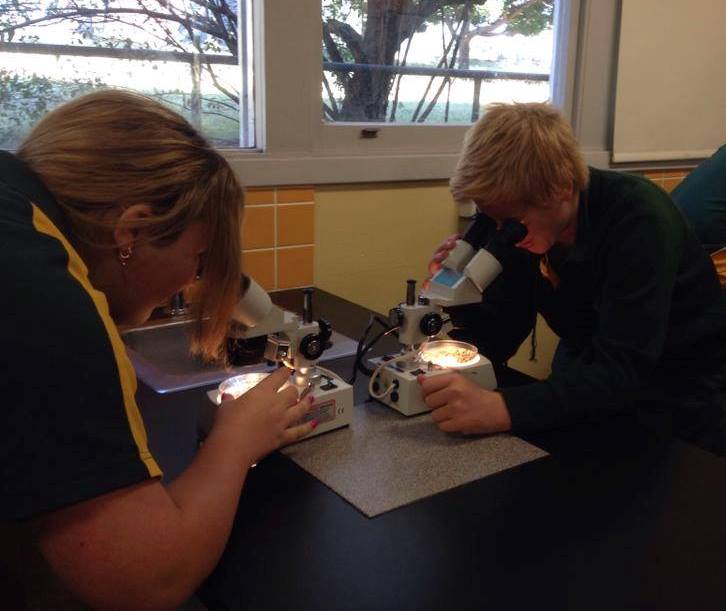
So for the past year I have gotten my school in a program run by the CSIRO called Scientists and Mathematicians in Schools (SMIS). SMIS pairs a school with a practising scientist (or mathematician) who will work with students, teachers and schools on a range of activities from talks about science as a career to running lessons on specific content. My school’s partner scientist is Dr Melina Georgousakis, a scientist specialising in immunology and a government advisers on vaccinations. In a year she has done two general talks on what it’s like to be a scientist, one specific talk on how vaccinations work to Year 9s (really useful as it was held a week before students were scheduled to receive vaccinations) and a lesson on how the immune system works with Year 12 Biology students. My school were also lucky enough to have Dr Cameron Webb speak to them about research on mosquitoes and mosquito-borne diseases. Cameron even brought in a range of dead mosquitoes for students to examine under  the microscope. It is a great example of how scientists can work with schools to provide learning opportunities for students that would otherwise be difficult to organise.

Dr Melina explaining how the immune system works with Year 12 Biology students.

Dr Melina explaining how the immune system works with Year 12 Biology students.

Dr Cameron Webb sharing his work and life as a scientist with Year 9 students.

Dr Cameron Webb sharing his work and life as a scientist with Year 9 students.

Students examining mosquitoes under the microscope in a lesson with Dr Cameron Webb.

Students examining mosquitoes under the microscope in a lesson with Dr Cameron Webb.

While utilising social media and web conferencing tools are useful to connect students and scientists with ease, there is nothing like having a real scientist connect and work with students in the flesh. Since my school’s involvement with SMIS, our students are more aware of careers in science (as shown in our student evaluation surveys) with some students being inspired to work in the fields of our partner scientists. The SMIS program has done wonders in helping to lift the profile of science. It is vital that students can refer to real faces when they are talking about what scientists do and science as a career. It is also essential that students hear and see first-hand the diverse things that scientists do in their day-to-day jobs.

If you’re in an Australian school, I highly recommend contacting CSIRO and being involved in their SMIS program.

Science with gummy bears

Gummy bears are not only a delicious treat, they also have multiple uses in science. This term my year 9 class are completing a project called Project Mars. Project Mars is a joint project with the Powerhouse Museum where students can remotely control a Mars Rover to perform experiments on a recreated Martian surface to find out whether Mars could support life.

To collect and analyse the data from these experiments on the Martian surface, students need to learn about atoms and waves, and this is where gummy bears come in. Gummy bears have come in really handy for two experiments showing the properties of light.

(1) Gummy bears and laser experiment

Gummy bears can be used to show how light is absorbed, transmitted and reflected. This activity show why objects have different colours.

Students shined a red laser light onto red gummy bears and green gummy bears. The red light will transmit and reflect on the red gummy bears, but absorbed by the green gummy bears. Students then shined a green laser light onto red gummy bears and green gummy bears and compare the observations. This experiment makes the concept of absorption, transmission and reflection of light more real to students.

20140611-185431-68071593.jpg

(2) Gummy bear wave machine

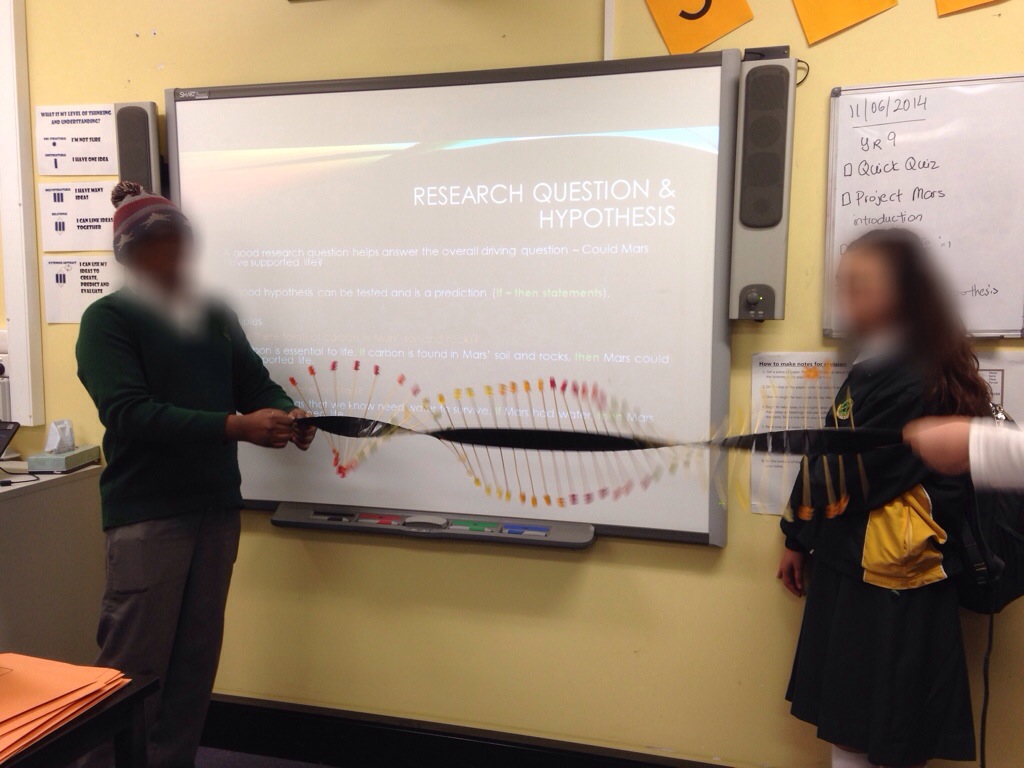
I came across this experiment on YouTube. Gummy bears, skewers and duct tape is used to make a wave machine to demonstrate a range of properties of waves. I really like this experiment as it is a hands-on and visual way to show students properties of waves and works a lot better than skipping ropes and slinkys.

20140611-185609-68169592.jpg


Acting out the nitrogen cycle

I’ve always found the nitrogen cycle to be one of those concepts that students find difficult to understand. Not only are there so many unfamiliar terms and ideas (denitrifying bacteria, nitrogen fixation, different types of ammonia, etc), but students often think that the nitrogen cycle is linear, that all nitrogen atoms go around the cycle step by step. I often hear questions like “Where does the nitrogen cycle start?”

To challenge this misconception, I decided to play the nitrogen cycle game with my Year 9s this year. I first saw this activity in action from my student teacher, Smriti Mediratta, who is now a temporary teacher in my faculty. She adapted the activity from a range of websites such as this one.  All you have to do is to place station signs that show reservoirs of nitrogen and place 1 dice on each sign. Students then role play a nitrogen atom and follow the instructions on each sign. On their nitrogen cycle journey, they fill out a worksheet to show where they went in each step and how they got there.

Note that these resources have been created by Smriti so hat tip to her 🙂

During the activity, I heard one group say “We are going to soil again. We are always going to soil!” From this and the class discussion afterwards, it was evident that students understood that the nitrogen cycle is non-linear; that some nitrogen atoms might never go to all reservoirs and just go from one to another.

20140516-181617.jpg

I also found this activity to be effective in allowing students to physically act out the nitrogen cycle, which makes it more memorable than just reading a text and looking at a a diagram. If you are a science teacher, I highly recommend trying this activity with your students.