This is probably not new but this term I’m trialling a different way of doing homework with Year 9s.
I try to make homework so it doesn’t become a workload burden for myself and my students. A lot of my students have extra-curricular activities like sport and I have had quite a few parent phone calls raising the concern between balancing their family lives and homework. I’ve also had the issue of different access to resources from home. A lot of my students love doing homework activities online, but not all of my students have internet access. To create a set of online homework activities and then another set of offline activities, for all four of my classes became too labour-intensive that there was very low return-of-investment.
So this term I’m doing something different with Year 9s. They will be given a choice in what kinds of homework they want to. The topic is on the nervous system, endocrine system and immune system.
I’ve made sure there are activities that are quite basic (like completing a table) to activities that are higher-order that require the creation of products like video. I’ve also made sure that students can choose HOW they complete their homework. They can do things electronically or on paper.
Not sure how this will go, but is worth trying. I’d love your thoughts on this, whether you’re a student, parent, teacher or anyone else.
Today was the first day where all students were back at school. I had my first lesson with most of my classes today. I never launch into content in the first day. I like to get to know my students first. This year however I want to go further than that and kick off the year by allowing my students to get to know each other as learners. Many of my students know each other socially, but not how they like to learn.
While I donât have any hard data, Iâve always had the inkling that high student achievement not only depends on individual students, but how the whole class works as a group. My higher-performing classes are where individual students apply themselves more but they also get along with each other and help each other. These classes have a sense of community. Each student has a sense of belonging. They work as a team. I want this for all my classes by design, not by random luck.
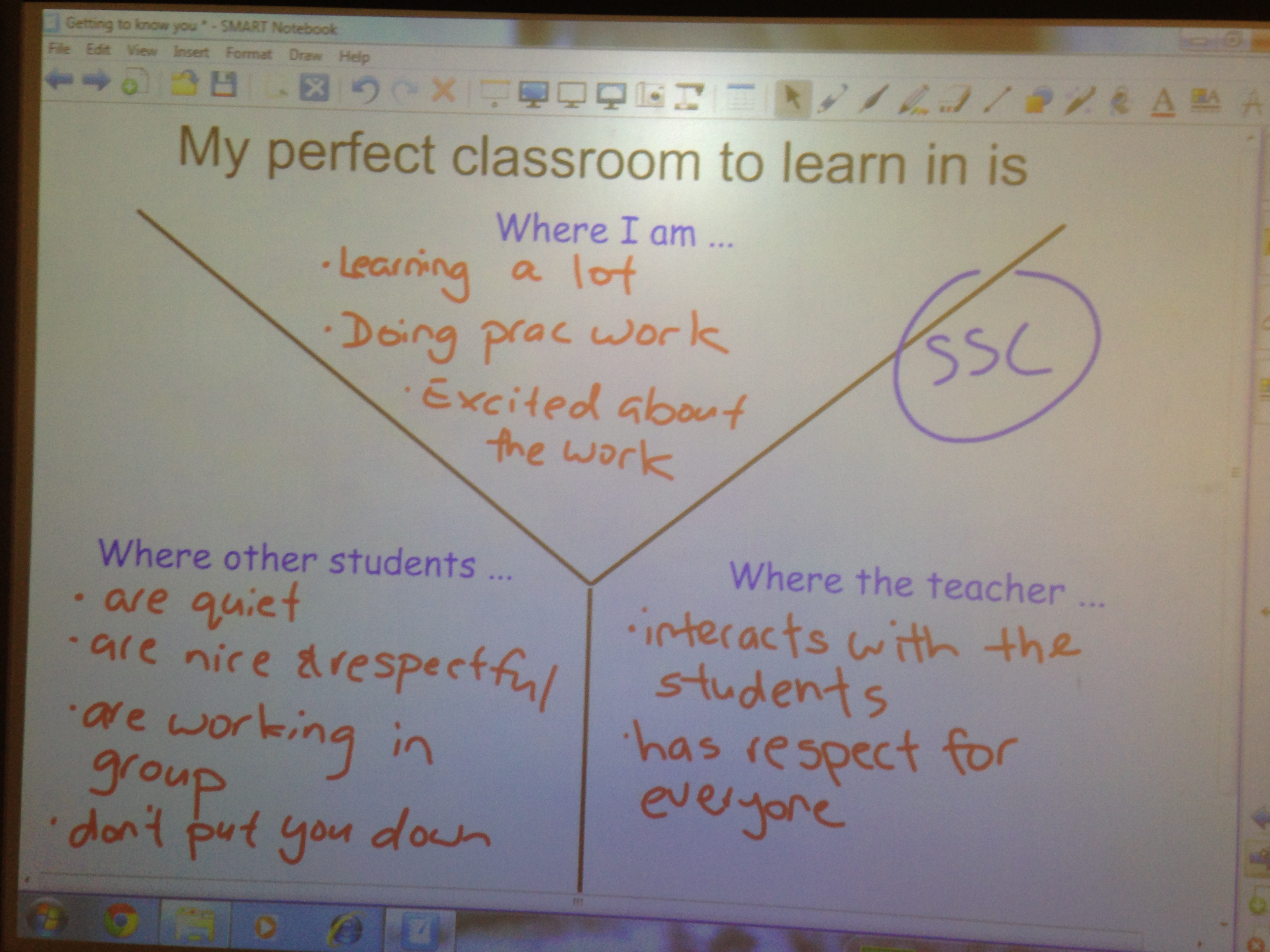
So this year I used the first lesson to kick start the establishment of a class community. Students did two activities: (1) Getting to know you as a learner in 3-2-1 and (2) My perfect classroom to learn in âŚ
Getting to know you as a learner in 3-2-1
Students paired up and interviewed each other on 3 of their favourite things about science, 2 things they find hard about science and 1 thing they want the teacher to know to help them learn the best that they can.
For larger classes, I asked some students to share their responses and then collected their interview sheets to look at later. For smaller classes, all students shared their responses and they were tallied so that students can see what they have in common with other students in terms of learning. Hereâs an example from my Year 11 Senior Science class.
My perfect classroom to learn in âŚ
This activity is used to establish classroom expectations where all students get a say. In pairs students brainstorm what their perfect classroom is like. In their perfect classroom what are they doing as students? What are other students doing? What is the teacher doing? All responses are collated on the board and classroom expectations are established.
I know some teachers will think this is a âsoftâ approach and that I should lay down the law instead and let students know who is boss. But I much prefer this way. I really want to focus on developing positive learning relationships amongst students as I strongly believe this will lead to better learning and achievement.
In New South Wales, Australia, the 2014 school year is just about to start so I thought Iâd share with you my 4 professional goals for 2014.
Goal #1 – Keeping science real
2013 was the year where I started the journey of connecting my students with current, practising Australian scientists. This was a response to our studentsâ survey responses that they did not know many careers or jobs that science can lead them to. They also did not know what scientists actually do. Many students have accountants, tradespeople, bankers, etc within their families or family friends but students often do not have exposure to scientists in their everyday lives (ask a student to name a scientist and theyâll still tell you Isaac Newton or Albert Einstein; they rarely name a living scientist). We wanted to make science real in the sense that we can put real peopleâs faces to what the students learn in the classroom. So in 2013 our school connected with Scientists and Mathematicians in Schools, where we are now partnered with scientist Melina Georgousakis. Melina has already spoken to our Year 8s and 9s on her journey to becoming a scientist, what she does in her job and explained how the immune system and vaccinations work (thatâs her area of expertise). In our end-of-topic survey, a lot of our year 9s listed Melinaâs visit as the best activity of the topic. In their words the best part of the topic was âwhen the lady came in to talk about vaccinesâ. In 2014 we have plans for our Year 12 Biology students to work with Melina when they explore the immune system more deeply.
2014 will also be the year where I want to utilise social media and technology to connect students with scientists, not just in Australia but from around the world. In 2013 social media led me to connect with a postgraduate student called Ash from the University of Technology, Sydney, where he came to the school and spoke to Year 8s about his work with sharks (Year 8s were learning about the role of sharks in the ecosystem and how removing sharks as apex predators impact on the ecosystem). We also connected with Dr Mel Thompson from Deakin University and Dr Karl via Skype. In 2014 I am hoping to expand to using Twitter to connect with my students with scientists. I want to create a class Twitter account for my students and connect with scientists on Twitter. Thereâs so many of them such as @realscientists and Dr Cameron Webb.
Goal #2 – Embed science communication into my teaching
I was very privileged to be involved in the UTS Summer School this year where I worked with Christy, a former Questacon presenter (a science communicator who does science shows for children). She re-emphasised to me the importance of designing learning that drives studentsâ curiosity and create learning experiences that are memorable. One of my biggest gripes with science education is that it uses flash-bang experiments inappropriately. You hear lots of students say they just want to do pracs. You hear a lot of teachers say that all students want to do are pracs. A lot of the times I think showy experiments are wasted at school as they only serve as entertainment. Christy re-emphasised to me that showy experiments need to be set up in a way that drives students to want to know the science WHY something has happened and the journey to understanding they experience must be memorable. This can mean turning explanations into stories, plays, musical items.
One of the ideas I have this year is to have a science communication project where students work in small groups and become science communicators themselves where they design and perform an act that explains a scientific concept. If I could Iâd like to make this a cross-curricular project with Drama.
Goal #3 – Making learning, thinking and understanding visible
This year is where our faculty applies the Structured Observed Learning Framework (SOLO) for all students in Year 9. We have used this yearâs implementation of the new syllabus for the Australian Curriculum as a drive for this change. See this previous post for more details. The challenge (not so much a goal) will be to evaluate the impact on student learning.
Goal #4 – A better work/life balance
Over the last few years I realise that looking after yourself is a one of the most important jobs for teachers. After reading this post on 10 tips for slowing down, I really want to make sure that my entire facultyâs wellbeing is well looked after this year. I tend to be someone who doesnât know when to stop. I feel guilty when Iâm not doing work related to school. When Iâm relaxing it feels like Iâm doing some kind of injustice to my studentsâ education. I love my job but Iâm no use to my students if I burn out. From the post on 10 tips for slowing down, I want to make these changes:
Allocate time to opening and closing meetings
Schools are such busy places that many teachers schedule meetings right on bell times so that we are rushing from one place to another. This year I want meetings where people are now running from their classrooms, crashing down and then expected to immediately adjust their mindframes. Iâm hoping that simple things like having meetings start 5-10 minutes after the bell will avoid that rush feeling that make people stress.
Make time to eat
Eating recess and lunch is my other goal for wellbeing this year. While this seems self-explanatory, I know many teachers donât eat, or sit down, or even visit the bathroom during school hours because thereâs just so much to do. Iâm not sure how successful Iâll be at this but this year I want to reduce the number of times where I eat my sandwich while driving home.
This year my faculty have been designing units of work for the new NSW science syllabus for the Australian Curriculum with the Structured Observed Learning Outcome (SOLO) framework.(If you don’t know what SOLO is, watch this video for a crash course) The reason why we are investing quite heavily into SOLO is because as teachers, we know that self-regulation and quality feedback are the two of the most effective elements in increasing student achievement. SOLO, with its associated learning intentions and success criteria, will allow our faculty to develop our students’ self regulation skills and further improve the quality of teacher feedback and peer feedback.
For most of the year, we have been designing learning with the SOLO framework so that each series of lessons have learning intentions and success criteria catergorised  by the different SOLO levels of thinking and understanding. A couple of weeks ago, we went a step further. The whole faculty sat down and designed an agreed approach to how we will use these learning intentions and success criteria. As a team, we decided learning intentions, success criteria and SOLO were examples of best practice, but we need to ensure that it filters down to every individual student. We agreed that learning intentions, success criteria and SOLO must be high visible and evident in everyday teacher practice for it to have maximum impact on student achievement.
As a team we decided on the following for communicating learning intentions and success criteria to students:
At the start of a topic, students are given a list of the learning intentions and success criteria for the whole topic so they know where they are headed before they start learning about the topic.
Each lesson will have the specific learning intentions and success criteria displayed. This can be written on the board, or displayed via a data projector or interactive whiteboard.
The teacher will explain the learning intentions and success criteria to students at the start of the lesson.
At the last 10 minutes of the lesson, students are to reflect on whether they have achieved the success criteria for the lesson and what they need to do next to be successful.
As a team we also agreed that we need to teach students about SOLO. We have designed different activities for students to learn about SOLO. Here’s one of the activities
As a team we also agreed to providing student feedback using the SOLO framework.
What we hope to see are:
Students and teachers using a common language to discuss levels of thinking and understanding
Students and teachers using SOLO as a way to see current levels of thinking and learning and where that thinking and learning needs to head
More students moving from a fixed mindset to a growth mindset. Many students have a mindset that they are “not good” at science. We want our students to realise that to be good at science, there needs to be a certain level of thinking and learning that can be achieved with effort, as opposed to natural abilities. It’s part of making learning and thinking visible.
Our faculty has also devised a draft plan to evaluate the impact of SOLO on students’ achievements and mindsets, with help from a university academic. So watch this space for more updates on our SOLO journey.
One of the teachers on my faculty (let’s call her Ann for this post) said this to me during our scheduled discussion on her professional goals. At the start of the year, Ann said her professional goal for 2013 was to implement project based learning (PBL) in her Year 9 class.
After looking at the BIE website for a while and attending one of Ashley Cantanzariti’s PBL workshop, Ann created crowd-sourced a driving question for this term’s unit for her Year 9 class with a cross-school group of teachers (this happened in our school’s School Development Day which involved our community of schools). We came up with the driving question of “Will an earthquake or tsunami happen in Sydney?”. The only teacher-centred lesson that Ann gave was the introduction lesson to let the students know the expectations and organisation of their new project. The class sorted themselves into groups and brainstormed what they needed to find out for this project. Ann used Edmodo for students to collaborate and upload their progress of work so she could give them feedback. After several weeks, the groups of students presented their findings to the driving question by choosing whatever medium they thought was appropriate. Some groups chose GoAnimate while other groups made a diorama.
When we were discussing whether Ann thought PBL was very effective for her students to learn science, one of the most memorable things she said was
They found out what an epicenter was, the focus and all other features of earthquakes by themselves. I didn’t have to even tell them.”
This ties in with the first quote on this blog post. Ann expressed that she didn’t feel like she was “teaching” because the students were driving so much of the learning. She recognised that most of the “work” was done prior to the project in designing the driving question and the workflows of how students will submit drafts of work, receive feedback and revise their work, but it was so different to what she was used to she felt like she was not teaching. Her concept of teaching was changing from content deliverer to learning designer and facilitator.
I often feel this way as well. When my students are happily working in their groups, finding answers to their own questions, negotiating with others on what sort of product to make and reflecting on their goals, I often feel like I’m not their teacher or even needed in the classroom. I know that for effective learning to happen students are working harder than teachers (or just as hard) and an effective teacher makes themselves redundant overtime. However, both and I are still somewhat influenced by the traditional notion of teaching – that teaching is a teacher telling students what they need to know. This often challenged concept still has a lot of pull on what both teachers and students perceive learning to be.
Overall this is a step forward for our faculty in terms of changing pedagogies. Instead of only me doing PBL, we now have another teacher implementing PBL and talking to others about how good it is for students.
Student voice is something that I really value. In the perfect world students would have a complete say in what they learn and how they learn. But in the meantime the confines of syllabuses I still like to give my students a say in the learning that’s happening in the classroom. What things do they like learning about? How do they like to learn? Is what they are learning too difficult or too easy? What parts of the classroom learning design do they think needs improvement? What can I do as their teacher to make learning better for them?
My Year 8 class gave their feedback on their learning this week as Term 2 in NSW, Australia drew to a close. Here’s what they thought:
The main topic we studied in Term 2 was called Water Water Everywhere, which is essentially using the particle model to explain the properties of solids, liquids and gases and why one state of matter changes to another when energy is added or removed from the system. This topic is probably one of the most difficult and often disengaging topic for students because it involves an abstract concept. The particle model lends itself to a lot of student misconceptions and is generally something students find difficult to understand, which I have discussed in a previous post. To overcome this the learning was designed so to involve lots of interesting hands-on experiences such as making quicksand and using technology for students to increase their conceptual understanding and allow their misconceptions to be picked more and addressed more frequently.
From the students’ feedback, scientific metalanguage was emphasised as an area they thought needed improvement, so next topic there will be more activities that emphasise the use of scientific metalanguage.
What I also find interesting is students’ decisions on whether they will continue with Science in the post-compulsory years of schooling. What I find particularly interesting is that quite a few students who consistently say they find the learning in Year 8 science fun, interesting and related to the real world, do not want to study science in Year 11 & 12 because their chosen career does not need science. There seems to be a perception with my Year 8s that science in Year 11 and 12 are for people who want to be scientists. This perception is also found in evaluations completed by Year 9 and 10 students.
So one of my challenges for the rest of the year is how am I going to design the learning for these students value science and view it as important to learn, even though they aren’t going to pursue a career in science.
This term my Year 8 class has been running Science News. Science News is where each student in the class takes turns in presenting a science news item that they have found interesting. They have to showcase  the science news item in a two minute presentation. The purpose of Science News is to expose students to the latest discoveries in science. I wanted them to know that science is everywhere.
However, Science News has also taught me new things and not just scientific things. One Science News item challenged how I was designing my learning for my students and how our education system designs learning for our students. Daniel talked about new discoveries on black holes. You can read Danielâs speech to the class here. Right after Daniel finished his speech, half of the classâ hands shot up with questions.
âWhat exactly are black holes?â
âWhat happens when you go into a black hole?â
âI heard that time slows down when go inside a black hole. Is that true?â
âIf we canât see a black hole. How do we know it is there?â
âWhat is a light year?â
I was really happy that my students were so enthusiastic about learning more on black holes. So what did I do? I spent about 5 minutes skimming through the basics of gravity, dark matter and the speed of light and then I said, âOK. We actually learn about this stuff in Year 10. We need to stop now and continue learning about the ozone layer.â
While ozone in the Earthâs atmosphere is very important and Year 8s were also interested in ozone, I felt really guilty in almost extinguishing my studentsâ curiosity in black holes because the syllabus said that they should learn it in Year 10 and right now they should be learning about the ozone layer. Iâm sure many teachers have faced this kind of situation before but it really got me thinking on how the current education system does so much to restrict the learning of our students.
Why do we have to learn about black holes in Year 10?
To be more accurate, students in NSW learn about black holes in Year 9 or 10 (Itâs this thing we call Stage 5, which is Year 9 and 10). I understand that the need to learn age-appropriate concepts. For example, many early primary school-aged students may not have the cognitive ability to tackle abstract concepts (you know, because of all the Piaget stuff). However, I donât see why if my Year 8s want to learn about black holes (and I know they will be able to), they canât learn about it because the syllabus says they learn it in Stage 5. When you learn swimming, your age doesnât determine what kind of things you learn, itâs how fast you are progressing and what you are ready to learn.
Why canât we learn about black holes and the ozone layer?
Why couldn’t I have let my students go online on their phones and look up videos and websites that helped answer their questions about black holes and share it with the class, and then continue with the ozone layer? I wanted to, but I only have 3 hours with them a week and I only see them an hour at a time. Last year I had the same class for 14 hours a week in an integrated curriculum and I would’ve let them explore black holes and then continue with ozone layer because I had the flexibility to do so. However, now I am back to a more traditional and rigid timetable where learning starts and stops with the school bell. Previously I have blogged about the challenges of implementing project based learning in such a traditional school structure. The more I try to implement project based learning or anything that builds on studentsâ curiosity and passion or anything that personlises their learning, the more I want to knock down the existing school structure. A few days ago, I was in a workshop with Greg Whitby on teaching and learning in a Web2.0 world. He said the timetable is the one thing that is stopping effective learning and teaching. I couldnât agree with that point more.
Greg also talked about agile learning spaces. I have to admit when I first heard of agile learning spaces a few years ago, I just liked the look of them. The bright colours and funky furniture looked particularly attractive when you are used to 1950s furniture in classrooms. But since Iâve started PBL, I get it a bit more. So going back to the black hole scenario … In an agile learning space style of learning, Daniel would’ve presented his science news to the whole cohort of Year 8 or a mixture of students from different year groups in one large space. The ones who were interested in learning more about black holes can go with one teacher and the others can go with the other teachers to continue to learn about the ozone layer. Teaching and learning is no longer restricted to one teacher teaching 30 students. Depending on the need, you can be teaching one student or 10 students or 80 students. The space enables you to do so. There are no walls that says you have to teach 30 students at a time. There are also no bells to tell you that you need to spend 60 minutes on learning something; you take as long as you need to. The video below gives you an idea of what learning is like in an agile learning environment.
And now I donât how to end this post. I sort of feel disillusioned. I want to knock down the walls of my classroom but realistically that canât happen. Not just yet anyway. So when the school week starts again, it will be back to the status quo. *Sigh*
Sound waves and waves in general are concepts that Iâve found many students have difficulty understanding. These are concepts that deal with understanding how energy is transmitted from one place to another through a scientific model. Why are these concepts difficult? Firstly it is abstract. You canât see waves. When you speak or hear music you canât see the waves coming out from the source and travelling to your ear. You canât see the vibrations of particles. Secondly learning about the transmission of waves comes with a lot of academic language. Hereâs just a sample of academic scientific jargon youâll hear when you sit in a lesson learning about waves:
Equilibrium
Particles
Transmission
Transfer
Amplitude
Frequency
Period
Wavelength
Compression
Rarefaction
Due to this, learning about waves is particularly challenging for students who are also English language learners. Not only do they have to deal with difficult and abstract scientific concepts, they also have to deal with the intense bombardment of academic language.
This year I have a Year 9 class who are students learning English as a second language. I didnât want to start the topic with a waveform diagram and pointing out what is an amplitude, etc. I planned a learning sequence that will move them from concrete to abstract, and from everyday language to academic language.
The first concept I wanted them to understand is that sound is vibration, or things shaking back-and-forth very quickly. We used the good olâ tin can phones for this. We also did an experiment where students used a vibrating tuning forks to tickle their noses and make tiny splashes with a beaker of water (I thought they would find these experiments too boring, but they absolutely loved it). Every single student left that lesson knowing that sound is caused by vibrations.
The second concept I wanted them to understand is that we can represent sounds as waves. Students used Audacity to record their voices and experiment with how the loudness and pitch of their voice affected how the sound wave looked like on Audacity. We also experimented on whether saying âHello, My name is ____â in English and studentsâ first languages had a difference in pitch.
Hereâs a video on Audacity. Itâs a free program that can be downloaded.
Students worked out from this Audacity activity that the higher pitched their voices were the more squashy the waves were. They also worked out the louder their voices were the taller the waves. I was happy for them to use the words âsquashyâ and âhighâ to describe the waves for the time being.
The following lesson I introduced frequency and amplitude. By now the students had a conceptual understanding of the relationship between sound and vibrations, the relationship between pitch and âsquashinessâ and the relationship between volume and the tallness of waves. They now just had to replace âsquashyâ with frequency and tallness with amplitude.
I really like the strategy of teaching a concept with everyday language first and then introducing the scientific terms after students have actually understood it. Science is hard enough without a bunch of difficult words bombarding students as well.
So it has been about a week after #sologlobalchat, a TweetMeet (an online conversation on Twitter) that involved teachers from Australia, New Zealand and the UK. If you donât know what SOLO is watch this video and read this.
From #sologlobalchat we created an Edmodo group to continue our conversations and collaboration. On that Edmodo group I shared an assessment that a colleague and I worked on for a unit of work based on SOLO.
For Part 2 we came up with some questions that will guide studentsâ evaluation of an existing public health campaign. When I uploaded it onto Edmodo, a teacher called Craig Perry from Christchurch, New Zealand, modified the part into a SOLO exploded map. Not only is the exploded map more visually appealing than a bunch of questions typed up on a sheet (which is essentially what I had at the start), but the exploded map also classifies each question into a SOLO level. (Note that Craig and I have never met. This once again shows how generous the teaching profession is.)
The exploded map demonstrates one of the main reasons why I love SOLO. SOLO lets teachers take a step back and analyse whether they are helping students develop higher order thinking skills. When we talk about 21st learning, we often criticise how traditional school tasks can be completed by students using Google. Using SOLO can help teachers overcome this. If a task only requires students to work the unistructural, multistructural and sometimes even the relational level, can be completed by Google. For something that is non-Googlable, it needs to be extended abstract.
How many of the tasks your students do are non-Googlable? Perhaps SOLO can help đ
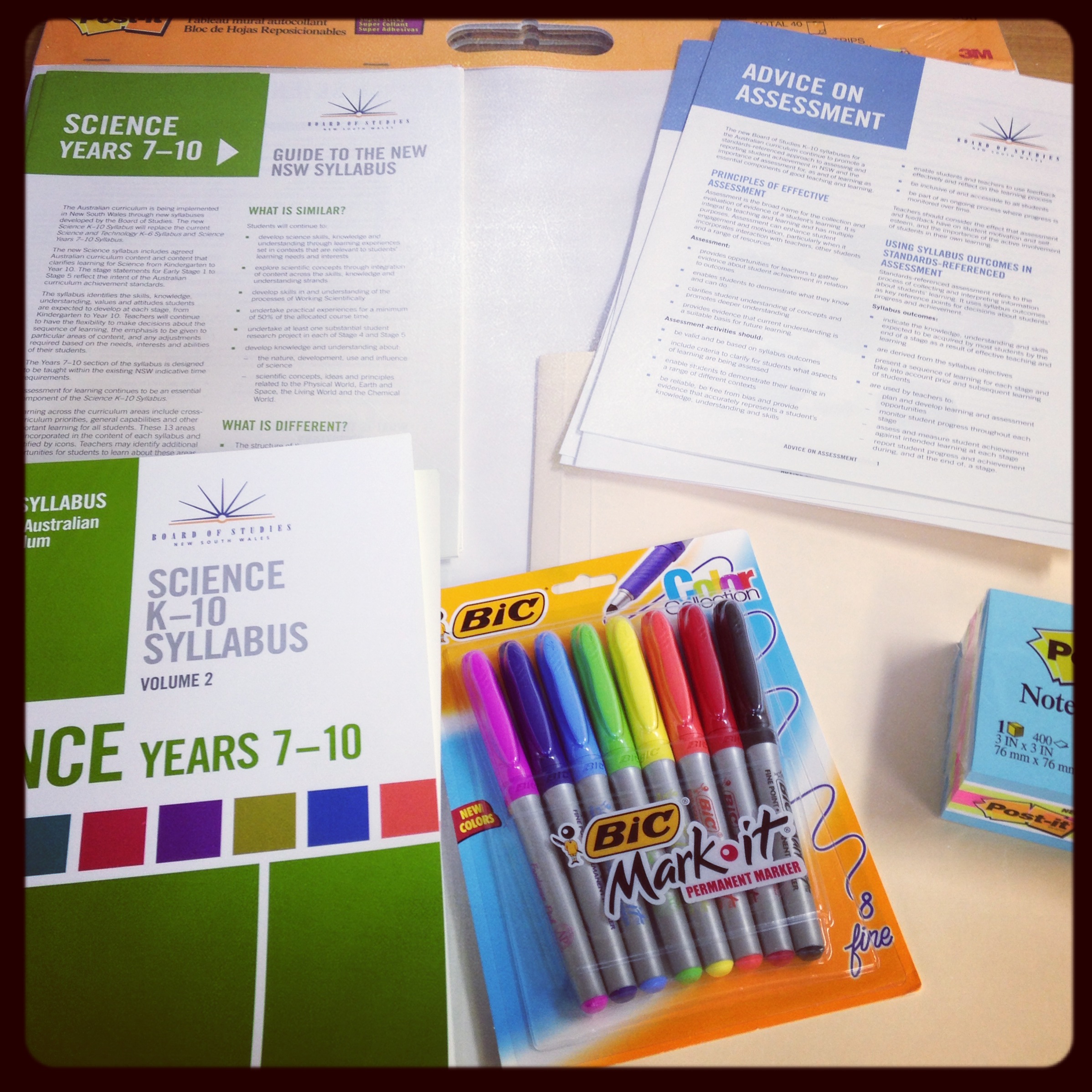
I led my science faculty in using structured observed learning outcomes (SOLO) to design learning for the new NSW science syllabus over the past two days. Like all other NSW schools, we are spending this year preparing for the implementation of new syllabuses for the Australian Curriculum. As a faculty we felt that this was a great opportunity to evaluate the effectiveness of our current teaching and learning practices. We are using the new syllabus as a driver of change in teaching and learning.
We decided to use SOLO as the framework to design learning for the new syllabus. Why did we choose SOLO? One of the main reasons is that the Essential Secondary Science Assessment (ESSA) uses SOLO to assess studentsâ understanding. ESSA is a state-wide science assessment that is completed by all Year 8 students from NSW government schools. An analysis of the trend data shows we needed to work on moving students from being able to recall scientific information to making relationships with this information and then applying this information to real world situations. Another reason why we chose to use SOLO is because it makes learning visible to students and teachers when it is accompanied by learning intentions and success criteria. Learning intentions and success criteria help students focus on the purpose of learning activities rather than just merely completing work. They also help enhance studentsâ self regulation.
So the two days played out like this:
(1)Â Â Â Getting everyone on the same page
We started the two days by analysing where our students currently are and where we want to move our students in their learning and achievements. Why SOLO was explored. We used a KWHLAQ table to do this.
 (2)   Drawing out main concepts from the syllabus
We decided to program a unit on human health and diseases first. We familiarised ourselves with the relevant sections of the syllabus and brainstormed all the concepts, ideas and facts that students needed to understand. Individually we wrote each concept, idea and fact onto post-it notes and stuck them on the whiteboard. As a team we sorted the post-it notes into logical categories.
 (3)   Classifying into SOLO categories
We then classified each concept, idea and fact into SOLO categories. We decided to have 3 SOLO categories:
Level 1 â unistructural and multistructural
Level 2 â relational
Level 3 â extended abstract
 (4)   Assigning SOLO verbs
We assigned SOLO verbs for each concept, idea and fact.
Level 1
Uni/multistructural
Level 2
Relational
Level 3
Extended abstract
Describe
Identify
Name
List
Follow a simple procedure
Compare and contrast
Explain causes
Sequence
Analyse
Relate
Form an analogy
Apply
Criticise