A story in 2 minutes – a multimedia activity for all subjects

My principal shared this video with me today. It’s called Our Story in 2 Minutes. The video summarises the Earth’s history from the Big Bang till now in two minutes.

This inspired me to come up with some similar story-in-2-minutes activities where students can create a video using images only to represent the development of an event. It doesn’t even have to be two minutes. It can be one minute, three minutes, however long you and your students like. A video of images can be made to sequence the events in the evolution of life on Earth, the development of our current understanding of the universe, development of the cell theory, development of our understanding of genetics … the list goes on and on and it can be used in subjects other than science.

What I like about this activity is that it’s simple and yet allows students to create and engage in deep learning that extends from a subject area and even be part of a cross-KLA activity. It’s simple for both students and teachers as it involves searching and selecting images that represents certain ideas and events and then inserting the images into a video-editing program such as Windows Movie Maker or even PowerPoint. Technology tools that don’t require a high level of technical expertise from either teachers or students and are available to most students. The activity is also simple in the sense that it does not have to take long, which can be a good activity to suggest to teachers who are concerned about being pressed for time.

To create stories in 2 minutes also allow students the opportunity to learn about digital citizenship. Can students use any images pulled from the web? Do they have to search for creative commons images? How do they acknowledge the source of images? This activity is not only about the content of a subject area.

Finally creating stories in 2 minutes can be adapted into project-based learning or provide an opportunity to create a product that can be shared with a public audience beyond the classroom. Creating a story in 2 minutes require students to first understand the content, select and justify appropriate images that best represent the content and sequence them in a logical order. It allows students to apply higher order thinking skills.

I teach in Sydney, Australia so my school year is starting in about a week’s time. I will be definitely using the story-in-2-minutes concept this year.

What will you use it for?


Learning about SOLO – using self regulation and feedback to increase student achievement

This year my faculty have been designing units of work for the new NSW science syllabus for the Australian Curriculum with the Structured Observed Learning Outcome (SOLO) framework.(If you don’t know what SOLO is, watch this video for a crash course) The reason why we are investing quite heavily into SOLO is because as teachers, we know that self-regulation and quality feedback are the two of the most effective elements in increasing student achievement. SOLO, with its associated learning intentions and success criteria, will allow our faculty to develop our students’ self regulation skills and further improve the quality of teacher feedback and peer feedback.

For most of the year, we have been designing learning with the SOLO framework so that each series of lessons have learning intentions and success criteria catergorised  by the different SOLO levels of thinking and understanding. A couple of weeks ago, we went a step further. The whole faculty sat down and designed an agreed approach to how we will use these learning intentions and success criteria. As a team, we decided learning intentions, success criteria and SOLO were examples of best practice, but we need to ensure that it filters down to every individual student. We agreed that learning intentions, success criteria and SOLO must be high visible and evident in everyday teacher practice for it to have maximum impact on student achievement.

As a team we decided on the following for communicating learning intentions and success criteria to students:

  • At the start of a topic, students are given a list of the learning intentions and success criteria for the whole topic so they know where they are headed before they start learning about the topic.
  • Each lesson will have the specific learning intentions and success criteria displayed. This can be written on the board, or displayed via a data projector or interactive whiteboard.
  • The teacher will explain the learning intentions and success criteria to students at the start of the lesson.
  • At the last 10 minutes of the lesson, students are to reflect on whether they have achieved the success criteria for the lesson and what they need to do next to be successful.

As a team we also agreed that we need to teach students about SOLO. We have designed different activities for students to learn about SOLO. Here’s one of the activities

As a team we also agreed to providing student feedback using the SOLO framework.

What we hope to see are:

  • Students and teachers using a common language to discuss levels of thinking and understanding
  • Students and teachers using SOLO as a way to see current levels of thinking and learning and where that thinking and learning needs to head
  • More students moving from a fixed mindset to a growth mindset. Many students have a mindset that they are “not good” at science. We want our students to realise that to be good at science, there needs to be a certain level of thinking and learning that can be achieved with effort, as opposed to natural abilities. It’s part of making learning and thinking visible.

Our faculty has also devised a draft plan to evaluate the impact of SOLO on students’ achievements and mindsets, with help from a university academic. So watch this space for more updates on our SOLO journey.


3 reasons why students are switching off science

There is a decline in student interest in science. Just type “students decline science” and hundreds of articles will come up of students not choosing to study science in post-compulsory schooling in countries like Australia, USA and the UK. At a time where technology is rapidly increasing and the world is facing issues like climate change, rapid rates of extinction, water shortage and food shortage, it is worrying to see students switching off science.

What I find more concerning is my observations that kids love watching science YouTube channels at home in their own time, but they are not enjoying school science. Something is wrong. While the reasons below for why students are switching off science are not validated by any research data, they are inklings that I have based on observations of students and numerous student surveys completed at my school on their engagement in science.

Reason #1 – Science teachers rely too much on whiz-bang experiments to make science interesting

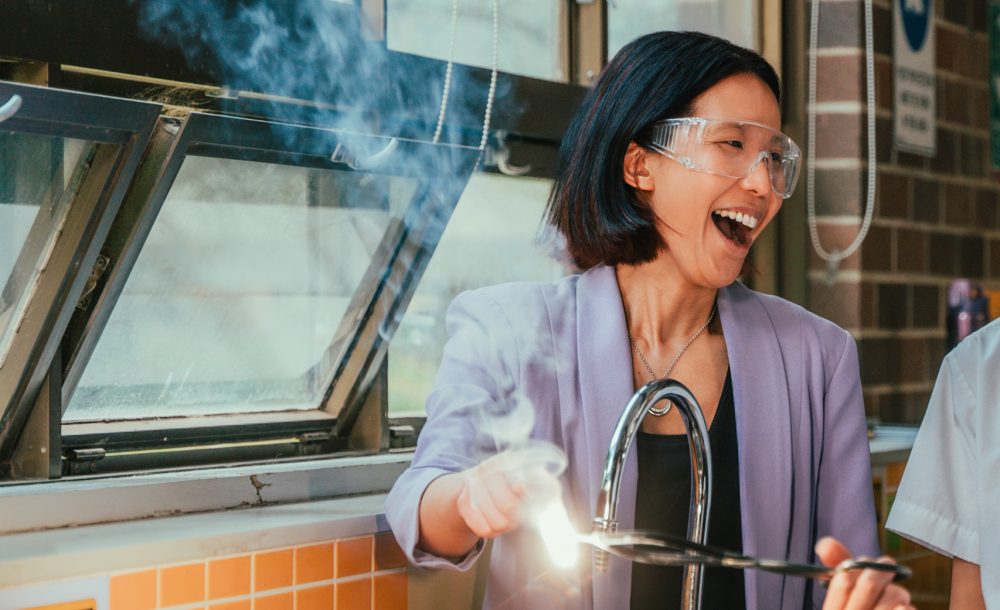
I think every science teacher is guilty of this. I certainly am. We often use showy experiments for entertainment to keep students engaged. Instead of promoting our subject as intrinsically interesting, we use colourful and bubbly experiments to “trick” students into liking science. How many times do we have students walk into a science lab and ask “are we doing an experiment today” and groan when the answer is no. Of course experiments have a place in science, but science isn’t about setting things on fire or making things explode. Science is a way of thinking and aligns with humans’ natural curiosity of understanding of the world around us. I think we have pushed science as a subject of fire and explosions for so long that this is what students expect and they are disappointed when a unit of work or a series of lessons do not have experiments.

Reason #2 – Science lessons often do not allow all students to experience some success

In NSW, Australia, Year 8 students do a state-wide test called Essential Secondary Science Assessment (ESSA). At the end of ESSA, students are asked to rank their favourite subjects. Since 2006, year after year the results show students like PDHPE and Visual Art the most. My gut feeling is that these subjects allow ALL students to experience some success. In Visual Art, it doesn’t matter if you are a not-so-good painter or if you are as brilliant as Picasso, every single student is able to produce an artwork, which is showcased. Same with PDHPE, it doesn’t matter how bad or good you are at sport, every single student have been part of a team that has won a game and experienced the excitement of success. Not so in science. In many science lessons, students don’t produce anything that can be showcased. Only a handful of student who are “good” at science feel success. A lot of students think they are “bad” at science. This is one of the reasons why I’m a fan of project based learning (PBL). PBL enables students to create a product that shows their learning and they showcase that product to an authentic audience. This give students a sense of success.

Reason #3 – Students don’t know the careers that science can lead to

Not many students see scientists in their everyday lives. They see bankers, accountants, lawyers but they rarely see scientists or associate jobs with science. In the surveys at my school, the most common reason given for not wanting to study science in post-compulsory schooling is that they don’t need science for their job or career. While we as science teachers know that many jobs and careers require some understanding of science, do our students know? Do we link our students to current practicing scientists so they can what they learn in school is actually used in people’s jobs in real life?

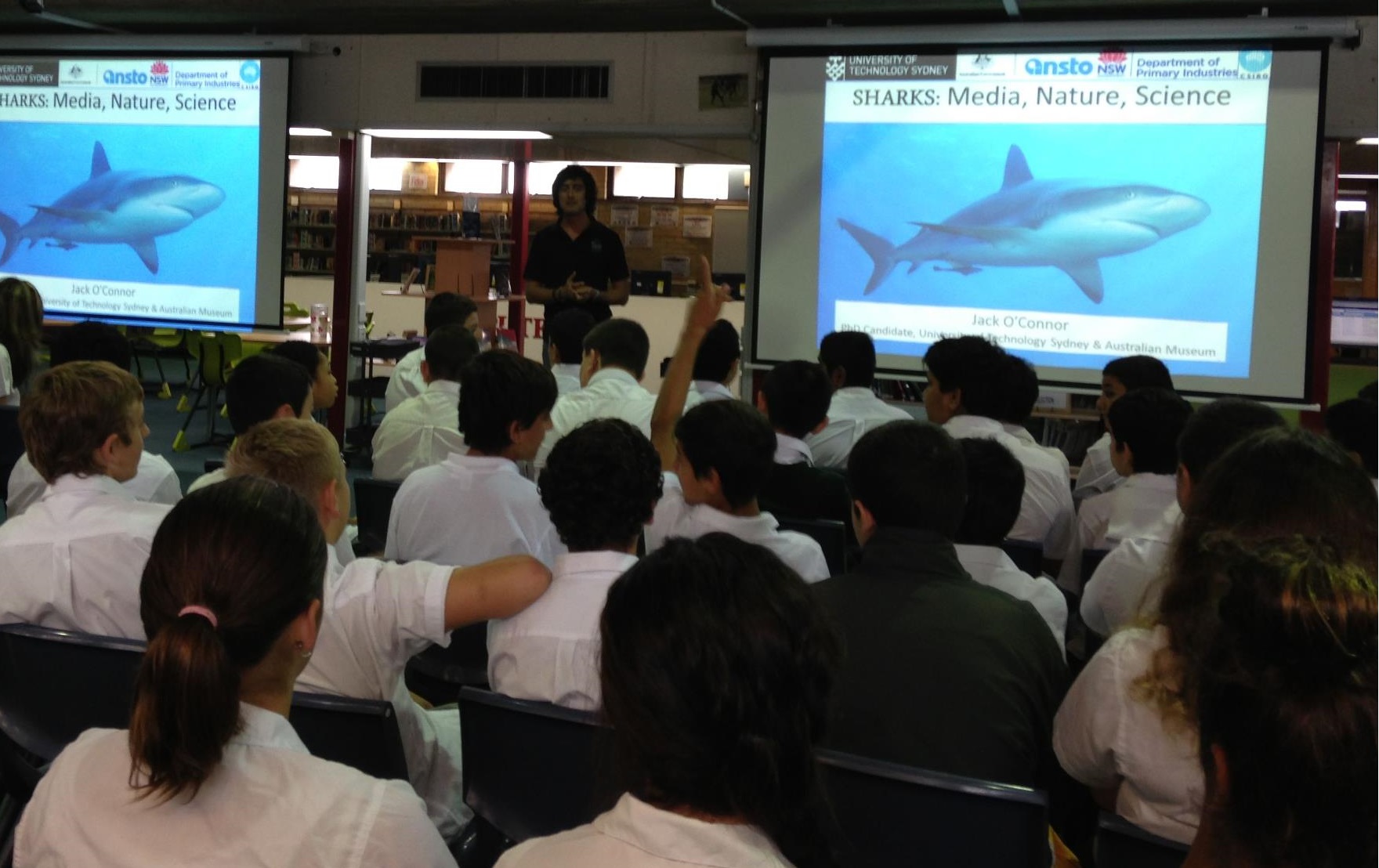
At my school we have been pushing for connections with university pHd students and current scientists. Through the University of Technology, Sydney (UTS), our students have been lucky enough to go to the university regularly and hear about current research conducted pHd students and meet scientists face-to-face and know that science can lead to a fulfilling career. We have utlised the scientists in schools program to have a scientist come to talk to our students about what she does in her everyday job and why finds her job fun and rewarding. We also ask parents to come to school and speak to our students. This year, we had a parent who works in the communications industry speak to our students about his job, how it requires an understanding of energy transmission and waves and how much he loves his job.

A marine biologist specialising in sharks speak to Year 8s about this job and why he loves being a scientist.

A marine biologist specialising in sharks speak to Year 8s about this job and why he loves being a scientist.

And has all this gotten results? Many of our year 10 students apply to attend UTS summer school where they can choose from film, design, science, IT and health over the Christmas holidays. In previous years I have struggled to get any students to apply for the science summer school. Everyone wanted to film and design. After a couple of years of connecting students with university science students and real scientists, we have 12 students apply for science summer school this year.

As we are entering the new syllabus for the Australian Curriculum in NSW, it is time that science teachers re-think HOW we teach science and how can we work with the scientific community to increase student engagement in science.
 

School holidays – the perfect time to learn from other schools

“I don’t know why you would even think about going near any school while you’re on holidays”

This is what one teacher said to me when I told them that I was going to spend half a day visiting a school during the school holidays. At the moment it is the Term 3 school holidays in New South Wales, Australia. For me teaching isn’t something I can switch off. Don’t get me wrong, I still have my down time and I think this down time is important for all teachers’ wellbeing. But I personally like to take advantage of the school holidays and use the time to visit schools that are outside the NSW public education system. Especially schools that are drastically different to the one I currently teach in because what I’ve learnt is that almost every school faces a similar set of challenges whether it is student engagement, student wellbeing or finding ways to develop students higher-order thinking. I find that when I visit schools that have different circumstances than my own, I am exposed to different solutions that I can adapt to my own school and my own classes.

Over the past two years I have been able to visit schools outside of New South Wales and outside of Australia, and they have been some of the best professional learning I have ever had. While some of these visits were done during term time, most visits were done during school holidays. Here are some of the schools I’ve visited and what I’ve learnt from them.

During my time with Microsoft’s Partners in Learning team in 2012, I was able to travel to Auckland, New Zealand and visit Ferguson Intermediate School and Howick College. These two schools kick-started my journey and my faculty’s journey into using the Structured Observed Learning Outcomes (SOLO) framework, learning intentions and success criteria to design learning for the new science syllabus for the Australian Curriculum. Howick College is also where I saw the fantastic Julia Breen and got ideas from her on how to use green screens in student-produced videos.

I took a week of without pay from school in December 2012 and travelled to London and visited ACS International School, Egham. I ‘met’ the Principal of ACS International School, Egham online via LinkedIn and he was kind enough to take time out to show me his school for half a day. I was also privileged enough to speak to their Head of Science and observed a part of a middle school science lesson. During this visit I learnt more about the International Baccalaureate Middle Years Program and how technology was integrated into the school’s middle years science program.

Just last week I was able to visit two schools in Canberra – Brindabella Christian College and Dickson College. I was able to further connect with two passionate educators who are part of my online professional learning network on Twitter, Melanie Spencer and Betty Chau. From these schools I took away ideas for learning space design, how to drive change and how to further develop the digital leaders team at my own school.

Visiting other schools is one of the best professional learning that I undertake. If you’re a teacher and you have some spare time in the school holidays, ask another school if you can visit them and then return the favour to them 🙂

Incidentally I am planning to travel to Tokyo, Japan in the April school holidays in 2014. Would love any suggestions of schools in Tokyo that I can visit.

Small changes can make a huge difference

Over the past few years I have been constantly changing the way I teach due to introduction of 1:1 laptop initiatives in some classes and a continually-developing understanding of how students learn. In a lot of cases it has involved turning things upside down and completely rewriting units of work. This is tiring. Worth it but tiring. But I found out recently that small, minor changes can make a huge difference too. The Student Research Project (SRP) has been around since I was in high school. It’s an oldie but a goodie. The SRP involves students planning, doing and reporting on an experiment of their choice. It is a compulsory activity for all Year 7-10 students in NSW, Australia. Each student must do at least one SRP once in Year 7 and 8, and another one in Year 9 and 10. By doing the SRP, students learn how to design a fair experiment, a must-have skill for all scientists! See here for more info on the SRP.

It was the Year 8’s turn to do the SRP in September this year. The traditional way of doing the SRP is for students to choose an experiment, plan it, do it and then submit a written report. This year my faculty decided to revamp it and not just rehash the status quo. However this didn’t involve major changes that would stress everyone out. It involved a few tweaks that would have the most impact. Like always we gave students the choice of whatever experiment they wanted. My class were doing experiments ranging from water absorption of different types of soils to whether particular types of video games would improve people’s reaction times to using Gary’s Mod to run a simulated experiment. However instead of forcing students to do a written report, we decided to let students choose how to present their SRP findings in whatever medium they wanted. Some students still chose to submit a written report (but by sharing it as a Google document to make the feedback process more efficient) while other students chose to create Prezis or videos. Students had to justify why their chosen medium would be the most effective in communicating their findings to others. At the conclusion of the SRP, students shared their findings with their class over a two-day conference, just like real scientists.

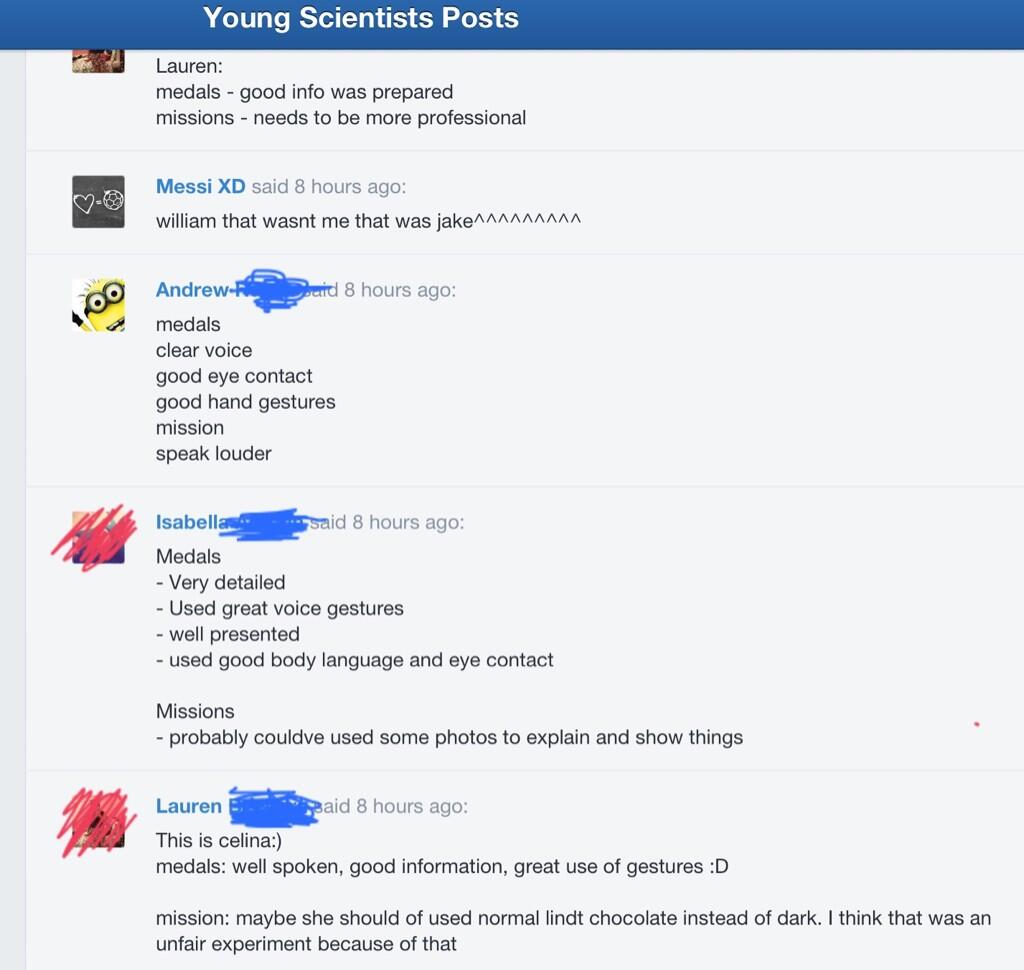
In the presentations I would usually get students to give each other feedback (one medal and one mission) by writing it down on a piece of paper, which I will take home and collate and then give back to students. This was a really inefficient way of doing it. Students had to wait at least 24 hours to get peer feedback and it took me time to type of the students’ feedback. This time I decided to create a backchannel on Edmodo that students used to give feedback to each presenter. Students did this by using laptops. A designated student had the role of creating a post for each presenter and then the whole class will reply to that post with a medal and mission for the presenter. Doing it this way meant that the presenter got the feedback as soon as they finished presenting; they didn’t have to wait till the next day after I’ve collated the class’ feedback. Students really liked the immediacy of the feedback they got from the Edmodo backchannel. There was also one student who made a video for his SRP, but he was ill over the two days of the presentations. His video was still shown and he was able to receive feedback on it at home from his peers via the Edmodo backchannel.

A sample of the Edmodo backchannel

So just with a little of tweaking, the good ol’ SRP has been thrusted into the 21st century. I didn’t have to completely re-write it or turn it upside down. Just by adding Google docs, more student choice and Edmodo, the SRP was made a million times better for students as a learning process. From the end-of-term evaluations, many students from across all Year 8 classes identified the SRP to be their favourite activity this term because it gave them choice, it let them use technology and they learnt by doing.

Next time I’d like to have students sharing their findings with a global audience, or at least with an audience beyond their class. But one small step at a time 🙂

All high school teachers should teach primary school

20130822-202405.jpg
I am so lucky this year that I get to teach with my primary school colleagues from our partner primary schools. For the last two terms I taught Year 5s from Hilltop Road Public School and for the rest of this year I am teaching Year 5s at Merrylands East Public School and Merrylands Public School.

Teaching with primary school teachers have been one of the best professional learning experiences I have had. Here are the main things from primary schools that really speak to me:

-It’s all about students and learning. It isn’t about particular subjects and pushing content. Everything from what is displayed on the walls to the activities is all about the learner.
-Primary school students can do a lot more than you think. While I have never been one of those teachers who think Year 7 students are babies, the level and rigour of learning in primary schools continue to amaze me. Kids are making stop motion animations, blogging, producing their own news … The level of richness is their learning is often unknown to high school teachers.
-I learn so much from watching how primary school teachers structure learning. From how they break down complex tasks to how they use the wall space as another teacher. I have learnt so much from Brett Kent and Karlie Hindmarsh (@karliehindie)

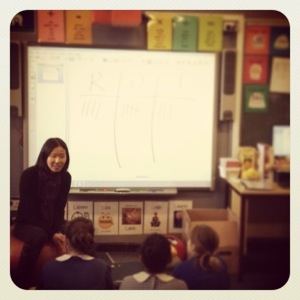
So if you are a high school teacher, you should see whether you can teach with your primary school colleagues. It will be one of the best learning experiences. Plus you get to teach while sitting on a yoga ball. Why wouldn’t you want that experience! 🙂

No longer the solo crazy dancing guy

We have all seen the crazy dancing guy video. The video emphasises that a leader must start a movement. At the start you will be dancing like a crazy lunatic by yourself but eventually you will have your first follower, then more followers and dancing like crazy will no longer be crazy but the norm. The important thing is to get the first initial followers!

For a while I have felt like I was dancing alone, but not anymore. I knew that when my faculty was programming for the new syllabus for the Australian Curriculum and a teacher said “I think we should make the natural disasters unit project based learning” and other teachers agreed. It is no longer me who is suggesting new pedagogical approaches, but other teachers in the faculty.

I also had another teacher in my faculty move from very traditional styles of assessment to experimenting with new approaches. Instead of relying on written, research-based assessments, his Year 11 Physics class was given the challenge of teaching a historical model of the solar system to Year 8 students.

20130816-195154.jpg

Year 11 Physics students teaching Year 8s

There are heaps more examples of other teachers in the faculty embracing and driving change themselves. They are now becoming dancers as well and are encouraging others to dance with them. I am so proud of my faculty and how far we have progressed as a team, all with the aim of improving science learning for our students.

“I didn’t feel like I was teaching” – journey in leading others in PBL

But I didn’t feel like I was teaching

One of the teachers on my faculty (let’s call her Ann for this post) said this to me during our scheduled discussion on her professional goals. At the start of the year, Ann said her professional goal for 2013 was to implement project based learning (PBL) in her Year 9 class.

After looking at the BIE website for a while and attending one of Ashley Cantanzariti’s PBL workshop, Ann created crowd-sourced a driving question for this term’s unit for her Year 9 class with a cross-school group of teachers (this happened in our school’s School Development Day which involved our community of schools). We came up with the driving question of “Will an earthquake or tsunami happen in Sydney?”. The only teacher-centred lesson that Ann gave was the introduction lesson to let the students know the expectations and organisation of their new project. The class sorted themselves into groups and brainstormed what they needed to find out for this project. Ann used Edmodo for students to collaborate and upload their progress of work so she could give them feedback. After several weeks, the groups of students presented their findings to the driving question by choosing whatever medium they thought was appropriate. Some groups chose GoAnimate while other groups made a diorama.

When we were discussing whether Ann thought PBL was very effective for her students to learn science, one of the most memorable things she said was

They found out what an epicenter was, the focus and all other features of earthquakes by themselves. I didn’t have to even tell them.”

This ties in with the first quote on this blog post. Ann expressed that she didn’t feel like she was “teaching” because the students were driving so much of the learning. She recognised that most of the “work” was done prior to the project in designing the driving question and the workflows of how students will submit drafts of work, receive feedback and revise their work, but it was so different to what she was used to she felt like she was not teaching. Her concept of teaching was changing from content deliverer to learning designer and facilitator.

I often feel this way as well. When my students are happily working in their groups, finding answers to their own questions, negotiating with others on what sort of product to make and reflecting on their goals, I often feel like I’m not their teacher or even needed in the classroom. I know that for effective learning to happen students are working harder than teachers (or just as hard) and an effective teacher makes themselves redundant overtime. However, both and I are still somewhat influenced by the traditional notion of teaching – that teaching is a teacher telling students what they need to know. This often challenged concept still has a lot of pull on what both teachers and students perceive learning to be.

Overall this is a step forward for our faculty in terms of changing pedagogies. Instead of only me doing PBL, we now have another teacher implementing PBL and talking to others about how good it is for students.

Using video as evidence of learning

Today my Year 8s used lollies and toothpicks to model elements, molecules, compounds and mixtures. This isn’t anything new. Lots of teachers and students have done this before. However, I decide to allow students to film themselves explaining how the lolly models they made represent elements, molecules, compounds and mixtures as evidence of learning. For one group, I decided to record a question-and-answer conversation on my iPad.

The video showed that this student understood to a certain extent how particles are arranged in elements, molecules, compounds and mixtures. The student did accurately use the lollies for this, but upon questioning, she was confused about how many different types of particles made up her lolly models of compounds and mixtures.

I’d like this type of evidence of learning to be prominent in schools. As a system I think we rely too heavily on written exams and assignments to elicit student understanding of concepts. Having videos such as the one shown above is much more powerful to give feedback to students and to use as evidence of learning. Eventually I’d like each of teacher in my faculty to a collection of videos like this for professional discussions on our students’ learning.

BYOD – the first steps

So my school has decided to journey down the BYOD path. This is for several reasons, including students already bringing in their own devices (not just their own smartphones but quite a few students bring in their own laptops and tablets) and asking for them to be connected to the school WiFi and wanting to continue technology-rich learning post DER (DER stands for Digital Education Revolution, an Australian government initiative that gave Year 9 students their own laptops. The funding for this has ended.)

Several teachers have asked for a blog post on our BYOD journey so far so here it is …

Before we jumped on the BYOD bandwagon, we wanted to know what students thought of this. This involved chatting to students to explain what BYOD is and whether they would bring the devices they already at home to school. We put the feelers out to see what students, parents and teachers think. The students we spoke to in these informal discussions were very supportive of the idea of BYOD and wanted to be involved in the school’s exploration of possibly implementing BYOD.

At the same time, we also looked at the literature review into BYOD and did some further research, which included using the insights from Mal Lee’s Bring Your Own Technology. Once we had a good grasp of the educational research and grounding for BYOD, looked into other school’s journey into BYOD, looked at what we already knew about our school community, we decided to propose a BYOD model where students bring in whichever laptops or tablets they wanted as long as the devices connected to the school WiFi and had certain basic software and apps installed. We also seeked feedback from people with a bit more expertise than we did at BYOD (hat tip to Pip Cleaves and Stephen Turner in particular).

So at this stage, the senior executive team was happy, the students we spoke to were happy and the teachers we seeked out for the BYOD trial was happy with the model. At this stage, our Community Liaison Officer and P&C gave their support to the model and was able to help us explain our BYOD proposal to parents. This launched us into mass data collection stage. We had a fair idea of what devices our students already owned and the challenges that will face our students’ families if BYOD is implemented, but wanted to be 100% sure and to hear as many voices and ideas as possible.

We surveyed Year 7 and 8 students and their parents. From the student survey data, we chose a group of students that held a diverse range of views towards BYOD for student focus groups, which is also acting as a student advisory group for BYOD. The focus groups enabled students to explain their concerns towards BYOD in detail and as a group come up with solutions to address their concerns.

From all the data collection and consultation with the school community, there was overwhelming support for BYOD and the reasons cited include:

-students already being familiar with their own devices
-having access to their own devices in class caves time as they longer need to move from their regular classrooms to a computer room
-bringing their own devices to school will make learning more fluid between school and home
-technology being a part of students everyday lives

The main concerns that were raised were:
-how equity issues will be addressed
-safety and storage of devices
-digital citizenship

The main lessons we’ve learnt from our BYOD journey so far is to involve the school community as much as possible. This sounds obvious but from our experience it is the students and parents who have come up with the best solutions to address challenges of BYOD.

Our next step is to work with teachers and students on the next challenges, which includes leading a classroom with multi-platform devices and learning design that will best utilise students’ devices.