Learning about SOLO – using self regulation and feedback to increase student achievement

This year my faculty have been designing units of work for the new NSW science syllabus for the Australian Curriculum with the Structured Observed Learning Outcome (SOLO) framework.(If you don’t know what SOLO is, watch this video for a crash course) The reason why we are investing quite heavily into SOLO is because as teachers, we know that self-regulation and quality feedback are the two of the most effective elements in increasing student achievement. SOLO, with its associated learning intentions and success criteria, will allow our faculty to develop our students’ self regulation skills and further improve the quality of teacher feedback and peer feedback.

For most of the year, we have been designing learning with the SOLO framework so that each series of lessons have learning intentions and success criteria catergorised  by the different SOLO levels of thinking and understanding. A couple of weeks ago, we went a step further. The whole faculty sat down and designed an agreed approach to how we will use these learning intentions and success criteria. As a team, we decided learning intentions, success criteria and SOLO were examples of best practice, but we need to ensure that it filters down to every individual student. We agreed that learning intentions, success criteria and SOLO must be high visible and evident in everyday teacher practice for it to have maximum impact on student achievement.

As a team we decided on the following for communicating learning intentions and success criteria to students:

  • At the start of a topic, students are given a list of the learning intentions and success criteria for the whole topic so they know where they are headed before they start learning about the topic.
  • Each lesson will have the specific learning intentions and success criteria displayed. This can be written on the board, or displayed via a data projector or interactive whiteboard.
  • The teacher will explain the learning intentions and success criteria to students at the start of the lesson.
  • At the last 10 minutes of the lesson, students are to reflect on whether they have achieved the success criteria for the lesson and what they need to do next to be successful.

As a team we also agreed that we need to teach students about SOLO. We have designed different activities for students to learn about SOLO. Here’s one of the activities

As a team we also agreed to providing student feedback using the SOLO framework.

What we hope to see are:

  • Students and teachers using a common language to discuss levels of thinking and understanding
  • Students and teachers using SOLO as a way to see current levels of thinking and learning and where that thinking and learning needs to head
  • More students moving from a fixed mindset to a growth mindset. Many students have a mindset that they are “not good” at science. We want our students to realise that to be good at science, there needs to be a certain level of thinking and learning that can be achieved with effort, as opposed to natural abilities. It’s part of making learning and thinking visible.

Our faculty has also devised a draft plan to evaluate the impact of SOLO on students’ achievements and mindsets, with help from a university academic. So watch this space for more updates on our SOLO journey.


3 reasons why students are switching off science

There is a decline in student interest in science. Just type “students decline science” and hundreds of articles will come up of students not choosing to study science in post-compulsory schooling in countries like Australia, USA and the UK. At a time where technology is rapidly increasing and the world is facing issues like climate change, rapid rates of extinction, water shortage and food shortage, it is worrying to see students switching off science.

What I find more concerning is my observations that kids love watching science YouTube channels at home in their own time, but they are not enjoying school science. Something is wrong. While the reasons below for why students are switching off science are not validated by any research data, they are inklings that I have based on observations of students and numerous student surveys completed at my school on their engagement in science.

Reason #1 – Science teachers rely too much on whiz-bang experiments to make science interesting

I think every science teacher is guilty of this. I certainly am. We often use showy experiments for entertainment to keep students engaged. Instead of promoting our subject as intrinsically interesting, we use colourful and bubbly experiments to “trick” students into liking science. How many times do we have students walk into a science lab and ask “are we doing an experiment today” and groan when the answer is no. Of course experiments have a place in science, but science isn’t about setting things on fire or making things explode. Science is a way of thinking and aligns with humans’ natural curiosity of understanding of the world around us. I think we have pushed science as a subject of fire and explosions for so long that this is what students expect and they are disappointed when a unit of work or a series of lessons do not have experiments.

Reason #2 – Science lessons often do not allow all students to experience some success

In NSW, Australia, Year 8 students do a state-wide test called Essential Secondary Science Assessment (ESSA). At the end of ESSA, students are asked to rank their favourite subjects. Since 2006, year after year the results show students like PDHPE and Visual Art the most. My gut feeling is that these subjects allow ALL students to experience some success. In Visual Art, it doesn’t matter if you are a not-so-good painter or if you are as brilliant as Picasso, every single student is able to produce an artwork, which is showcased. Same with PDHPE, it doesn’t matter how bad or good you are at sport, every single student have been part of a team that has won a game and experienced the excitement of success. Not so in science. In many science lessons, students don’t produce anything that can be showcased. Only a handful of student who are “good” at science feel success. A lot of students think they are “bad” at science. This is one of the reasons why I’m a fan of project based learning (PBL). PBL enables students to create a product that shows their learning and they showcase that product to an authentic audience. This give students a sense of success.

Reason #3 – Students don’t know the careers that science can lead to

Not many students see scientists in their everyday lives. They see bankers, accountants, lawyers but they rarely see scientists or associate jobs with science. In the surveys at my school, the most common reason given for not wanting to study science in post-compulsory schooling is that they don’t need science for their job or career. While we as science teachers know that many jobs and careers require some understanding of science, do our students know? Do we link our students to current practicing scientists so they can what they learn in school is actually used in people’s jobs in real life?

At my school we have been pushing for connections with university pHd students and current scientists. Through the University of Technology, Sydney (UTS), our students have been lucky enough to go to the university regularly and hear about current research conducted pHd students and meet scientists face-to-face and know that science can lead to a fulfilling career. We have utlised the scientists in schools program to have a scientist come to talk to our students about what she does in her everyday job and why finds her job fun and rewarding. We also ask parents to come to school and speak to our students. This year, we had a parent who works in the communications industry speak to our students about his job, how it requires an understanding of energy transmission and waves and how much he loves his job.

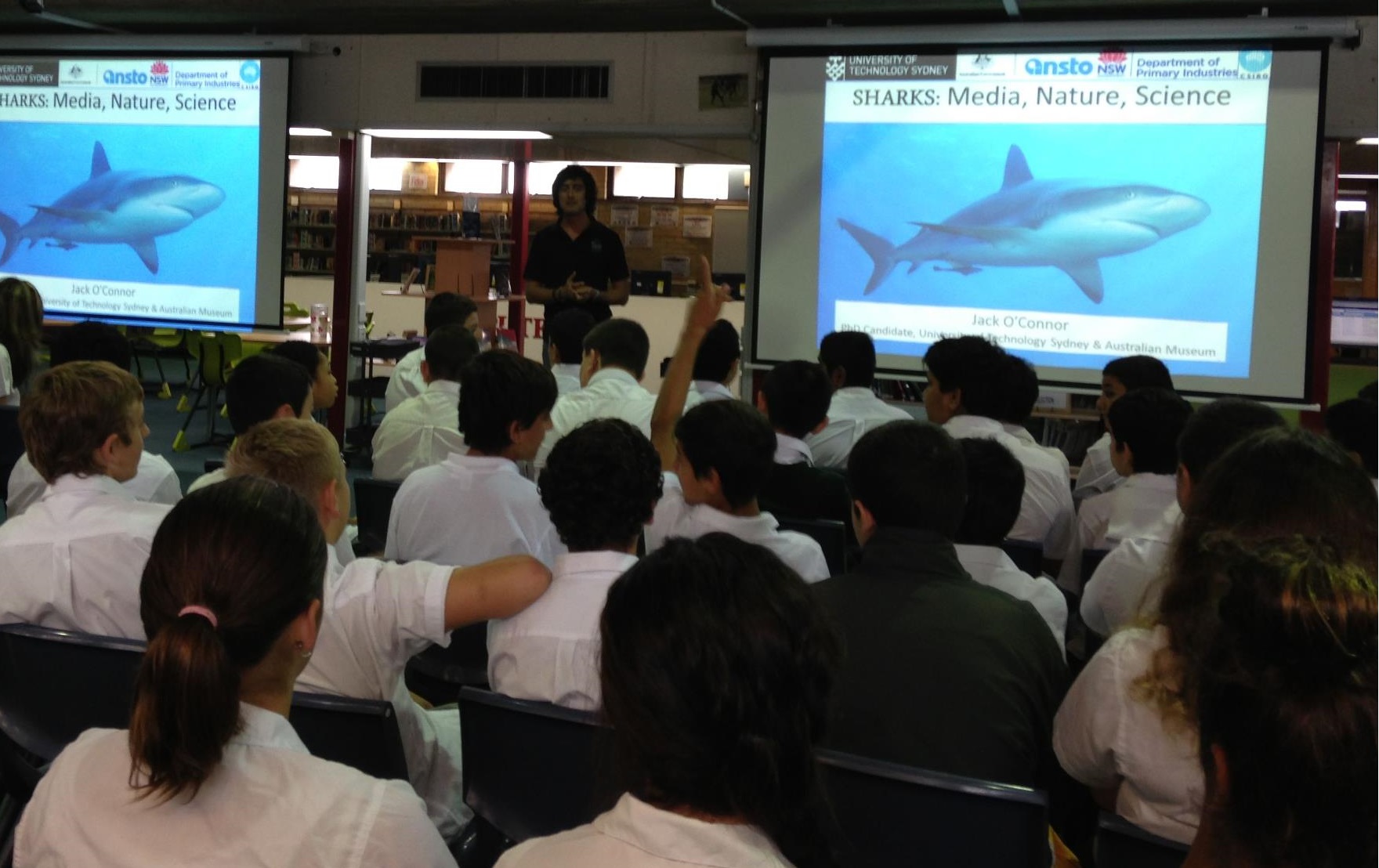
A marine biologist specialising in sharks speak to Year 8s about this job and why he loves being a scientist.

A marine biologist specialising in sharks speak to Year 8s about this job and why he loves being a scientist.

And has all this gotten results? Many of our year 10 students apply to attend UTS summer school where they can choose from film, design, science, IT and health over the Christmas holidays. In previous years I have struggled to get any students to apply for the science summer school. Everyone wanted to film and design. After a couple of years of connecting students with university science students and real scientists, we have 12 students apply for science summer school this year.

As we are entering the new syllabus for the Australian Curriculum in NSW, it is time that science teachers re-think HOW we teach science and how can we work with the scientific community to increase student engagement in science.


School holidays – the perfect time to learn from other schools

“I don’t know why you would even think about going near any school while you’re on holidays”

This is what one teacher said to me when I told them that I was going to spend half a day visiting a school during the school holidays. At the moment it is the Term 3 school holidays in New South Wales, Australia. For me teaching isn’t something I can switch off. Don’t get me wrong, I still have my down time and I think this down time is important for all teachers’ wellbeing. But I personally like to take advantage of the school holidays and use the time to visit schools that are outside the NSW public education system. Especially schools that are drastically different to the one I currently teach in because what I’ve learnt is that almost every school faces a similar set of challenges whether it is student engagement, student wellbeing or finding ways to develop students higher-order thinking. I find that when I visit schools that have different circumstances than my own, I am exposed to different solutions that I can adapt to my own school and my own classes.

Over the past two years I have been able to visit schools outside of New South Wales and outside of Australia, and they have been some of the best professional learning I have ever had. While some of these visits were done during term time, most visits were done during school holidays. Here are some of the schools I’ve visited and what I’ve learnt from them.

During my time with Microsoft’s Partners in Learning team in 2012, I was able to travel to Auckland, New Zealand and visit Ferguson Intermediate School and Howick College. These two schools kick-started my journey and my faculty’s journey into using the Structured Observed Learning Outcomes (SOLO) framework, learning intentions and success criteria to design learning for the new science syllabus for the Australian Curriculum. Howick College is also where I saw the fantastic Julia Breen and got ideas from her on how to use green screens in student-produced videos.

I took a week of without pay from school in December 2012 and travelled to London and visited ACS International School, Egham. I ‘met’ the Principal of ACS International School, Egham online via LinkedIn and he was kind enough to take time out to show me his school for half a day. I was also privileged enough to speak to their Head of Science and observed a part of a middle school science lesson. During this visit I learnt more about the International Baccalaureate Middle Years Program and how technology was integrated into the school’s middle years science program.

Just last week I was able to visit two schools in Canberra – Brindabella Christian College and Dickson College. I was able to further connect with two passionate educators who are part of my online professional learning network on Twitter, Melanie Spencer and Betty Chau. From these schools I took away ideas for learning space design, how to drive change and how to further develop the digital leaders team at my own school.

Visiting other schools is one of the best professional learning that I undertake. If you’re a teacher and you have some spare time in the school holidays, ask another school if you can visit them and then return the favour to them 🙂

Incidentally I am planning to travel to Tokyo, Japan in the April school holidays in 2014. Would love any suggestions of schools in Tokyo that I can visit.

Small changes can make a huge difference

Over the past few years I have been constantly changing the way I teach due to introduction of 1:1 laptop initiatives in some classes and a continually-developing understanding of how students learn. In a lot of cases it has involved turning things upside down and completely rewriting units of work. This is tiring. Worth it but tiring. But I found out recently that small, minor changes can make a huge difference too. The Student Research Project (SRP) has been around since I was in high school. It’s an oldie but a goodie. The SRP involves students planning, doing and reporting on an experiment of their choice. It is a compulsory activity for all Year 7-10 students in NSW, Australia. Each student must do at least one SRP once in Year 7 and 8, and another one in Year 9 and 10. By doing the SRP, students learn how to design a fair experiment, a must-have skill for all scientists! See here for more info on the SRP.

It was the Year 8’s turn to do the SRP in September this year. The traditional way of doing the SRP is for students to choose an experiment, plan it, do it and then submit a written report. This year my faculty decided to revamp it and not just rehash the status quo. However this didn’t involve major changes that would stress everyone out. It involved a few tweaks that would have the most impact. Like always we gave students the choice of whatever experiment they wanted. My class were doing experiments ranging from water absorption of different types of soils to whether particular types of video games would improve people’s reaction times to using Gary’s Mod to run a simulated experiment. However instead of forcing students to do a written report, we decided to let students choose how to present their SRP findings in whatever medium they wanted. Some students still chose to submit a written report (but by sharing it as a Google document to make the feedback process more efficient) while other students chose to create Prezis or videos. Students had to justify why their chosen medium would be the most effective in communicating their findings to others. At the conclusion of the SRP, students shared their findings with their class over a two-day conference, just like real scientists.

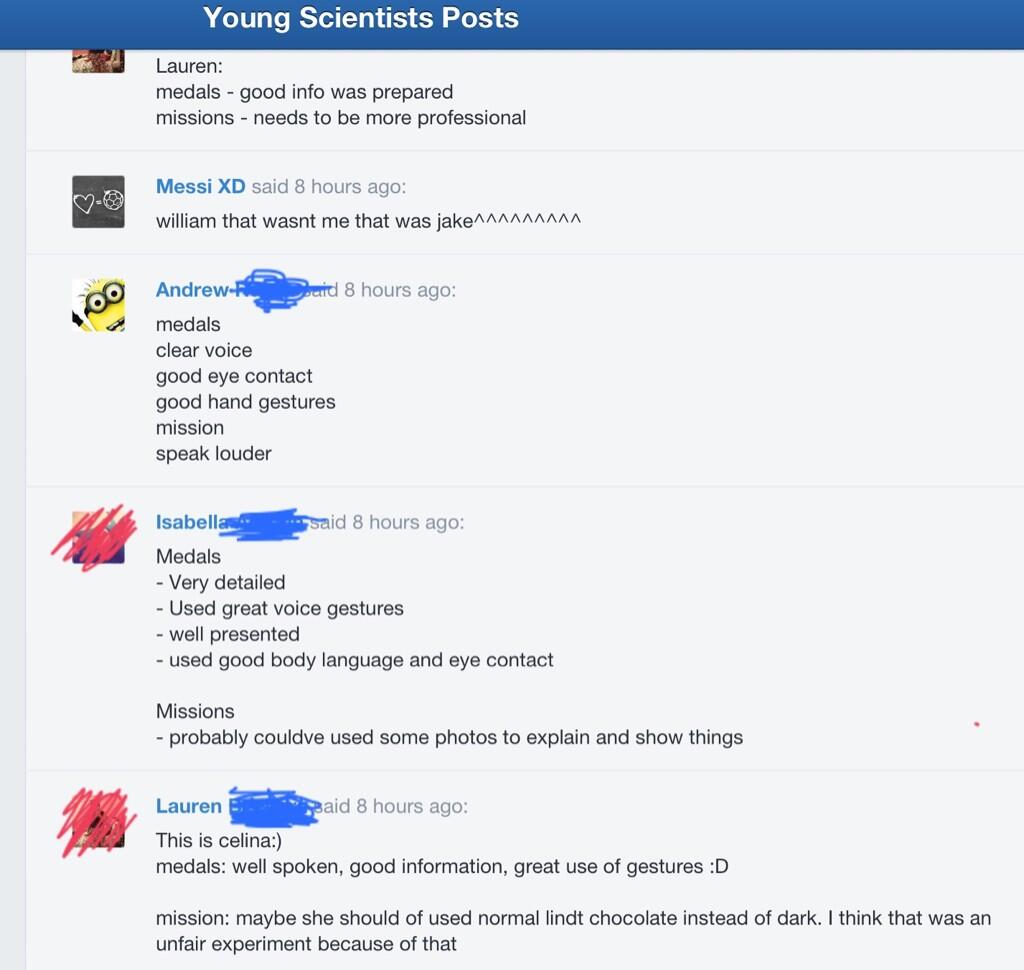
In the presentations I would usually get students to give each other feedback (one medal and one mission) by writing it down on a piece of paper, which I will take home and collate and then give back to students. This was a really inefficient way of doing it. Students had to wait at least 24 hours to get peer feedback and it took me time to type of the students’ feedback. This time I decided to create a backchannel on Edmodo that students used to give feedback to each presenter. Students did this by using laptops. A designated student had the role of creating a post for each presenter and then the whole class will reply to that post with a medal and mission for the presenter. Doing it this way meant that the presenter got the feedback as soon as they finished presenting; they didn’t have to wait till the next day after I’ve collated the class’ feedback. Students really liked the immediacy of the feedback they got from the Edmodo backchannel. There was also one student who made a video for his SRP, but he was ill over the two days of the presentations. His video was still shown and he was able to receive feedback on it at home from his peers via the Edmodo backchannel.

A sample of the Edmodo backchannel

So just with a little of tweaking, the good ol’ SRP has been thrusted into the 21st century. I didn’t have to completely re-write it or turn it upside down. Just by adding Google docs, more student choice and Edmodo, the SRP was made a million times better for students as a learning process. From the end-of-term evaluations, many students from across all Year 8 classes identified the SRP to be their favourite activity this term because it gave them choice, it let them use technology and they learnt by doing.

Next time I’d like to have students sharing their findings with a global audience, or at least with an audience beyond their class. But one small step at a time 🙂

Using video as evidence of learning

Today my Year 8s used lollies and toothpicks to model elements, molecules, compounds and mixtures. This isn’t anything new. Lots of teachers and students have done this before. However, I decide to allow students to film themselves explaining how the lolly models they made represent elements, molecules, compounds and mixtures as evidence of learning. For one group, I decided to record a question-and-answer conversation on my iPad.

The video showed that this student understood to a certain extent how particles are arranged in elements, molecules, compounds and mixtures. The student did accurately use the lollies for this, but upon questioning, she was confused about how many different types of particles made up her lolly models of compounds and mixtures.

I’d like this type of evidence of learning to be prominent in schools. As a system I think we rely too heavily on written exams and assignments to elicit student understanding of concepts. Having videos such as the one shown above is much more powerful to give feedback to students and to use as evidence of learning. Eventually I’d like each of teacher in my faculty to a collection of videos like this for professional discussions on our students’ learning.

What do students think of their learning?

Student voice is something that I really value. In the perfect world students would have a complete say in what they learn and how they learn. But in the meantime the confines of syllabuses I still like to give my students a say in the learning that’s happening in the classroom. What things do they like learning about? How do they like to learn? Is what they are learning too difficult or too easy? What parts of the classroom learning design do they think needs improvement? What can I do as their teacher to make learning better for them?

My Year 8 class gave their feedback on their learning this week as Term 2 in NSW, Australia drew to a close. Here’s what they thought:

infographic of evaluation results


The main topic we studied in Term 2 was called Water Water Everywhere, which is essentially using the particle model to explain the properties of solids, liquids and gases and why one state of matter changes to another when energy is added or removed from the system. This topic is probably one of the most difficult and often disengaging topic for students because it involves an abstract concept. The particle model lends itself to a lot of student misconceptions and is generally something students find difficult to understand, which I have discussed in a previous post. To overcome this the learning was designed so to involve lots of interesting hands-on experiences such as making quicksand and using technology for students to increase their conceptual understanding and allow their misconceptions to be picked more and addressed more frequently.

From the students’ feedback, scientific metalanguage was emphasised as an area they thought needed improvement, so next topic there will be more activities that emphasise the use of scientific metalanguage.

What I also find interesting is students’ decisions on whether they will continue with Science in the post-compulsory years of schooling. What I find particularly interesting is that quite a few students who consistently say they find the learning in Year 8 science fun, interesting and related to the real world, do not want to study science in Year 11 & 12 because their chosen career does not need science. There seems to be a perception with my Year 8s that science in Year 11 and 12 are for people who want to be scientists. This perception is also found in evaluations completed by Year 9 and 10 students.

So one of my challenges for the rest of the year is how am I going to design the learning for these students value science and view it as important to learn, even though they aren’t going to pursue a career in science.

TeachMeet at the Zoo – a different kind of Professional Learning

Last week I had the privilege of leading a science-flavoured TeachMeet with Matt Esterman at Taronga Zoo. With a great view of the monkeys at the zoo, over 70 educators from pre-service teachers, primary school teachers, high school teachers, university staff and other educational institutions, gathered to share ideas on ways to make learning more effective for our students. There were teachers from government schools, Catholic schools and independent schools sharing their classroom practice with each other with the aim of improving teaching and learning for all students.

We had presentations on differentiated learning, learning design, inquiry based learning, using iPads in the science classroom, mash ups, social media and many other ideas and strategies to enhance learning for our students. Mitch Squires and Jackie Slaviero captured the crowd with their talk about NASA space camp. We got to make a pocket solar system with Rob Hollow from CSIRO to experience a way to introduce students to the scale of the universe. We also got to pet a snake to learn about how Taronga Zoo’s education programs are addressing sustainability in the Australian Curriculum.


What I really like about TeachMeet is that it is a different kind of professional learning. You get to see real teachers sharing ideas and strategies they have implemented in their classrooms. You build cross-sector networks and have opportunities to share and learn from teachers from government, Catholic and independent schools. You are also exposed to many new ideas in a very short amount of time.

What I like most of all is that teachers volunteer to attend TeachMeets. Teachers attend out of their own time because they want to learn. Presenters are not paid (they might receive a chocolate koala for their efforts) and are sharing their practice because they want to. I think this really shows the collaborative and generous nature of teaching as a profession.

So if you haven’t been to a TeachMeet, it is very worthwhile to check one out. If you been to one, I’m sure you will go to another one very soon. To find out more about TeachMeets in Sydney visit this website and join the Facebook group.

The challenges of PBL in a traditional school structure

I’ve been trialling project based learning for about a year. Last year I was lucky enough to have a year 7 class for 14 hours a week for 5 different subjects so I was able to easily design and implement cross-curriculuar units of work that were framed  by project based learning. This year I’m back to traditional high school teaching where I see kids for 60 minutes at a time. I had to change my game plan for project based learning. What I have found most challenging is balancing the students’ passion for learning with ‘getting through the syllabus’.

I’ve just finished a unit called ‘Sharks: Friends or Foes’, which is basically a unit on ecosystems and food webs. I modified the unit with a PBL framework. Instead of just looking at food web diagrams in a textbook or playing with interactive food webs online, students acted as scientists and produced a product for a shark scientists conference to convince the community whether sharks are our friends or foes in the midst of all the media attention on shark attacks.

The project was done throughout the unit in different stages and students also had to learn about population sampling techniques, food webs and how energy flows through ecosystems. During the unit they also had a real shark scientist talk to them.

From the results in the students’ pre-tests and post tests, all students made huge progress in their understanding of ecological relationships. On average students improved over 40% between their pre-test scores and their post-test scores.

In comparison to last year, the students’ teamwork skills and self-regulation skills have massively improved. My main challenge this year is time. PBL takes time. A lot more time than traditional teaching. The unit that ‘Sharks: Friends or Foes’ is based on is supposed to take 5 weeks maximum, but my modified PBL unit took 8 ½ weeks. There were times that I was feeling pressured to rush my students to make sure I don’t fall behind and so that I can get through the syllabus in time. Last year, I saw my students for large blocks of time (5 hours straight twice a week) and they can use these chunks of time to work on their movies, posters and other products for their projects. This year I see them for 3 separate hours a week and this lack of continuity makes the product creation process a lot more challenging.

But does it have to be this way?

This term I realised that I wished high schools did not to have separate subjects. I wish schools didn’t require students to walk in and out of classrooms like they are on a conveyor belt.

I wish every unit was cross-curricular so that subject experts can work together as a team and students can have more time to develop their passions for learning and be knowledge creators rather than just consumers. If you need 4 hours straight to work on a science/maths/geography project then you should be able to do it without being prevented by a timetable structure. Is there a reason why we need to have separate subjects? What is the reason for timetables?

I don’t have the answer or solutions to these questions, but I hope education is moving towards this direction. In the meantime I’m going to take small steps. I’ll continue with PBL with my year 8s and have already approached another faculty at my school to design and implement a cross-curricular PBL unit.

Leading learning design with SOLO

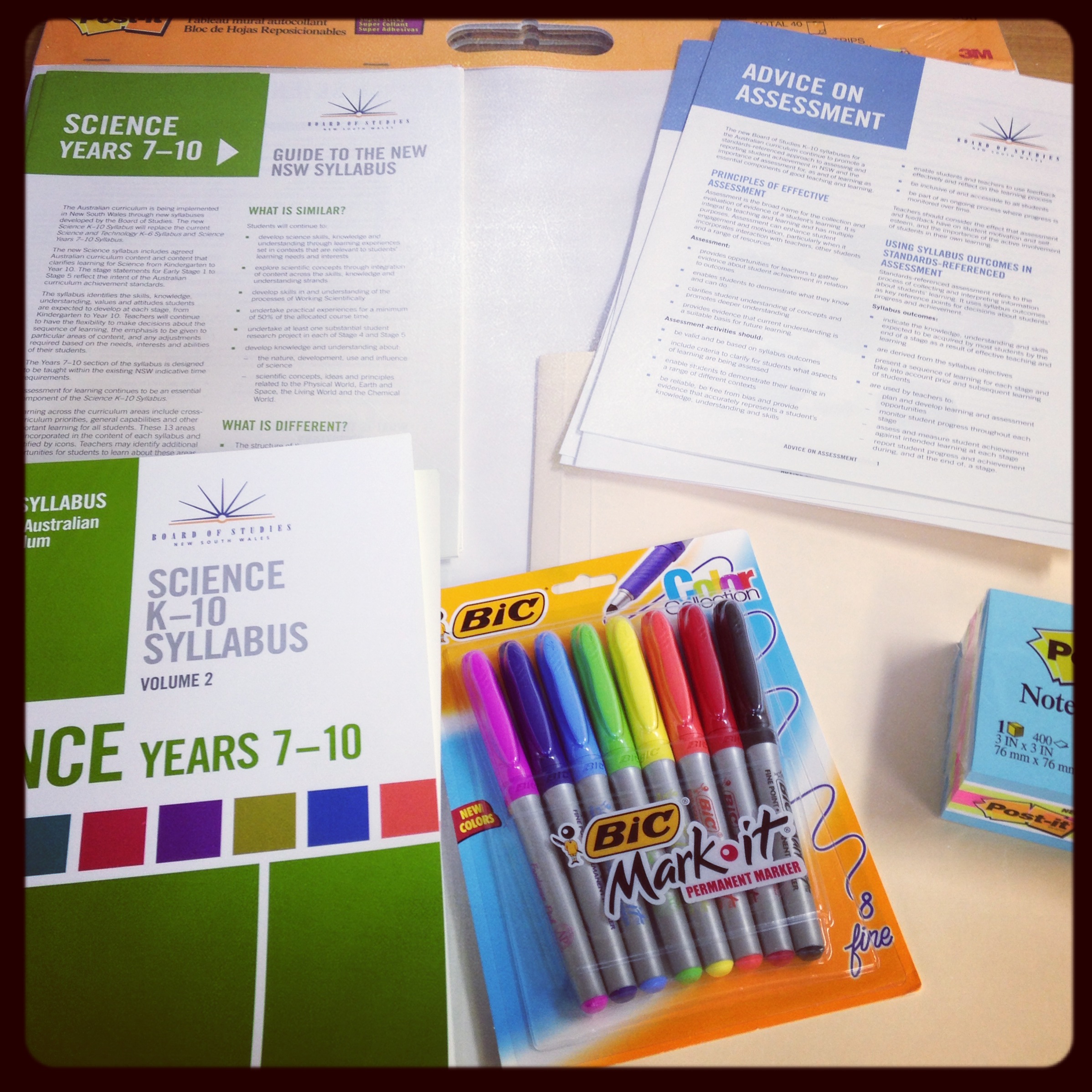
A photo of resources for designing learning for new syllabus

I led my science faculty in using structured observed learning outcomes (SOLO) to design learning for the new NSW science syllabus over the past two days. Like all other NSW schools, we are spending this year preparing for the implementation of new syllabuses for the Australian Curriculum. As a faculty we felt that this was a great opportunity to evaluate the effectiveness of our current teaching and learning practices. We are using the new syllabus as a driver of change in teaching and learning.

We decided to use SOLO as the framework to design learning for the new syllabus. Why did we choose SOLO? One of the main reasons is that the Essential Secondary Science Assessment (ESSA) uses SOLO to assess students’ understanding. ESSA is a state-wide science assessment that is completed by all Year 8 students from NSW government schools. An analysis of the trend data shows we needed to work on moving students from being able to recall scientific information to making relationships with this information and then applying this information to real world situations. Another reason why we chose to use SOLO is because it makes learning visible to students and teachers when it is accompanied by learning intentions and success criteria. Learning intentions and success criteria help students focus on the purpose of learning activities rather than just merely completing work. They also help enhance students’ self regulation.

So the two days played out like this:

(1)    Getting everyone on the same page

We started the two days by analysing where our students currently are and where we want to move our students in their learning and achievements. Why SOLO was explored. We used a KWHLAQ table to do this.

 (2)    Drawing out main concepts from the syllabus

We decided to program a unit on human health and diseases first. We familiarised ourselves with the relevant sections of the syllabus and brainstormed all the concepts, ideas and facts that students needed to understand. Individually we wrote each concept, idea and fact onto post-it notes and stuck them on the whiteboard. As a team we sorted the post-it notes into logical categories.

 (3)    Classifying into SOLO categories

We then classified each concept, idea and fact into SOLO categories. We decided to have 3 SOLO categories:

  • Level 1 – unistructural and multistructural
  • Level 2 – relational
  • Level 3 – extended abstract

IMG_4162

 (4)    Assigning SOLO verbs

We assigned SOLO verbs for each concept, idea and fact.

Level 1
Uni/multistructural
Level 2
Relational
Level 3
Extended abstract
Describe
Identify
Name
List
Follow a simple procedure
Compare and contrast
Explain causes
Sequence
Analyse
Relate
Form an analogy
Apply
Criticise
Evaluate
Predict
Hypothesise
Reflect
Generate
Formulate
CreateJustify

 (5)    Creating learning intentions and success criteria

We created learning intentions and success criteria based on the verbs for each category.

 (6)    Teaching and learning activities

We split up into three teams to design teaching and learning activities that will allow students to meet the success criteria.

We also designed an assessment task gives students an authentic context to learn this unit.

What next?

We are still in the progress of completing the unit and I will share it once it is completed. Meanwhile some of our next steps will also include

  • using SOLO for feedback and feedforward
  • working with our school’s PDHPE faculty to see whether we can make this into a cross-curricular unit and assessment

It will be great to get some feedback on how we are going so far in using SOLO to design learning.

Learning in Term 3

Now that Term 3 has come to an end, I am again analysing the data from Year 7’s evaluation of their learning. Year 7s complete a weekly reflection on their learning as well as an end-of-term evaluation. Their end-of-term evaluations gives me an idea on how they feel about how I structure their learning activities so that I can adjust the next term’s learning accordingly.

For Term 3 our project based learning focus has been on newspapers. For 8 weeks, students deconstructed the language features of news articles and put together a range of articles on the Olympics, the Paralympics and other newsworthy items. Some of these articles were written in groups and some were written individually. Year 7s then selected some of these articles to put together a newspaper using Microsoft Publisher. Each news article involved students revising the article at least twice using the goals, medals and missions structure of feedback. In Term 3 we also did science experiments on Tuesdays that were based on sport science under the theme of the Olympics. For half of Term 3 the class worked with Year 6 students from Merrylands East Public School on Murder under the Microscope, an online environmental science game where students acted as forensic scientists to solve a crime involving the pollution of a catchment area. One new activity I introduced in Term 3 were weekly revision quizzes. These quizzes were essentially thirty-minute pen-and-paper-exams that tested Year 7’s understanding of concepts we have learnt during the week. However, they were allowed to refer to their books if necessary (I just think this is more realistic of real life. When in your life do you come across something you can’t do and force yourself to sit there for 30 minutes without makin any attempt on finding out how to do it. I also think it gives a purpose to students’ book work and instil in them a routine of what revision and studying looks like and feels like.) With these weekly revision quizzes, students mark each other’s work. The quiz is divided into concept areas such as algebra, language features of newspapers and scientific investigations and marks are awarded separately to each concept. Students then look at their performance for each concept area and write a short reflection on what they are good at and what they need to improve on.

So this week, Year 7s completed an end-of-term evaluation of their learning on Survey Monkey.

Term 3’s evaluation consisted of these questions:

  • What is your favourite subject?
  • What makes this subject your favourite subject? What do you like about it?
  • Rate how much you enjoy the following activities (students choose from “I enjoy it”, “I find it OK” and “I don’t enjoy it”
    • Project work
    • Science experiments
    • Maths and numeracy
    • Murder under the Microscope
    • Edmodo homework
    • Rate how much you learn from the following activities (students choose from “I learn lots from it”, “I learn some things from it” and “I barely learn anything from it”)
      • Project work
      • Science experiments
      • Maths and numeracy
      • Murder under the Microscope
      • Edmodo homework
      • Do you want to continue doing project work on Mondays and Fridays?
      • What are 3 things you have learnt from the newspaper project?
      • List 3 things you want to improve on next term.
      • If you were the teacher of 7L, what would you do to improve learning for the class?

So here are the results:

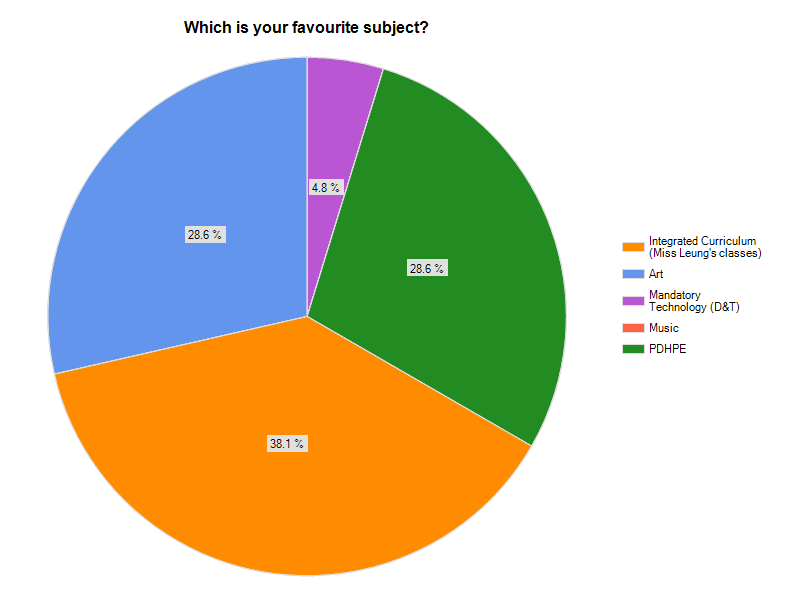
What is your favourite subject?
A pie chart of Year 7's favourite subject

I’m going to conclude by just saying it takes a lot to beat PDHPE as students’ favourite subject.

Reasons why integrated curriculum is their favourite subject

Below are some of the responses from students who chose integrated curriculum as their favourite subject:

Because we get to have fun in those classes and do interesting stuff.


The experiments we do and how all the subjects are put into one class.


It involves technology.


There are so many opportunities to do fun activities and showing people my work.


Some of the major themes from this question are that students find integrated curriculum classes “fun”. They also like using technology such as laptops and tablets for their learning, as well as having 5 subjects embedded into one class.  Some students enjoy having their work showcased on the class blog.

Rate how much you enjoy the following activities
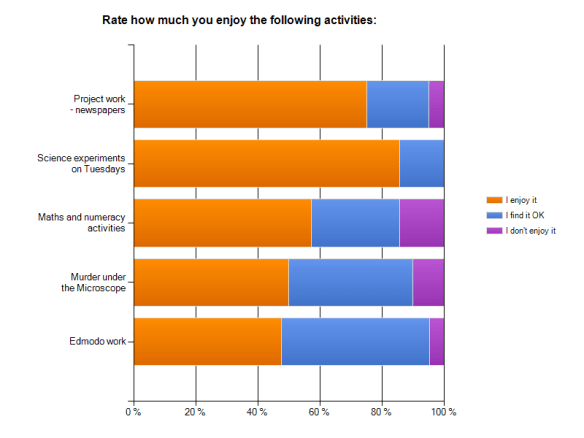
A sector bar graph showing year 7's enjoyment rating of different activities

Rate how much you learn from the following activities
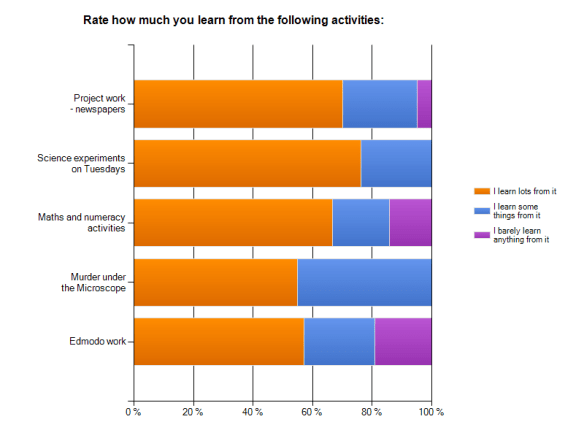
A sector bar graph showing how much year 7s learn from different activities

What are 3 things you have learnt from the newspaper project?

 A word cloud was created for students’ responses to this question where the larger the word in the word cloud, the more frequent that word appeared in the responses.

A word cloud showing what students have learnt in the newspaper project

List 3 things you want to improve on next term.

This term was the first time students wrote features of effective team work for their improvements for the following term. In previous end-of-term evaluations, students often listed relatively superficial things they’d like to improve on such as write faster or finish work faster. For this term’s evaluation, the majority of students listed features of team work skills such as listening to other students, working as a team and self control. Many students also identified specific areas of content they’d like to improve on such as algebra or types of scientific variables. This is in contrast to how they listed their improvements in previous evaluations where many students wrote umbrella terms such as numeracy or literacy.

For me, this shows an increased level of maturity in the way they assess their learning. While I can’t attribute the cause of this change to any particular strategy I’ve used, I do have a strong feeling it is to do with the goals, medals and missions structure of providing feedback in their PBL tasks and also their weekly reflections on their revision quizzes. Over a term I think most Year 7s have increased their self-awareness of their own learning.

What have I learnt?

For most of this year I have been experimenting on strategies on guiding students to become more effective learners. The PBL initiatives, the goals-medals-missions structure of feedback, the weekly revision quizzes and weekly reflections of learning have all been things aimed at allowing my students to further develop into effective learners. While I always knew that features such as working together and being self-aware of your strengths and areas for improvement are equally important as understanding subject-specific concepts, I think teaching my Year 7s for 5 different subjects have really made that clear to me. When I think back to how I structure my learning in previous years for my science classes it has always been more focused on content rather than developing students into effective learners. When I do eventually return to teaching science classes only, the way I will structure learning for those classes will be very different to how I used to structure them. Teaching an integrated curriculum has so far been one of the best professional learning I’ve had.